Question
Draw a line segment of length $12.8\ cm,$ Using compasses, divide it into four equal parts. Verify by actual measurement.
Answer


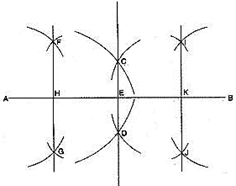
$i.\ $Draw a line segment $\overline {A B}$ of length $12.8\ cm.$
$ii.\ $With A as centre, using compasses, draw an arc. The radius of this arc should be more than half of the length of $\overline {A B}$ .
$iii.\ $With the same radius and with $B$ as centre, draw another arc using compasses. Let it cut the previous arc at $C$ and $D.$
$iv.\ $Join $\overline {C D}$ . It cuts $\overline {A B}$ at $E.$ Then $\overline {C D}$ is the perpendicular bisector of the line segment $\overline {A B}$.
$v.\ $With $A$ as centre, using compasses, draw an arc. The radius of this arc should be more than half of the length of $AE.$
$vi.\ $With the same radius and with $E$ as centre, draw another arc using compasses. Let it cut the previous arc at $F$ and $G.$
$vii.\ $Join $\overline {F G}$ . It cuts $\overline {A E}$ at $H.$ Then $\overline {F G}$ is the perpendicular bisector of the line segment $\overline {A E}$ .
$viii.\ $With $E$ as centre, using compasses, draw an arc . The radius of this arc should be more than half of the length of $EB.$
$ix.\ $With the same radius and with $B$ as centre, draw another arc using compasses. Let it cut the previous arc at $I$ and $J.$
$x.\ $Join $\overline {I J}$. It cuts $\overline {E B}$ at $K.$ Then $\overline {I J}$ is the perpendicular bisector of the line segment $\overline {E B}$.
$xi.\ $Now, the points $H, E$ and $K$ divide $AB$ into four equal parts, i.e.,
$\overline{A H}=\overline{H E}=\overline{E K}=\overline{K B}$
By measurement,
$\overline{\mathrm{AH}}=\overline{\mathrm{HE}}=\overline{\mathrm{EK}}=\overline{\mathrm{KB}} = 3.2\ cm.$

Need a full question paper?

Generate a complete, print-ready paper with questions like this in minutes — across 16+ boards, with answer keys.

Start Generating Free

Similar questions

If $57 : x = 51 : 85,$ then the value of $x$ is:
Take three non-collinear points $A, B$ and $C$ on a page of your notebook. Join $AB, BC$ and $CA.$ What figure do you get$?$ Name the triangle. Also, name:
$i.\ $The side opposite to $\angle\text{B.}$
$ii.\ $The angle opposite to side $AB.$
$iii.\ $The vertex opposite to site $BC.$
$iv.\ $The side opposite to vertex $B.$
The final marks in mathematics of 30 students are as follows:
536148607868551006790
75887737845860486256
44585264985970395060
(i) Arrange these marks in the ascending order. 30 to 39 one group, 40 to 49 second group, etc
(ii) What is the highest score?
(iii) What is the lowest score?
(iv) What is the range?
(v) If 40 is the pass mark how many have failed?
(vi) How many have scored 75 or more?
(vii) Which observations between 50 and 60 have not actually appeared?
(viii) How many have scored less than 50?
Find the $HCF$ of the numbers in the following using the division method $:658, 940, 1128$
Using a pair of compasses construct the following angles: $60^\circ $
Draw a line $l$ and a point $X$ on it. Through $X,$ draw a line segment $\overline{\text{XY}}$ perpendicular to $l.$ Now draw a perpendicular to $\overline{\text{XY}}$ at $Y. ($use ruler and compasses$)$
A square piece of paper is folded in half. The square is then cut into two rectangles along the fold. Regardless of the size of the square, one of the following statements is always true. Which statement is true here?
(a) The area of each rectangle is larger than the area of the square.
(b) The perimeter of the square is greater than the perimeters of both the rectangles added together.
(c) The perimeters of both the rectangles added together are always $1 \frac{1}{2}$ times the perimeter of the square.
(d) The area of the square is always three times as large as the areas of both rectangles added together.
Write the fractions and pair up the equivalent fractions from each row.
The figure below shows different fractional units of a whole chikki. How much of a whole chikki is each piece?
Image
Solve the following equation and verify the answer: $\frac{\text{2m}}{3}+8=\frac{\text{m}}{2}-1$