Question
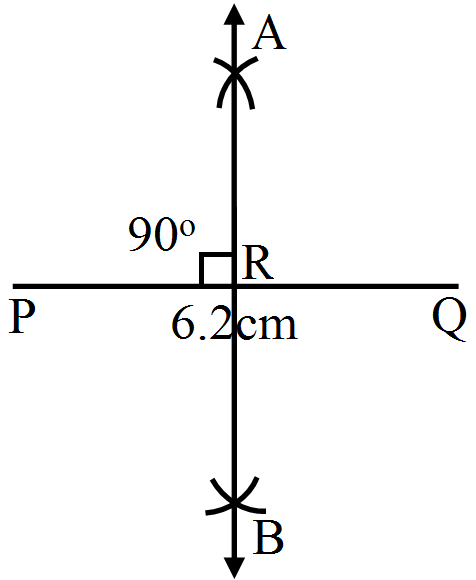
Draw a line segment $PQ = 6.2\ cm$. Draw the perpendicular bisector of $PQ.$
Answer


Steps for construction:
$1.$Draw a line segment $PQ,$ which is equal $6.2\ cm.$
$2.$With $P$ as the centre and radius more than half of $PQ,$ draw arcs, one on each side of $PQ.$
$3.$With $Q$ as the centre and the same radius as before, draw arcs cutting the perviously drawn arcs at $A$ and $B,$ respectively.
$4.$Draw $AB,$ meeting $PQ$ at $R.$

Need a full question paper?

Generate a complete, print-ready paper with questions like this in minutes — across 16+ boards, with answer keys.

Start Generating Free

Similar questions

A survey was carried out on $30$ students of class $VI$ in a school. Data about the different modes of transport used by them to travel to school was displayed as pictograph.
What can you conclude from the pictograph?
Modes of travelling Number of students $- 1$ student
Private car
Public bus
School bus
Cycle
Walking
Reduce the fraction to simplest from: $\frac{84}{98}$
If $AB = 7.5\ cm$ and $CD = 2.5\ cm,$ construct a segment whose length is equal to:
$2AB + 3CD$
Mark the correct alternative in the following: If $4 : 5 : : x : 45,$ then $x =$
Draw an angle and label it as $\angle\text{BAC}.$ Construct another angle, equal to $\angle\text{BAC}.$
Draw a line segment AB of length 5.8 cm. Draw the perpendicular bisector of this line segment.
Find the $HCF$ of the numbers in the following using the division method $:658, 940, 1128$
Match the following columns on whole numbers:
S.No.
Column A
S.No.
Column B
$(a)$
$137 + 63 = 63 + 137$
$(i)$
Associativity of multiplication
$(b)$
$(16 \times 25)$ is a number
$(ii)$
Commutativity of multiplication
$(c)$
$365 \times 18 = 18 \times 365$
$(iii)$
Distributive law of multiplication over addition.
$(d)$
$(d) (86 \times 14) \times 25 = 86 \times (14 \times 25)$
$(iv)$
Commutativity of addition
$(e)$
$23 \times (80 + 5) = (23 \times 80) + (23 \times 5)$
$(v)$
Closure property for multiplication
Asha and Samuel have bookshelves of the same size partly filled with books. Asha's shelf $\frac56$th full and Samuel's shelf is$\frac25$ th full. Whose bookshelf is more full? By what fraction?
Using the number line, write the integer which is $4$ more than $–1.$