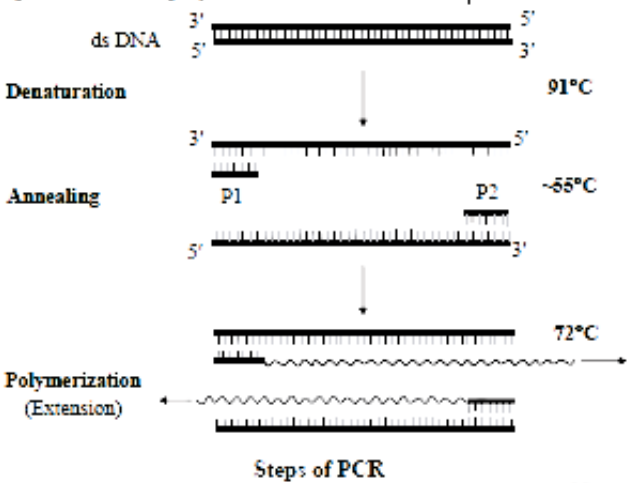
Draw a neat labelled diagram showing steps of PCR.
(March 2013)
Download our app for free and get startedPlay store
One cycle of Polymerase Chain Reaction involves three basic steps:

1. Denaturation
2. Annealing
3. Polymerization

1. Denaturation:
The desired DNA is heated to a high temperature of about 91°C and forms a single-stranded DNA. It results in the separation of the two strands of DNA, each of which would function as a template for the synthesis of a new molecule of DNA.

2. Annealing:
It is the process in which the two primers (oligonucleotides) hybridize to each of the strands of DNA. It requires a temperature of 55°C.

3. Polymerization:
In this step, the Taq polymerase carries out the synthesis of the DNA region between the two primers by using deoxyribonucleotides (dNTPs) and Mg2+. The optimum temperature for this polymerization reaction is 72°C.
Image
art

Download our app
and get started for free

Experience the future of education. Simply download our apps or reach out to us for more information. Let's shape the future of learning together!No signup needed.*

Similar Questions

  • 1
    What are transgenic plants? Explain with any two examples.
    View Solution
  • 2
    With the help of a neat and labelled diagram describe steps in recombinant DNA technology.
    View Solution
  • 3
    Define 'genomics'. Give any 'two' applications of it.
    View Solution
  • 4
    During DNA replication one of the strand is synthesized continuously and other discontinuously. Name these two strands and mention two features of each strand.
    View Solution
  • 5
    Identify '1' and '2' in the following diagram
    Image
    Write in brief about production of vaccine.
    View Solution
  • 6
    Illustrate any 'three' genes which can be used in gene therapy.
    View Solution
  • 7
    Explain any three examples of biopiracy.
    View Solution
  • 8
    With the help of a suitable example illustrate Palindrome.
    View Solution
  • 9
    Describe the steps of PCR technique.
    View Solution
  • 10
    Give the applications of PCR technique.
    View Solution