Question
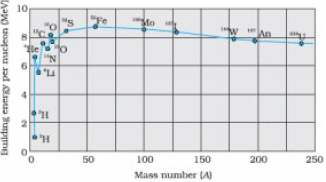
Draw a plot showing the variation of binding energy per nucleon versus the mass number A. Explain with the help of this plot the release of energy in the processes of nuclear fission and fusion.

Answer

Plot:

Explanation: A very heavy nucleus, say A = 240, has lower binding energy per nucleon compared to that of a nucleus with A = 120. Thus if a nucleus A = 240 breaks into two A = 120 nuclei, nucleons get more tightly bound.
This implies energy would be released in the process of fission.
Consider two very light nuclei  $({\text{A}}\leq 10) $ joining to form a heavier nucleus. The binding energy per nucleon of the fused heavier nuclei is more than the binding energy per nucleon of the lighter nuclei. This means that the final system is more tightly bound than the initial system. Again energy would be released in such a process of fusion.

Need a full question paper?

Generate a complete, print-ready paper with questions like this in minutes — across 16+ boards, with answer keys.
Start Generating Free

Similar questions

Two moving coil meters, M1 and M2 have the following particulars:
R1 = 10 Ω, N1 = 30,
A1 = 3.6 × 10–3 m2, B1 = 0.25 T
R2 = 14 Ω, N2 = 42,
A2 = 1.8 × 10–3 m2, B2 = 0.50 T
(The spring constants are identical for the two meters).
Determine the ratio of (a) current sensitivity and (b) voltage sensitivity of M2 and M1.
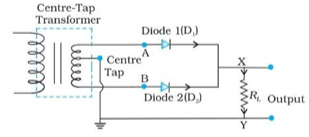
(I) Identify the circuit elements X and Y as shown in the given block diagram and draw the output waveforms of X and Y.

Image

(II) If the centre tapping is shifted towards Diode D1 as shown in the diagram, draw the output waveform of the given circuit.

Image
Two particles, carrying charges -q and +q and having equal masses m each, are fixed at the ends of a light rod of length a to form a dipole. The rod is clamped at an end and is placed in a uniform electric field E with the axis of the dipole along the electric field. The rod is slightly tilted and then released. Neglecting gravity find the time period of small oscillations.
A mosquito is sitting on an L.P. record disc rotating on a turn table at $33\frac{1}{3}$ revolutions per minute. The distance of the mosquito from the centre of the turn table is 10cm. Show that the friction coefficient between the record and the mosquito is greater than $\frac{\pi^2}{81}.$ Take g =10 m/s2.
An electromagnetic wave of wavelength $\lambda$ is incident on a photosensitive surface of negligible work function. If the photoelectrons emitted from the surface have the same de Broglie wavelength $\lambda\text{B,}$ prove that $\lambda=\Big(\frac{2\text{mc}}{\text{h}}\Big)\lambda^2_\text{B}.$
Define the term ‘mutual inductance’ between the two coils.
Obtain the expression for mutual inductance of a pair of long coaxial solenoids each of length l and radii r1 and r2 (r2 >> r1). Total number of turns in the two solenoids are N1 and N2 respectively.
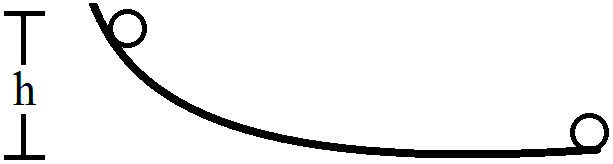
A small spherical ball is released from a point at a height h on a rough track shown in figure. Assuming that it does not slip anywhere, find its linear speed when it rolls on the horizontal part of the track.

A potential difference V is applied across a conductor of length L and diameter D. How is the drift velocity, Vd, of charge carriers in the conductor affected when (i) V is halved, (ii) L is doubled and (iii) D is halved? Justify your answer in each case.
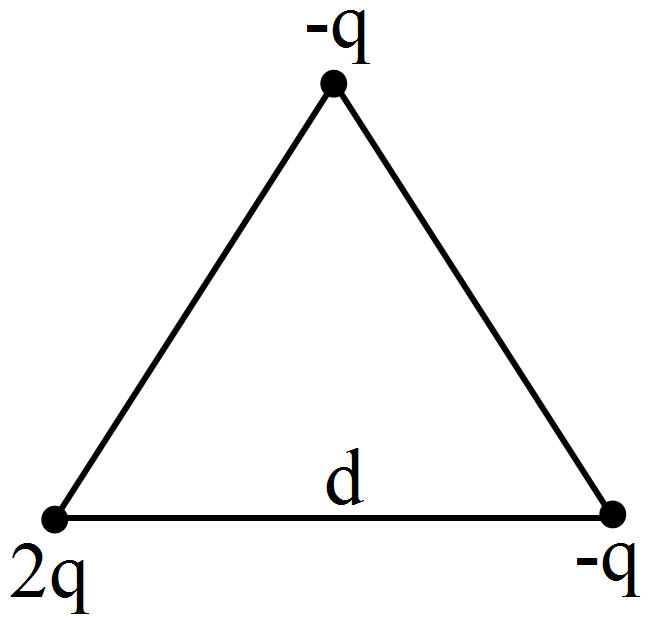
Three charges are arranged on the vertices of an equilateral triangle as shown in figure. Find the dipole moment of the combination.

A square coil of side 10 cm consists of 20 turns and carries a current of 12 A. The coil is suspended vertically and normal to the plane of the coil makes an angle of $30^{\circ}$with the direction of a uniform horizontal magnetic field of magnitude 0.80 T. What is the magnitude of the torque experienced by the coil?