Question
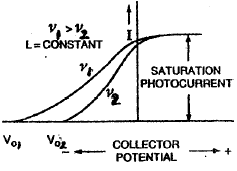
Draw a plot showing the variation of photoelectric current with collector plate potential for two different frequencies, $ν_1 > ν_2,$ of incident radiation having the same intensity. In which case will the stopping potential be higher? Justify your answer.
Answer


Stopping potential is more for the curve corresponding to frequency $v_1$ Stopping potential is directly proportional to the frequency of incident radiation.
Alternate Answer
The maximum energy(of the emitted photoelectrons) increases with an increase in the frequency of the incident radiation.

Need a full question paper?

Generate a complete, print-ready paper with questions like this in minutes — across 16+ boards, with answer keys.

Start Generating Free

Similar questions

Draw a schematic diagram of the experimental arrangement used by Davisson and Germer to establish the wave nature of electrons. Explain briefly how the de-Broglie relation was experimentally verified in case of electrons.
A person sitting on the top of a tall building is dropping balls at regular intervals of one second. Find the positions of the $3^{\text {rd }}, 4^{\text {th }}$ and $5^{\text {th }}$ ball when the $6^{\text {th }}$ ball is being dropped.
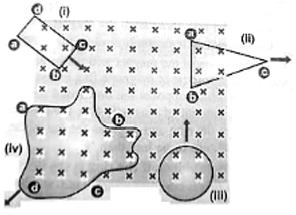
The figure below shows planer loops of different shapes moving out of or into a region of the magnetic field which is directed normal to the plane of the loops away from the reader. Determine the direction of induced current in each loop using Lenz's law. Check if you would obtain the same answers by considering the magnetic force on the charge inside the moving loops.

Image
A uniform rod of mass 300g and length 50cm rotates at a uniform angular speed of 2rad/s about an axis perpendicular to the rod through an end. Calculate:
  1. The angular momentum of the rod about the axis of rotation.
  2. The speed of the centre of the rod.
  3. Its kinetic energy.
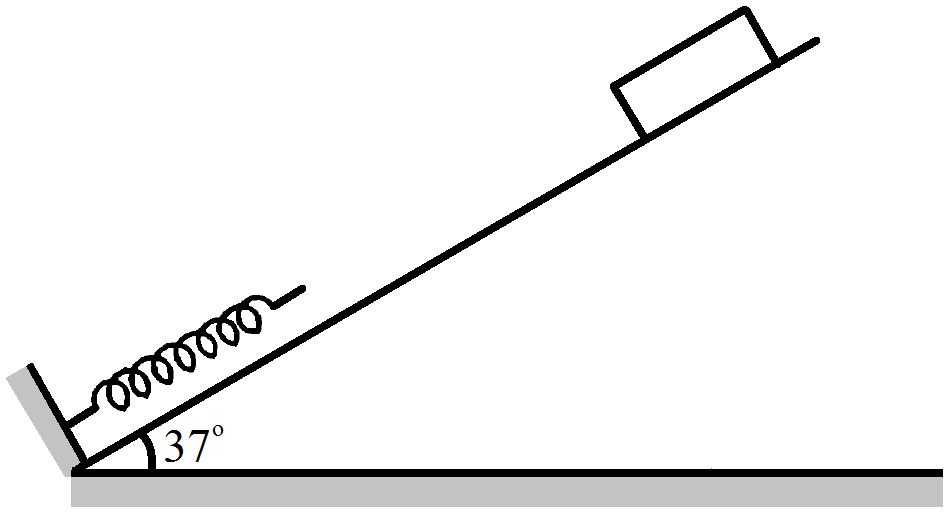
Figure shows a spring fixed at the bottom end of an incline of inclination 37°. A small block of mass 2kg starts slipping down the incline from a point 4.8m away from the spring. The block compresses the spring by 20cm, stops momentarily and then rebounds through a distance of 1m up the incline. Find.
  1. The friction coefficient between the plane and the block.
  2. The spring constant of the spring. Take $g = 10m/s^2.$
Explain the quantisation of angular momentum for an electron orbiting a nucleus.
$\#\#\#$ Write second postulate of Bohr's model and De$-$Broglie's explanation of it.
What is meant by nuclear fusion? What happens in this reaction?
Suppose the bob of the previous problem has a speed of 1.4m/ s when the string makes an angle of 0.20 radian with the vertical. Find the tension at this instant. You can use $\cos\theta\approx1-\frac{\theta^2}{2}$ and $\sin\theta\approx\theta$ for small $\theta.$
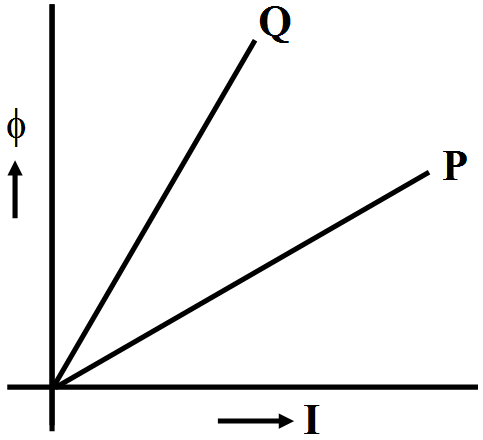
The given graph shows a plot of magnetic flux $(\phi)$ and the electric current (I) flowing through two inductors P and Q. Which of the two inductors has smaller value of self-inductance?
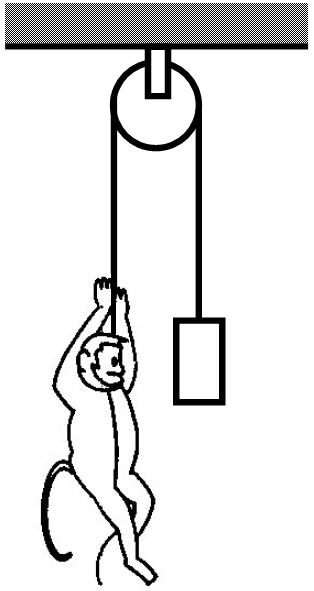
A monkey is climbing on a rope that goes over a smooth light pulley and supports a block of equal mass at the other end figure. Show that whatever force the monkey exerts on the rope, the monkey and the blockmove in the same direction with equal acceleration. If initially both were at rest, their separation will not change as time passes.