Question
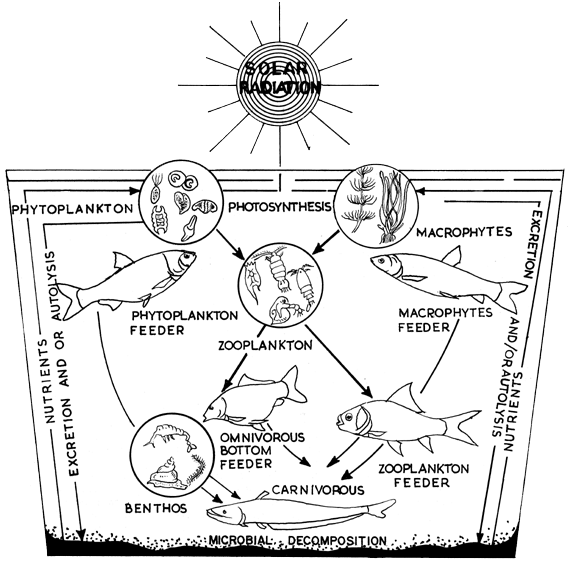
Draw a pond ecosystem showing its different components.

Answer


Pond and lake are fresh water ecosystems in which, like other ecosystems, there are two main components:
  1. Abiotic component: Abiotic component of pond consists of water, dissolved minerals, oxygen and carbon dioxide. Solar radiations are the main source of energy.
  2. Biotic component: It includes the following:
  1. Producers: The main producers in pond or lake ecosystem are algae and other aquatic plants, such as Azolla, Hydrilla, Potamogeton, Pistia, Wolffia, Lemna, Eichhornia, Nymphaea, Jussiaea, etc. These are either floating or suspended or rooted at the bottom. The green plants convert the radiant energy into chemical energy through photosynthesis. The chemical energy stored in the form of food is utilized by all the organisms. Oxygen evolved by producers in photosynthesis is utilized by all the living organisms in respiration.
  2. Consumers: In a pond ecosystem, the primary consumers are tadpole larvae of frogs, fishes and other aquatic animals which consume green plants and algae as their food. These herbivorous aquatic animals are the food of secondary consumers. Frogs, big fishes, water snakes, crabs are secondary consumers. In the pond, besides the secondary consumers, there are consumers of highest order, such as water-birds, turtles, etc.
  3. Decomposers and Transformers: When aquatic plants and animals die, a large number of bacteria and fungi attack their dead bodies and convert the complex organic substances into simpler inorganic compounds and elements. These micro-organisms are called decomposers chemical elements liberated by decomposers are again utilized by green plants in their nutrition.

Need a full question paper?

Generate a complete, print-ready paper with questions like this in minutes — across 16+ boards, with answer keys.
Start Generating Free

Similar questions

  1. List the three events that accur during the process of photosynthesis. Explain the role of stomata in this process.
  2. Describe an experiment to show that ''sunlight is essential for photosynthesis.''
With the help of a ray diagram, state what is meant by refraction of light. State Snell’s law for refraction of light and also express it mathematically.
The refractive index of air with respect to glass is 2/3 and the refractive index of water with respect to air is 4/3. If the speed of light in glass is $\text{2}\times 10^{8} \text{m/s,}$ find the speed of light in (a) air, (b) water.
  1. Electropositive nature of the element(s) increases down the group and decreases across the period.
  2. Electronegativity of the element decreases down the group and increases across the period.
  3. Atomic size increases down the group and decreases across a period (left to right).
  4. Metallic character increases down the group and decreases across a period.
On the basis of the above trends of the Periodic Table, answer the following about the elements with atomic numbers 3 to 9.
  1. Name the most electropositive element among them.
  2. Name the most electronegative element.
  3. Name the element with smallest atomic size.
  4. Name the element which is a metalloid.
  5. Name the element which shows maximum valency.
Write the names of all the major endocrine glands present in the human body. Which of these glands also function as exocrine glands?
i. What are tropic movements? Give an example of a plant hormone which (1) inhibits growth and (2) promotes cell division.
ii. Explain directional movement of a tendril in pea plant in response to touch. Name the hormone responsible for this movement.
What is biomass? Explain the principle and working of a biogas plant using a labelled schematic diagram.
Suppose you have three concave mirrors A, B and C of focal lengths 10cm, 15cm and 20cm. For each concave mirror, you perform the experiment of image formation for three values of object distance of 10cm, 20cm and 30cm. Giving reason answer the following:
  1. For the three object distances, identify the mirror/mirrors which will form an image of magnification - 1.
  2. Out of the three mirrors identify the mirror which would be preferred to be used for shaving purposes/ makeup.
  3. For the mirror B draw, ray diagram for image formation for object distances 10 cm and 20 cm.
Prepare a list of five activities that you perform daily in which natural resources can be conserved or energy utilisation can be minimised.
Why did Mendel choose pea plant for his experiments?
  1. Suggest an explanation for the fact that the chemicals produced by endocrine glands arc usually in the form of small molecules.
  2. Write any three endocrine glands and chemically produced by them.