Question
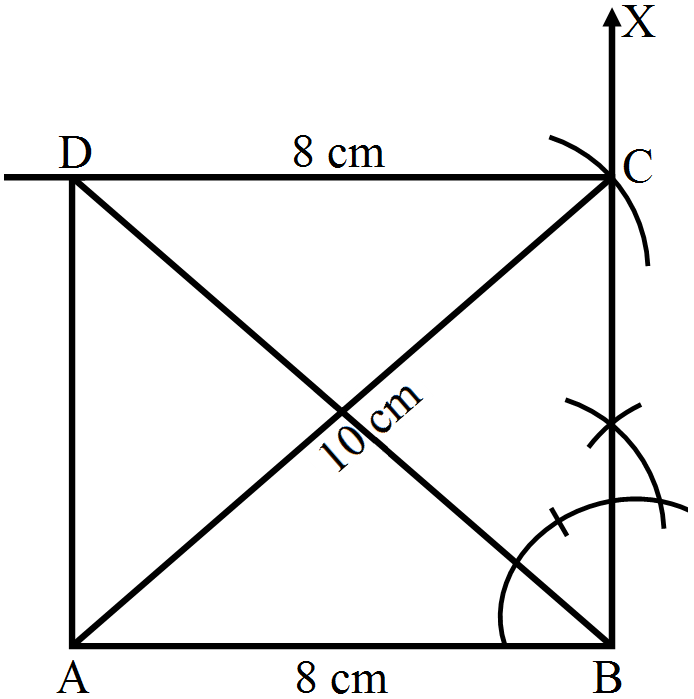
Draw a rectangle whose one side measures $8\ cm$ and the length of each of whose diagonals is $10\ cm$.
Answer


Steps of construction:
$1.$ Draw a line segment $\text{AB} = 8\ cm$
$2.$ At $B$, draw a perpendicular $\text{BX}$
$3.$ With centre $A$ and radius $10\ cm$, draw an arc which intersects $\text{BX}$ at $C$.
$4.$ With centre $C$ and radius equal to $\text{AB}$ and with centre $A$ and radius equal to $\text{BC}$, draw arcs which intersect at $D$.
$5.$ Join $\text{AD, AC, CD}$ and $\text{BD}$.
Then $\text{ABCD}$ is the required rectangle.

Need a full question paper?

Generate a complete, print-ready paper with questions like this in minutes — across 16+ boards, with answer keys.

Start Generating Free

Similar questions

The dimensions of an oil tin are $26\ cm \times 26\ cm \times 45\ cm$. Find the area of the tin sheet required for making $20$ such tins. If $1$ square metre of the tin sheet costs $Rs. 10$, find the cost of the tin sheet used for these $20$ tins.
Four horses are tethered with equal ropes at $4$ corners of a square field of side $70$ metres so that they just can reach one another. Find the area left ungrazed by the horses.
From a pipe of inner radius $0.75\ cm$, water flows at the rate of $7\ m$ per second. Find the volume in litres of water delivered by the pipe in $1$ hour.
Solve the following equation and also check your result in case:
$0.18(5\text{x}-4)=0.5\text{x}+0.8$
Locate the points:
$1. (1, 1), (1, 2), (1, 3), (1, 4)$
$2. (2, 1), (2, 2), (2, 3), (2, 4)$
$3. (1, 3), (2, 3), (3, 3), (4, 3)$
$4. (1, 4), (2, 4), (3, 4), (4, 4).$
Draw a graph for the points given. Is it a linear graph?
Side of a square (in cm) $2$ $3$ $3.5$ $5$ $6$
Perimeter (in cm) $8$ $12$ $14$ $20$ $24$
Roller Coaster at an amusement park is $\frac{2}{3}\text{m}$ high. If a new roller coaster is built that is $\frac{3}{5}$ times the height of the existing coaster, what will be the height of the new roller coaster?
In a quadrilateral $ABCD$, the angles $A, B, C$ and $D$ are in the ratio $1 : 2 : 4 : 5$. Find the measure of each angle of the quadrilateral.
Match each of the entries in Column $I$ with the appropriate entry in Column $II$
S.No
Column $I$
S.No
Column II
$1.$
 
x and y vary inversely to each other
$A.$
 
$\frac{\text{x}}{\text{y}}=\text{constant}$
$2.$
Mathematical representation of inverse
variation of quantities $p$ and $q$
$B.$
$y$ will increase in proportion
$3.$
Mathematical representation of
direct variation of quantities
$m$ and $n$
$C.$
$xy$ = Constant
$4.$
When $x = 5, y = 2.5$ and when
$y = 5, x = 10$
$D.$
$\text{p} \propto\frac{1}{\text{q}}$
$5.$
When $x = 10 , y = 5$ and when
$x = 20, y = 2.5$
$E.$
$y$ will decrease in proportion
$6.$
x and y vary directly with each other
$F.$
$x$ and $y$ are directly proportional
$7.$
If x and y vary inversely then on decreasing x
$G.$
$\text{m }\alpha \text{ n}$
$8.$
If x and y vary directly then on decreasing
$H.$
$x$ and $y$ vary inversely
 
 
$I.$
$\text{p } \alpha \text{ q}$
 
 
$J.$
$\text{m }\alpha \frac{1}{\text{n}}$
 
Resolve each of the following quadratic trinomial into factor:
$7x - 6 - 2x^2$