Question
Draw a right triangle ABC in which AC = AB = 4.5cm and $\angle\text{A} = 90^\circ.$ Draw a triangle similar to $\triangle\text{ABC}$ with its sides equal to $\Big(\frac{5}{4}\Big)^\text{th}$ of the corresponding sides of $\triangle\text{ABC}.$
Answer

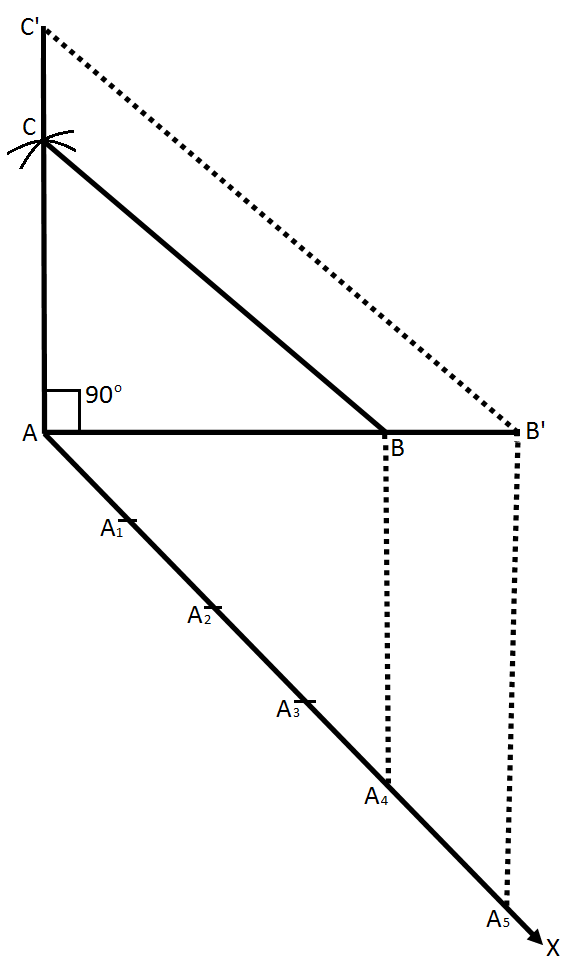
Given that Construct a right triangle of sides AB = AC = 4.5cm, and $\angle\text{A}=90^\circ$ and then a triangle similar to it whose sides are $\Big(\frac{5}{4}\Big)^\text{th}$ of the corresponding sides of $\triangle\text{ABC}.$ We follow the following steps to construct the given

Step of construction:
Step I: First of all we draw a line segment $A B=4.5 cm$.
Step II: With A as centre and draw an angle $\angle A =90^{\circ}$.
Step III: With $A$ as centre and radius $A C=4.5 cm$.
Step IV: Join $B C$ to obtain $\triangle ABC$.
Step V: Below $A B$, makes an acute angle $\angle B A X=60^{\circ}$.
Step VI: Along $A X$, mark off five points $A_1, A_2, A_3, A_4$ and $A_5$ such that $A A_1=A_1 A_2=A_2 A_3=A_3 A_4=A_4 A_5$.
Step VII: Join $A _4 B$.
Step VIII: Since we have to construct a triangle each of whose sides is $\left(\frac{5}{4}\right)^{\text {th }}$ of the corresponding sides of $\triangle ABC$.
So, we draw a line $A_5 B^{\prime}$ on $A X$ from point $A_5$ which is $A_5 B^{\prime} \| A_4 B$, and meeting $A B$ at $B^{\prime}$.
Step IX: From $B^{\prime}$ point draw $B^{\prime} C^{\prime} \| B C$, and meeting $A C$ at $C^{\prime}$. Thus, $\triangle AB ^{\prime} C ^{\prime}$ is the required triangle, each of whose sides is $\left(\frac{5}{4}\right)^{\text {th }}$ of the corresponding sides of $\triangle ABC$.

Need a full question paper?

Generate a complete, print-ready paper with questions like this in minutes — across 16+ boards, with answer keys.

Start Generating Free

Similar questions

If $\alpha$ and $\beta$ are the zeroes of the quadratic polynomial $f(x) = ax^2 + bx + c$, find evaluate:$\frac{\beta}{\text{a}\alpha+\text{b}}+\frac{\alpha}{\text{a}\beta+\text{b}} $
Write the expression $a_n - a_k$ for the $A.P. a, a + d, a + 2d, ...$
Hence, find the common difference of the A.P. for which,
$20^{th}$​​​​​​​ term is 10 more than the $18^{th}​​​​​​​$​​​​​​​ term.
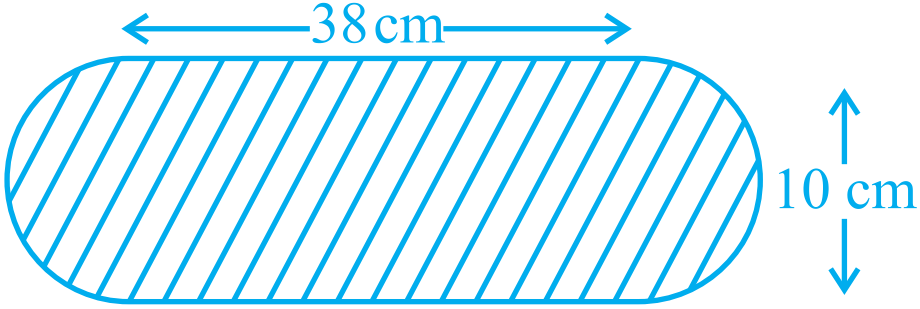
Find the area of the flower bed $($with semi$-$circular ends$)$ shown in Fig.
Find the mean, median and mode of the following data:
Class
0-50
50-100
100-150
150-200
200-250
250-300
300-350
Frequency
2
3
5
6
5
3
1
In what ratio does the x–axis divide the line segment joining the points (-4, -6) and (-1, 7)? Find the coordinates of the point of division.
The sum of the squares of three consecutive natural number is 149. Find the numbers.
The angle of elevation of the top of building from the foot of a tower is 30°. The angle of elevation of the top of the tower from the foot of the building is 60°. If the tower is 60°. If the tower is 60m high, Find the height of the building.
Prove the following identities:
$\sin^6\theta+\cos^6\theta=1-3\sin^2\theta\cos^2\theta$
A cylindrical tub of radius $12 \ cm$ contains water to a depth of $20 \ cm.$ A spherical ball is dropped into the tub and the level of the water is raised by $6.75 \ cm.$ Find the radius of the ball.
Find the value of k for which each of the following system of equations have infinitely many solutions:
$2x - 3y = 7$
$(k + 2)x - (2k + 1)y = 3(2k - 1)$