Electrocardiography is an important medical technique used to study electrical signals generated by the active states of the heart's muscles and tissues. These signals are recorded using a device called an
electrocardiogram (ECG). In this procedure, by applying conducting jelly, three electrodes of the device are placed sequentially on the patient's chest, wrist, and legs. The obtained electrical signals, which are of a diminished nature, are amplified by the appropriate system in the device and recorded as a sensitive chart record.
An ECG captures electrical activities during the contraction and relaxation of different chambers of the heart as certain wave patterns, represented as PQRS and T-waves.
Each wave indicates a specific condition in the heart's muscles.
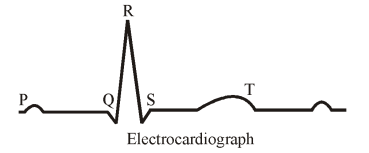 Fig. Schematic Diagram of Human ECG
It provides information about abnormalities in the heart. ECG aids in diagnosing heart-related conditions such as coronary thrombosis, angina pectoris. cardiomyopathy, myocarditis, and others.