Question
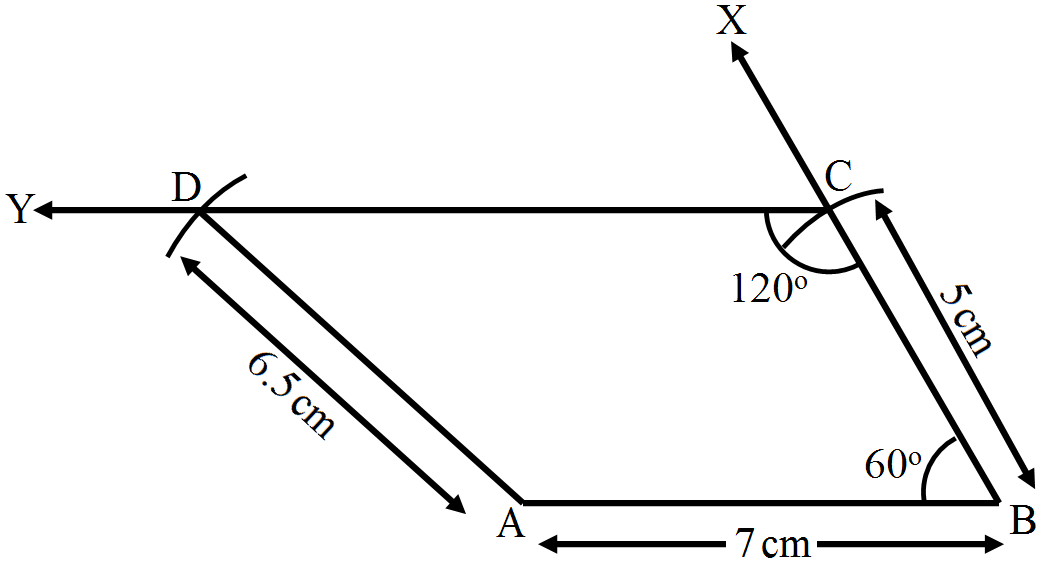
Draw a trapezium $ABCD$ in which $AB || DC, AB = 7\ cm, BC = 5\ cm, AD = 6.5\ cm$ and $\angle\text{B}=60^\circ.$
Answer


Steps of construction:
Step 1: Draw $AB$ equal to $7\ cm.$
Step 2: Make an angle, $\angle\text{ABX},$ equal to $60^\circ .$
Step 3: With $B$ as the centre, draw an arc of $5\ cm.$ Name that point as $C$. Join $B$ and $C.$​​​​​​​
Step 4: $AB || DC$
$\therefore\angle\text{ABX}+\angle\text{BCY}=180^\circ$
$\Rightarrow\angle\text{BCY}=180^\circ-60^\circ=120^\circ$
Draw an angle, $\angle\text{BCY},$ equal to $120^\circ .$​​​​​​​
Step 5: With $A$ as the centre, draw an arc of length $6.5\ cm,$ which cuts $CY.$ Mark that point as $D.$​​​​​​​
Step 6: Join $A$ and $D.$
​Thus, $ABCD$ is the required trapezium.

Need a full question paper?

Generate a complete, print-ready paper with questions like this in minutes — across 16+ boards, with answer keys.

Start Generating Free

Similar questions

Find the length of the longest rod that can be placed in a room $12m$ long, $9m$ broad and $8m$ high.
Difference of two numbers which are perfect cubes is 189. If the cube root of the smaller of the two numbers is 3, then find the cube root of the larger number.
What is the length of the side of a cube whose volume is $275\ cm^3$. Make use of the table for the cube root.
Verify commutativty of addition of rational numbers for the following pairs of rotional number: $-4$ and $\frac{4}{-7}$
Construct a rhombus $\text{CLUE}$ in which $\text{CL} = 7.5\ cm$ and $\text{LE} = 6\ cm$.
Carry out the following divisions.
(i) $51 x^3 y^2 z÷17 x y z$
(ii) $76 x^3 y z^3÷19 x^2 y^2$
(iii) $17 a b^2 c^3÷\left(-a b c^2\right)$
(iv) $-121 p^3 q^3 r^3÷\left(-11 x y^2 z^3\right)$
By what numbers should the following be divided to get a perfect square in case? Also, find the number whose square is the new number. $3698$
Arrange the following rational numbers in ascending order: $\frac{-4}{7},\frac{-9}{14},\frac{13}{-28},\frac{-23}{42}$
How many planks of size $2\ m × 25\ cm × 8\ cm$ can be prepared from a wooden block $5\ m$ long, $70\ cm$ broad and $32\ cm$ thick, assuming that there is no wastage?
In a television game show, the prize money of ₹ 100000 is to be divided equally amongst the winners. Complete the following table and find whether the prize money given to an individual winner is directly or inversely proportional to the number of winners?
Number of winnersPrize for each winner (in ₹)
1100000
250000
4
5
8
10
20