Question
Draw a triangle whose sides are of lengths $4\ cm, 5\ cm$ and $7\ cm$. Draw the perpendicular bisector of the largest side.
Answer


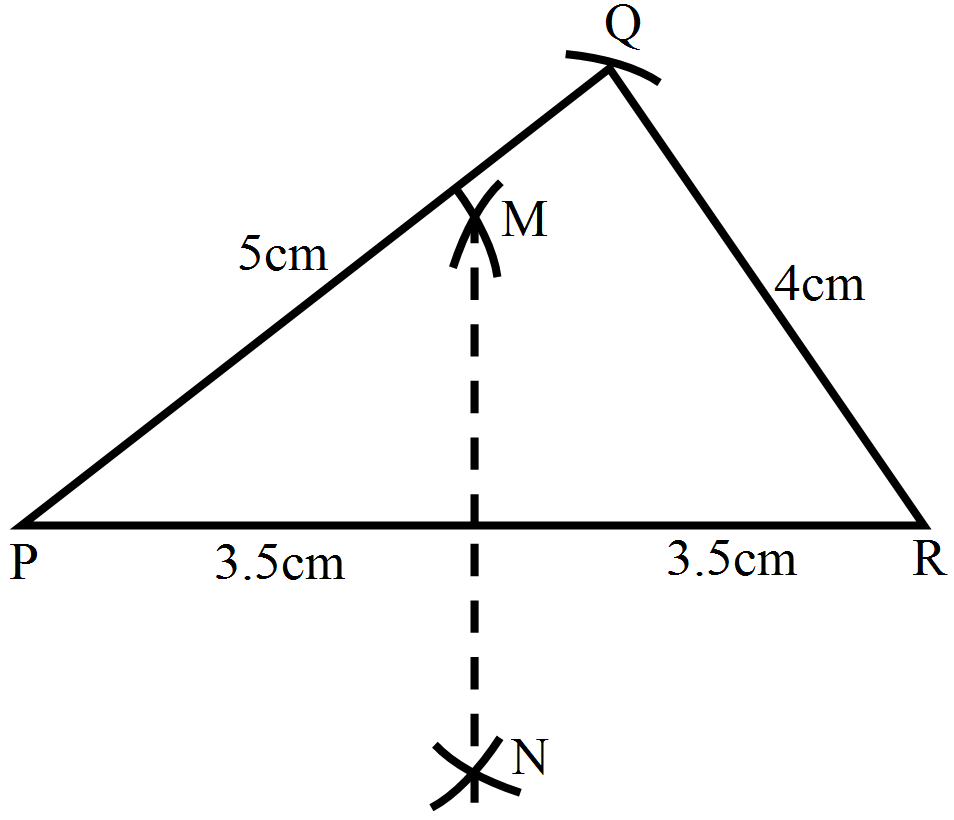
Steps of construction:
Step I: Draw a line segment $PR$ of length $7\ cm.$
Step II: With centre $P$, draw an arc of radius $5\ cm.$
Step III: With centre $R$, draw an arc of radius $4\ cm$ intersecting the previously drawn arc at $Q.$
Step IV: Join $PQ$ and $QR$ to obtain the required triangle.
Step V: From $P$, draw arcs with radius more than half of $PR$ on either side.
Step VI: With the same radius as in the previous step, draw arcs from $R$ on either sides of $PR$ intersecting the arcs drawn in the previous step at $M$ and $N.$
Step VII: $MN$ is the required perpendicular bisector of the largest side.

Need a full question paper?

Generate a complete, print-ready paper with questions like this in minutes — across 16+ boards, with answer keys.

Start Generating Free

Similar questions

At age of 2 yr, a cat or a dog is considered 24 "human" years old. Each year, after age 2 is equivalent to 4 "human" years. Fill in the expression [24+....(a-2)], so that it represents the age of a cat or dog in human years. Also, you need to determine for what 'a' stands for. Copy the chart and use your expression to complete it.
Age[24+......(a-2)]Age (human years)
2
3
4
5
6
In each of the following figures, write the number of lines of symmetry and order of rotational symmetry.
Image
In a triangle, an exterior angle at a vertex is $95^{\circ}$ and its one of the interior opposite angles is $55^{\circ}$. Find all the angles of the triangle.
Arrange the following fractions in ascending order: $\frac{3}{8},\frac{5}{6},\frac{6}{8},\frac{2}{4},\frac{1}{3}$
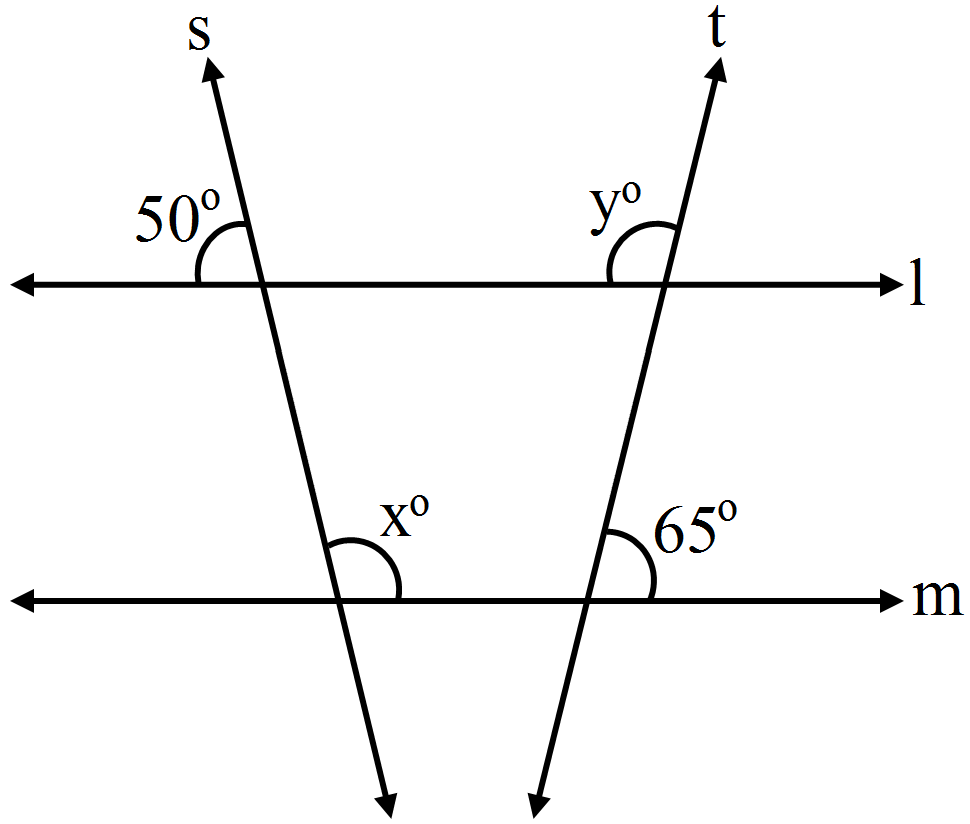
In the given figure $\text{l || m}.$ If s and t be transversals such that s is not parallel to $t.$ find the values of $x$ and $y.$
Find the mode and median of the data: 13, 16, 12, 14, 19, 12, 14, 13, 14. By using the empirical relation also find the mean.
There is a rectangular field of size $94 m \times 32 m$. Three roads each of 2 m width pass through the field such that two roads are parallel to the breadth of the field and the third is parallel to the length. Calculate : (i) area of the field covered by the three roads (ii) area of the field not covered by the roads.
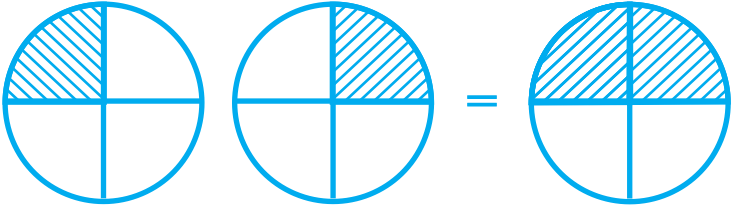
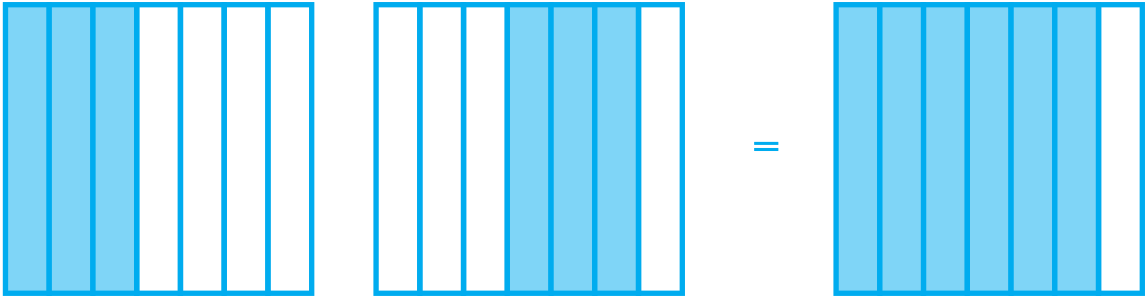
Some pictures $(a)$ to $(f)$ are given below. Tell which of them show:
$i. 2\times\frac{1}{4}$
$ii. 2\times\frac{3}{7}$
$iii. 2\times\frac{1}{3}$
$iv. \frac{1}{4}\times4$
$v. 3\times\frac{2}{9}$
$vi. \frac{1}{4}\times3$
$a.$
$b.$ 
$c.$ 
$d.$ 
$e.$ 
$f.$ 
Let us try to find a few more pairs of numbers from their sums and differences:
(a) Sum = 27, Difference = 9
(b) Sum = 4, Difference = 12
(c) Sum = 0, Difference = 10
(d) Sum = 0, Difference = -10
(e) Sum = -7, Difference = -1
(f) Sum = -7, Difference = -13
In Fig. $A B \| C D$ and a transversal $P Q$ cuts them at $L$ and $M$ respectively. If $\angle Q M D=100^{\circ}$, find all other angles.
Image