Question
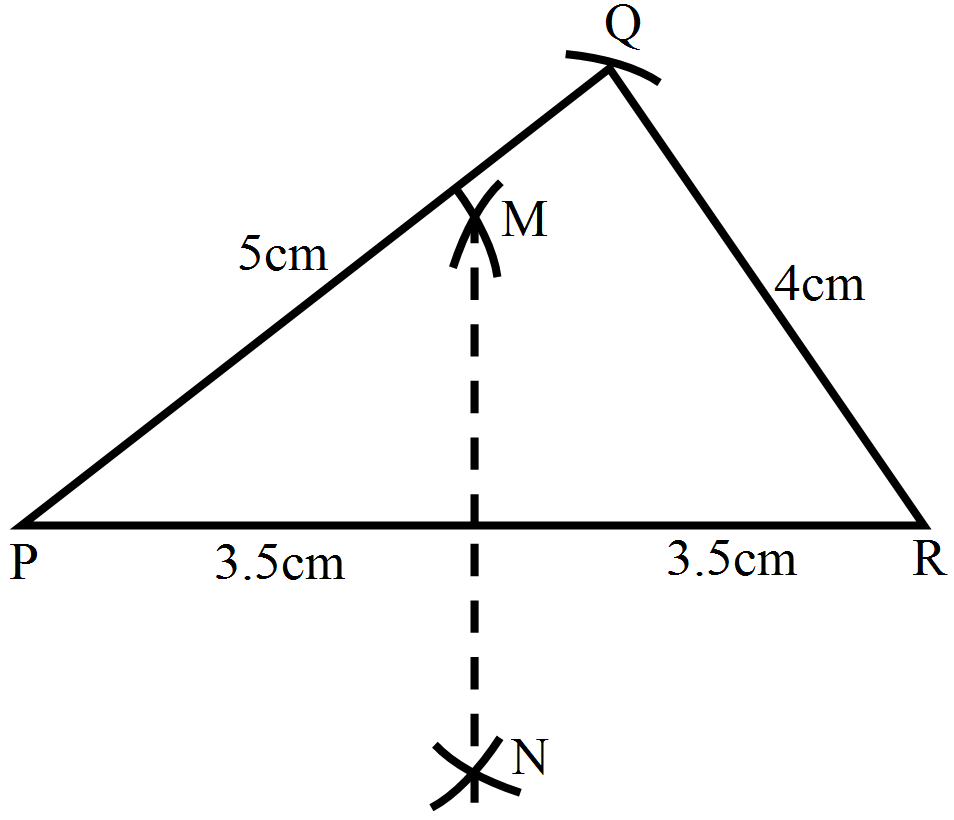
Draw a triangle whose sides are of lengths 4cm, 5cm and 7cm. Draw the perpendicular bisector of the largest side.
Answer


Steps of construction:
Step I: Draw a line segment PR of length 7cm.
Step II: With centre P, draw an arc of radius 5cm.
Step III: With centre R, draw an arc of radius 4cm intersecting the previously drawn arc at Q.
Step IV: Join PQ and QR to obtain the required triangle.
Step V: From P, draw arcs with radius more than half of PR on either side.
Step VI: With the same radius as in the previous step, draw arcs from R on either sides of PR intersecting the arcs drawn in the previous step at M and N.
Step VII: MN is the required perpendicular bisector of the largest side.

Need a full question paper?

Generate a complete, print-ready paper with questions like this in minutes — across 16+ boards, with answer keys.

Start Generating Free

Similar questions

The following numbers of votes were cast at 5 polling booths during the Gram Panchayat elections. Draw a joint bar graph for this data.
Persons\Booth No.1234270560820850
Women700240340640470
Students should take examples of their own and practice construction of triangles.
i. In ∆PQR, l(PQ) = 5 cm, l(QR) = 6.8 cm, l(PR) = 5.5 cm.
ii. In ∆XYZ, l(XY) = 5.7 cm, m∠Y = 120°, l(YZ) = 7 cm.
iii. In ∆RST, l(ST) = 6.7 cm, m∠S = 60°, m∠T = 40°.
iv. In ∆UVW, m∠U = 90°, l(UV) = 5 cm, l(VW) = 6 cm.
Find the value of p for the following distribution whose mean is 16.6
x:
8
12
15
p
20 25 30
f:
12
16
20
24
16 8 4
Draw triangle with the measures given. In ∆PRS, l(RS) = 5.5 cm, l(RP) = 4.2 cm, m∠R = 90°.
In $\triangle \text{ABC},$ if $3\angle \text{A}=4\angle \text{B}=6\angle \text{C},$ calculate the angles.
The following data gives the production of food grains (in thousand tonnes) for some years:
Year
1995
1996
1997
1998
1999
2000
Production(in thousand tones)
120
150
140
180
170
190
Represent the above data with the help of a bar graph.
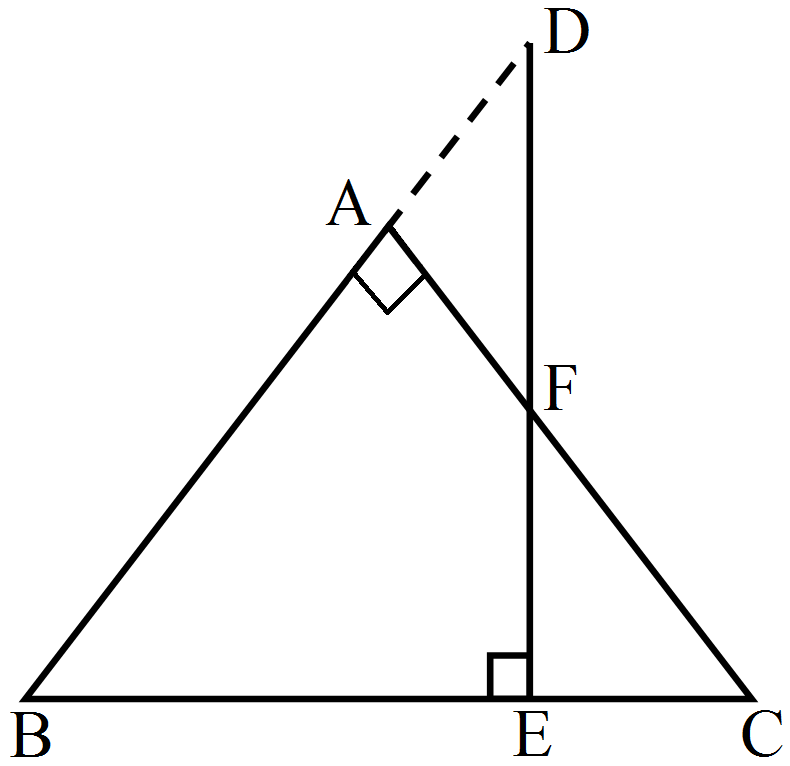
In Figure, ABC is a right triangle right angled at A. D lies on BA produced and DE perpendicular to BC intersecting AC at F. If $\angle \text{AFE}=130^\circ,$ find.
  1. $\angle \text{BDE}$
  2. $\angle \text{BCA}$
  3. $\angle \text{ABC}$
Take any three non-collinear points A, B, C and draw $\angle\text{ABC}.$ Through each vertex of the triangle, draw a line parallel to the opposite side.
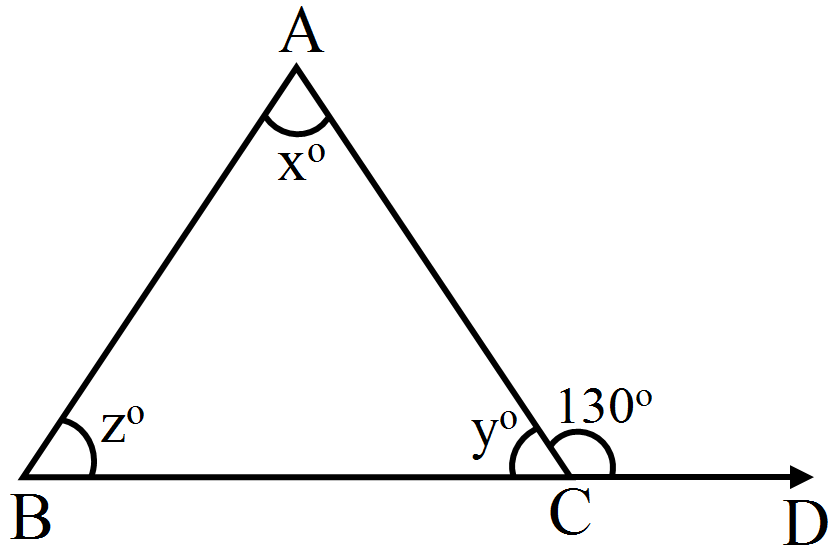
In the figure given alongside, x : y = 2 : 3 and $\angle\text{ACD}=130^\circ$. Find the values of x, y and z.
Shubhangi has twice as many 20-rupee notes as she has 50-rupee notes. Altogether, she has 2700 rupees. How many 50-rupee notes does she have ?