Question
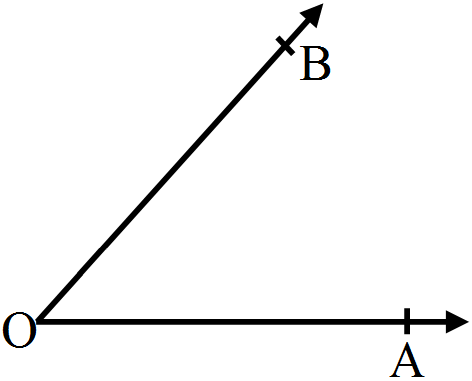
Draw an angle equal to $\triangle\text{AOB},$ given in the adjoining figure.
Answer


Here $\angle\text{AOB}$ is given.
Steps for construction:
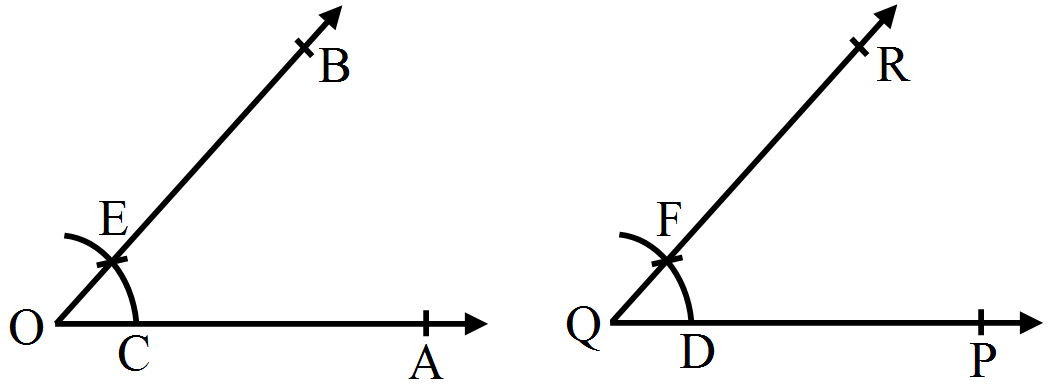
$1.$Draw a ray $QP.$
$2.$With $O$ as the centre and any suitable radius, draw an arc cutting $OA$ and $OB$ at $C$ and $E,$ respectively.
$3.$With $Q$ as the centre and the same radius as in step $(2),$ draw an arc cutting $QP$ at $D.$
$4.$With $D$ as the centre and radius equal to $CE,$ cut the arc through $D$ at $F.$
$5.$Draw $QF$ and produce it to point $R.$
$\therefore\ \angle\text{PQR}=\angle\text{AOB}$

Need a full question paper?

Generate a complete, print-ready paper with questions like this in minutes — across 16+ boards, with answer keys.

Start Generating Free

Similar questions

A ratio equivalent of $2 : 3$ is:
In a mathematics test following marks were obtained by $40$ students of class $VI$. Arrange these marks in a table using, tally marks.
$8$
$1$
$3$
$7$
$6$
$5$
$5$
$4$
$4$
$2$
$4$
$9$
$5$
$3$
$7$
$1$
$6$
$5$
$2$
$7$
$7$
$3$
$8$
$4$
$2$
$8$
$9$
$5$
$8$
$6$
$7$
$4$
$5$
$6$
$9$
$6$
$4$
$4$
$6$
$6$
$i.\ $Find how many students obtained marks equal to or more than $7$?
$ii.\ $How many students obtained marks below $4$?
Use a pair of compasses and construct the following angles: $22\frac{1}{2}^\circ$
If $4, a, a, 36$ are in proportion, then $a =$
Arrange the following fractions in ascending order:$\frac{1}{2},\frac{3}{4},\frac{5}{6}\ \text{and}\ \frac{7}{8}$
Determine the number nearest to $100000$ but greater than $100000$ which is exactly divisible by each of $8, 15$ and $21.$
Find. Write and indicate how you solved this. Is $\frac9{16}$ equal to$\frac59$?
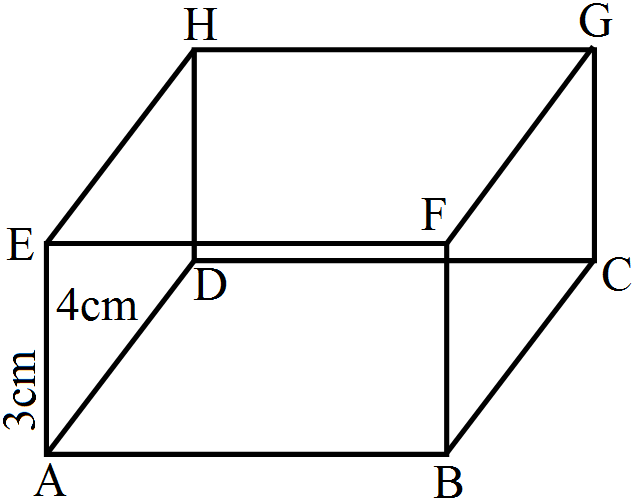
The dimensions of a cuboid with vertices $\text{A, B, C, D, E, F, G}$ and $H$ are as shown:

$i.\ $Which edges are of length $4\ cm?$ Which edges are of length $5\ cm?$
$ii.\ $Which faces have area equal to $20\ cm^2$?
$iii.\ $Which faces have the largest area$?$ What is this largest area$?$
$iv.\ $Which faces have a diagonal equal to $5\ cm?$
$v.\ $What is the area of the base of this cuboid$?$
$vi.\ $Do all the lateral faces have the same area$?$
Draw the perpendicular bisector of a given line segment $AB$ of length $6\ cm.$
Draw a line segment of length $6.5\ cm$ and divide it into four equal parts, using ruler and compasses.