Question
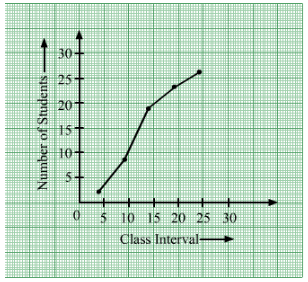
Draw an ogive to represent the following frequency distribution:
Class-interval
0-4
5-9
10-14
15-19
20-24
No. of students
2
6
10
5
3

Answer

Firstly, prepare the cumulative frequency table.
Class interval
No. of students
Less than
Cumulative frequency
Suitable points
0-4
2
4
2
(4,2)
5-9
6
9
8
(9,8)
10-14
10
14
18
(14,18)
15-19
5
19
23
(19,23)
20-24
3
24
26
(24,26)
Now, plot the less than ogive using the suitable points.

Need a full question paper?

Generate a complete, print-ready paper with questions like this in minutes — across 16+ boards, with answer keys.

Start Generating Free

Similar questions

What is the probability that an ordinary year has 53 Sundays?
On comparing the ratios $\frac{a_1}{a_2}, \frac{b_1}{b_2}$ and $\frac{c_1}{c_2}$, find out whether the pair of linear equations are consistent, or inconsistent: $\frac{4}{3} x+2 y =8 ; 2 x +3 y =12$.
In two concentric circles, the radii are $OA = r \ cm$ and $OQ =6 \ cm,$ as shown in the figure. Chord $CD$ of larger circle is a tangent to smaller circle at $Q . PA$ is tangent to larger circle. If $PA =16 \ cm$ and $OP =20 \ cm,$ find the length $CD.$
Image ​​​​​​​
A chord of a circle of radius 14cm a makes a right angle at the centre. Find the area of the sector.
Prove the following trigonometric identities.
$(\text{cosec}\text{A}-\sin\text{A})(\sec\text{A}-\cos\text{A})(\tan\text{A}+\cot\text{A})= 1$
A coin is tossed two times. Find the probability of getting at least one head.
A game consists of tossing a one-rupes coin three times, and noting its outcome each time. Find the probability of getting.
  1. Three heads.
  2. At least 2 tails.
What is the ratio of the areas of a circle and an equilateral triangle whose diameter and a side are respectively equal?
On comparing the ratios $\frac{\text{a}_1}{\text{a}_2},\frac{\text{b}_1}{\text{b}_2}$ and $\frac{\text{c}_1}{\text{c}_2},$ and without drawing them, find out whether the lines representing the following pairs of linear equations intersect at a point, are parallel or coincide.
$6x - 3y + 10 = 0$
$2x - y + 9 = 0$
Is the given statement correct or not correct?
If a die is thrown, there are two possible outcomes- an odd number or an even number. Therefore, the probability of getting an odd number is $\frac{1}{2}$.