Question
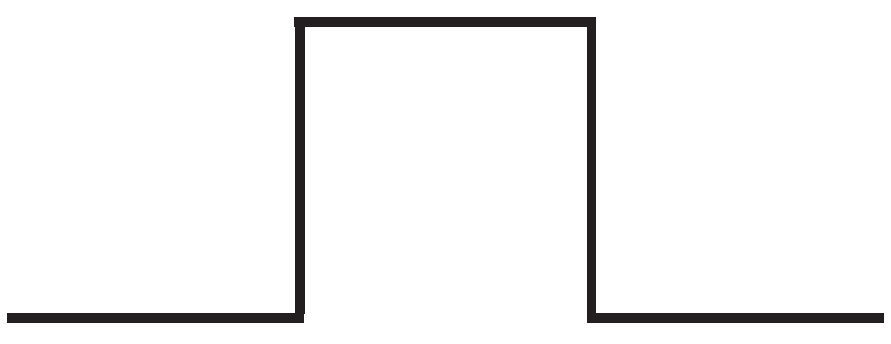
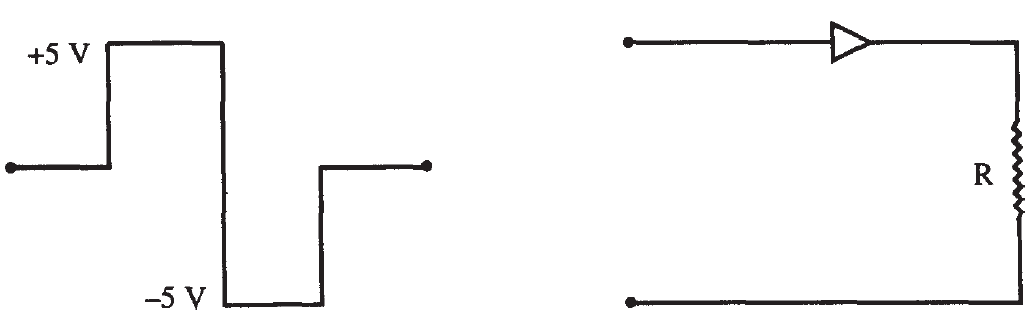
Draw and explain the output waveform across the load resistor R, if the input waveform is as shown in the given figure.
Answer

If the candidate considers it as a circuit containing diode.

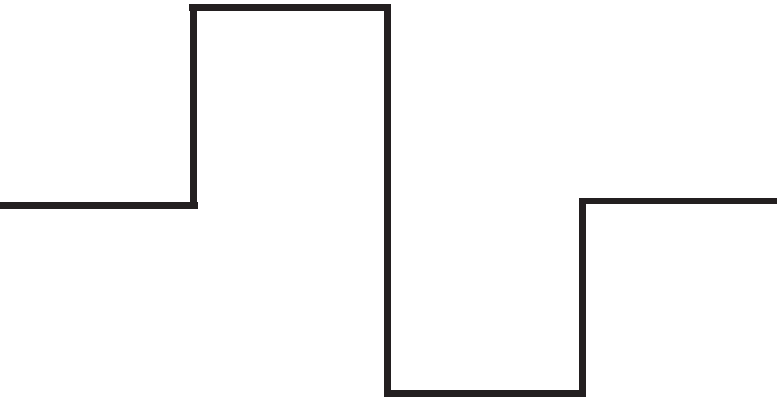
Wave form:

Explanation: 

When the input voltage is +5v, the diode, being forward biased, conducts and output is obtained across R. When the input is –5v, the diode being reverse biased does not conduct and hence there is no output.

Alternate Answer

If the candidate considers it as a circuit with NOT gate.

Wave form:

Explanation:

When the input is zero, NOT gate conducts and output is obtained across R.

When the input is 5V there will be no output.

Alternate Answer

Output waveform:
Need a full question paper?

Generate a complete, print-ready paper with questions like this in minutes — across 16+ boards, with answer keys.
Start Generating Free

Similar questions

Is there any lower limit to the electric force between two particles placed at a separation of 1cm ?
How will an air bubble behave like a lens in water?
A conducting disc of radius r rotates with a small but constant angular velocity $\omega$ about its axis. A uniform magnetic field B exists parallel to the axis of rotation. Find the motional emf between the centre and the periphery of the disc.
An electric field $\vec{\text{E}}=\vec{\text{i}}\text{Ax}$ exists in the space, where A= 10Vm-2. Take the potential at (10m, 20m) to be zero. Find the potential at the origin.
A platinum resistance thermometer reads 0°when its resistance is $80\Omega$ and 100° when its resistance is $90\Omega$. Find the temperature at the platinum scale at which the resistance is $86\Omega$.
Let I = current through a conductor, R = its resistance and V = potential difference across its ends. According to Ohm's law, product of two of these quantities equals the third. Obtain Ohm's law from dimensional analysis. Dimensional formulae for R and V are $\text{ML}^2\text{I}^{-2}\text{T}^{-3}$ and $\text{ML}^2\text{T}^{-3}\text{I}^{-1}$ respectively.
A circular coil of radius 2.0cm has 500 turns and carries a current of 1.0A. Its axis makes an angle of 30° with the uniform magnetic field of magnitude 0.40 T that exists in the space. Find the torque acting on the coil.
A cube of ice floats partly in water and partly in K. oil  Find the ratio of the volume of ice immersed in water to that in K.oil. Specific gravity of K. oil is 0.8 and that of ice is 0.9.

A rectangular coil of 100 turns has length 5cm and width 4cm. It is placed with its plane parallel to a uniform magnetic field and a current of 2A is sent through the coil. Find the magnitude of the magnetic field B if the torque acting on the coil is 0.2N m-1.
Draw the energy band diagram of (i) n-type, and (ii) p-type semiconductors at temperature T > 0 K. In the case of n-type Si-semiconductor, the donor energy level is slightly below the bottom of conduction band whereas in p-type semiconductor, the acceptor energy level is slightly above the top of valence band. Explain, giving examples, what role do these energy levels play in conduction and valence bands.