Question

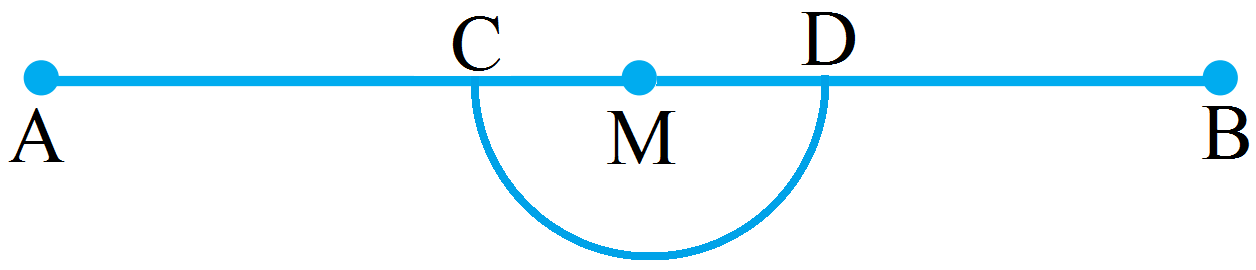
Draw any line segment $\overline{\text{AB}}$. Mark any point $M$ on it. Through $M,$ draw a perpendicular to $\overline{\text{AB}}$. $($use ruler and compasses$)$

Answer

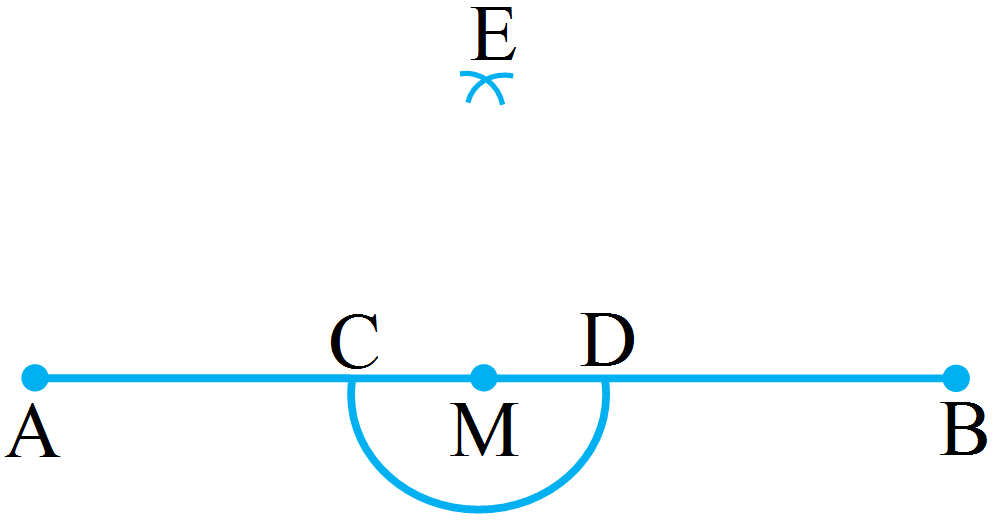
$1.$Draw the given line segment $\overline{\text{AB}}$ and mark any point $M$ on it.

$2.$With $M$ as centre and a convenient radius, construct an arc intersecting the line segment $\overline{\text{AB}}$ at two points $C$ and $D.$

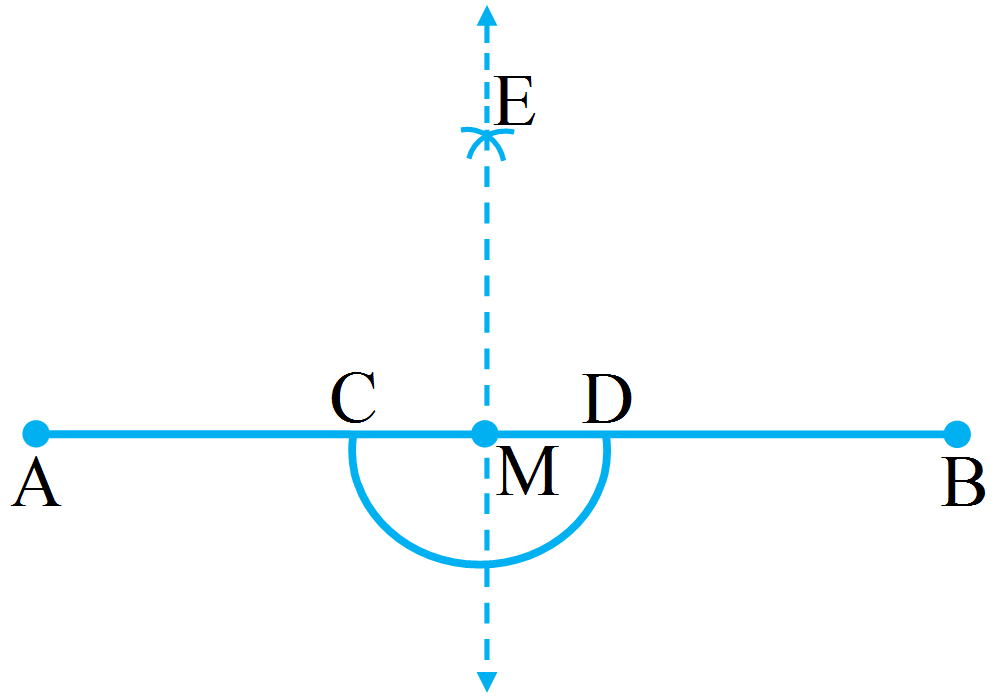
$3.$With $C$ and $D $ as centres and a radius greater than $CM$ construct two arcs. Let these are intersecting each other at $E.$

$4.$Join $EM.$ $\overline{\text{EM}}$ is perpendicular to $\overline{\text{AB}}$.

Need a full question paper?

Generate a complete, print-ready paper with questions like this in minutes — across 16+ boards, with answer keys.

Start Generating Free

Similar questions

Perimeter of a square and a rectangle is same. If a side of the square is $15\ cm$ and one side of the rectangle is $18\ cm,$ find the area of the rectangle.
Identify whether each statement is true or false. Explain.
(a) There is no prime number whose units digit is 4.
(b) A product of primes can also be prime.
(c) Prime numbers do not have any factors.
(d) All even numbers are composite numbers.
(e) 2 is a prime and so is the next number, 3. For every other prime, the next number is composite.
Draw an angle of $60^\circ ,$ using a pair of compasses. Bisect it to make an angle of $30^\circ .$
Draw a line segment $AB$ and bisect it. Bisect one of the equal parts to obtain a line segment of length $\frac{1}{2}(\text{AB}).$
Find the least number which when divided by $12, 16, 24$ and $36$ leaves a remainder $7$ in each case.
Match the following columns on whole numbers:
S.No.
Column A
S.No.
Column B
$(a)$
$137 + 63 = 63 + 137$
$(i)$
Associativity of multiplication
$(b)$
$(16 \times 25)$ is a number
$(ii)$
Commutativity of multiplication
$(c)$
$365 \times 18 = 18 \times 365$
$(iii)$
Distributive law of multiplication over addition.
$(d)$
$(d) (86 \times 14) \times 25 = 86 \times (14 \times 25)$
$(iv)$
Commutativity of addition
$(e)$
$23 \times (80 + 5) = (23 \times 80) + (23 \times 5)$
$(v)$
Closure property for multiplication
Find the $LCM$ of $12$ and $18.$
Match the following:
$(a)$ Straight angle $(i)$ Less than one-fourth a revolution
$(b)$ Right angle $(ii)$ More than half a revolution
$(c)$ Acute angle $(iii)$ Half of a revolution
$(d)$ Obtuse angle $(iv)$ One-fourth a revolution
$(v)$Reflex angle $(v)$Between $\frac{1}{4}$ and $\frac{1}{2}$ of a revolution
  $(vi)$One complete revolution
The circumferences of four wheels are $50\ cm, 60\ cm, 75\ cm$ and $100\ cm$. They start moving simultaneously. what least distance should they cover so that each wheel makes a complete number of revolutions?
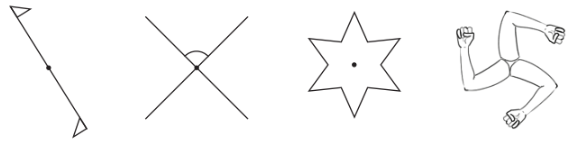
Give the order of rotational symmetry for each figure:
Image