Question
Draw any $\triangle\text{ABC}.$ Bisect side $AB$ at $D$. Through $D$, draw a line parallel to $BC$, meeting $AC$ in $E.$ Measure $AE$ and $EC.$
Answer


Steps of construction:
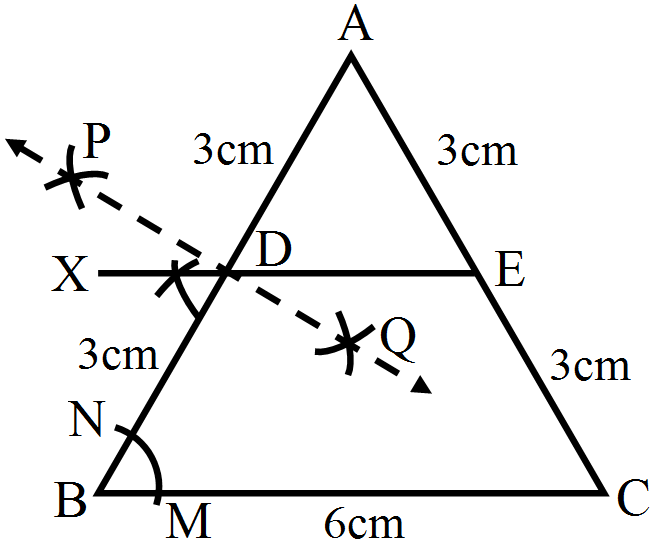
Step I: We first draw a triangle $A B C$ with each side $=6 cm$.
Steps to bisect line $AB:$
Step I: Draw an arc from $A$ on either side of line $A B$.
Step II: With the same radius as in the previous step, draw an arc from $B$ on either side of $AB$ intersecting the arcs drawn in the previous step at $P$ and $Q $.
Step III: Join $PQ$ cutting $A B$ at $D . P Q$ is the perpendicular bisector of $A B$.
Parallel line to $B C$ :
Step I: With $B$ as centre, draw an arc cutting $B C$ and $B A$ at $M$ and $N$, respectively.
Step II: With centre $D$ and the same radius as in the previous step, draw an arc on the opposite side of $A B$ to $c u t ~ A B$ at $Y$.
Step II: With centre $Y$ and radius equal to $MN$ , draw an arc cutting the arc drawn in the previous step at $X$ .
Step III: Join $XD$ and extend it to intersect $AC$ at $E.$
Step IV: $DE$ is the required parallel line.

Need a full question paper?

Generate a complete, print-ready paper with questions like this in minutes — across 16+ boards, with answer keys.

Start Generating Free

Similar questions

Number of children in six different classes are given below. Represent the data on a bar graph.
Class
$V $ $VI $ $VII $ $VIII $ $IX$ $X$
Number of children
$135$
$120$
$95$
$100$
$90$
$80$
$i.$ Which class has the maximum number of children?
$ii.$ Which class has the minimum number of children?
How do you choose the scale?
In $\triangle\text{DEF},  \angle\text{D} = 60^\circ , \angle\text{E} = 70^\circ $ and the bisectors of $\angle\text{E}$ and $\angle\text{F}$ meet at $O$. Find $(i) \ \angle\text{F}  \ (ii) \ \angle\text{EOF}.$
Draw an $\angle\text{BAC}$ of measure $50^\circ $ such that $AB = 5cm$ and $AC = 7cm$. Through $C$ draw a line parallel to $AB$ and through $B$ draw a line parallel to $AC$, intersecting each other at $D$. Measure $BD$ and $CD.$
$ABCD$ is a quadrilateral. Is $AB + BC + CD + DA > AC + BD?$
A room is 9 m long, 8 m broad and 6.5 m high. It has one door of dimensions $2 m \times 1.5 m$ and three windows each of dimensions $1.5 m \times 1 m$. Find the cost of white washing the walls at ₹ $ 3.80$ per square metre.
Draw a line l and draw another line m parallel to l at a distance of $4.3\ cm$ from it.
The area of circle is $100$ times the area of another circle. What is the ratio of their circumferences?
The following table shows the marks obtained by $41$ students of a class.
Marks obtained $15$ $17$ $20$ $22$ $25$ $30$
Number of students $2$ $5$ $10$ $12$ $8$ $4$
Find the median and mean marks. Using empirical formula, calculate its mode.
The value of the expression $(10 y-20)$ depends on the value of $y$. Verify this by giving five different values to $y$ and finding for each $y$ the value of $(10 y-20)$. From the different values of $(10 y-20)$ you obtain, do you see a solution to $10 y-20=50$ ?
If there is no solution, try giving more values to $y$ and find whether the condition $10 y-20=50$ is met.
The following data gives the number (in thousands) of applicants registered with an Employment Exchange during, 1995-2000:
Year199519961997199819992000
Number of applicants registered (in thousands)182024283034
Construct a bar graph to represent the above data.