Question
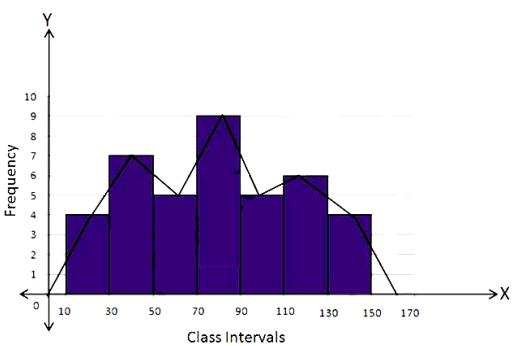
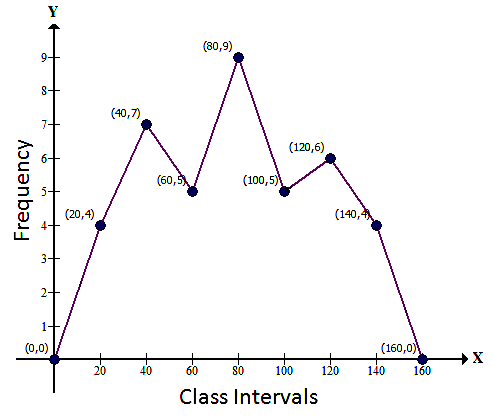
Draw frequency polygons for each of the following frequency distribution: $(a)$ using histogram$(b)$ without using histogram
$C.I$ $10 - 30$ $30 - 50$ $50 - 70$ $70 - 90$ $90 - 110$ $110 - 130$ $130 - 150$
$ƒ$ $4$ $7$ $5$ $9$ $5$ $6$ $4$

Answer

using histogram
$C.I$ $ƒ$
$10 - 30$ $4$
$30 - 50$ $7$
$50 - 70$ $5$
$70 - 90$ $9$
$90 - 110$ $5$
$110 - 130$ $6$
$130 - 150$ $4$
Steps:
    1. Draw a histogram for the given data.
    2. Mark the mid$-$point at the top of each rectangle of the histogram drawn.
    3. Also, mark the mid$-$point of the immediately lower class$-$interval and mid$-$point of the immediately higher class$-$interval.
    4. Join the consecutive mid$-$points marked by straight lines to obtain the required frequency polygon.
Image
Without using Histogram:Steps:
  1. Find the class$-$mark $($mid$-$value$) $of each given class-interval.
    classmark $=$ mid$-$value $=\frac{\text { Upper limit }+ \text { Lower limit }}{2}$
  2. On a graph paper, mark class-marks along $X-$axis and frequencies along $Y-$axis.
  3. On this graph paper, mark points taking values of class-marks along the $X-$axis and the values of their corresponding frequencies along $Y-$axis.
  4. Draw line segments joining the consecutive points marked in step $(3)$ above.
    $C.I.$ Class$-$mark $f$
    $-10 - 10$ $0$ $0$
    $10 - 30$ $20$ $4$
    $30 - 50$ $40$ $7$
    $50 - 70$ $60$ $5$
    $70 - 90$ $80$ $9$
    $90 - 110$ $100$ $5$
    $110 - 130$ $120$ $6$
    $130 - 150$ $140$ $4$
    $150 - 170$ $160$ $0$

Need a full question paper?

Generate a complete, print-ready paper with questions like this in minutes — across 16+ boards, with answer keys.

Start Generating Free

Similar questions

A well with $14\ m$ diameter is dug $21\ m$ deep. The earth taken out of it has been evenly spread all around it to a width of $14\ m$ to form an embankment. Find the height of the embankment.
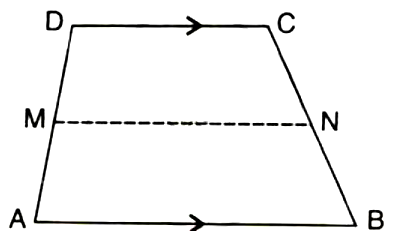
The figure, given below, shows a trapezium $\text{ABCD} . M$ and $N$ are the mid-point of the non$-$parallel sides $A D$ and $B C$ respectively. Find :

$(i) MN$, if $AB =11 \ cm$ and $DC =8 \ cm.(ii) A B$, if $D C=20 \ cm$ and $M N=27 \ cm.(iii) DC$, if $MN =15 \ cm$ and $AB =23 \ cm$.
A point $P (2, -1)$ is equidistant from the points $(a, 7)$ and $(-3, a)$. Find $a.$
A retailer buys a washing machine marked at $Rs.4800$ and gets two successive discounts of $15\%$ and $5\%.$ He spends $Rs.124$ on transportation and sells it at a gain of $13\%.$ Find the selling price of the machine.
Arrange $\frac{5}{8},-\frac{3}{16},-\frac{1}{4}$ and $\frac{17}{32}$ in descending order of their magnitudes.Also, find the sum of the lowest and largest of these fractions. Express the result obtained as a decimal fraction correct to two decimal places.
The perimeter of a rectangular plot is $300\ m$ . It has an area of $5600\\ m^2$. Taking the length of the plot as $x m$ , calculate the breadth of the plot in terms of $x$, form an equation and solve it to find the dimensions of the plot.
The mean of $6$ numbers is $42$. If one number is excluded, the mean of the remaining number is $45$. Find the excluded number.
A man borrows $Rs.62500$ at $8\% p.a.$, simple interest for $2$ years. He immediately lends the money out at $CI$ at the same rate and for same time. What is his gain at the end of $2$ years?
Calculate the amount and compound interest on $Rs.20000$ for $3$ years at $10\%$ per annum, interest being payable annually.
Construct a rectangle $\text{ABCD}$, when:Area $= 36 \ cm^2$ and height $= 4.5 \ cm$.