Question
Draw logic symbol of an OR gate and write its truth table.

Answer

Get the step-by-step solution for this question inside the Vidyadip app.

Get the answer in the app

Need a full question paper?

Generate a complete, print-ready paper with questions like this in minutes — across 16+ boards, with answer keys.
Start Generating Free

Similar questions

What is the direction of a current carrying solenoid when suspended freely in earth's horizontal plane?
Magnetic scalar potential is defined as$\text{U}(\overrightarrow{\text{r}_2})-\text{U}(\overrightarrow{\text{r}_1})=-\int\limits^{\vec{\text{r}}_2}_{\vec{\text{r}_1}} \vec{\text{B}}.\text{d}\vec{\text{l}}.$
Apply this equation to a closed curve enclosing a long atraicht wire. The RHS of the above equation is then $-{\mu}_\text{o} \text{ i}$ by Ampere's law. We see that $\text{U}(\vec{\text{r}_2})\neq\text{U}(\vec{\text{r}_1})$ even when $\vec{\text{r}_2}=\vec{\text{r}_1}.$Can we have a magnetic acalar potential in this case?
Consider the energy density in a solenoid at its centre and that near its ends. Which of the two is greater?
A hollow metal sphere and a solid metal sphere of equal radii are given equal charges. Which of the two will have higher potential?
Which physical quantity has newton/ampere- meter as unit? Is it scalar quantity or vector quantity?
Show that the minimum energy needed to separate a proton from a nucleus with Z protons and N neutrons is:
$\Delta\text{E}=(\text{M}_{\text{Z}-1,\text{N}}+\text{M}_{\text{H}}-\text{M}_{\text{Z,N}})\text{c}^2$
where $M_{Z,N}$= mass of an atom with Z protons and N neutrons in the nucleus and $M_H=$ mass of a hydrogen atom. This energy is known as proton-separation energy.
Assume that the total surface area of a human body is $1.6m^2$ and that it radiates like an ideal radiator. Calculate the amount of energy radiated per second by the body if the body temperature is $37^\circ$ C. Stefan constant $\sigma$ is $6.0 × 10^{-8}  Wm ^{-2}K^{-4}$.
Consider the self-inductance per unit length of a solenoid at its centre and that near its ends. Which of the two is greater?
Two persons pull a rope towards themselves. Each person exerts a force of 100N on the rope. Find the Young's modulus of the material of the rope if it extends in length by 1cm. Original length of the rope = 2m and the area of cross-section $= 2cm^2$.
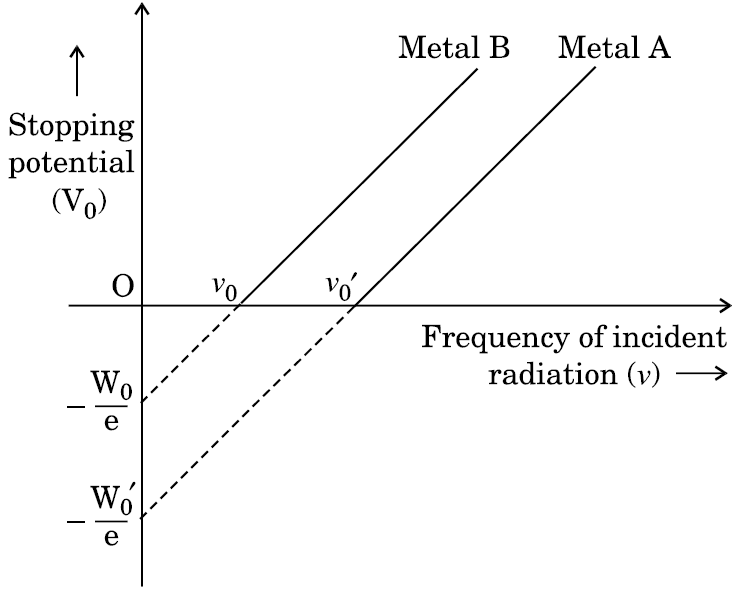
The graph shows variation of stopping potential $V_0$ versus frequency of incident radiation v for two photosensitive metals A and B. Which of the two metals has higher threshold frequency and why?