Question
Draw the circuit diagram of a half-wave rectifier. Hence explain its working.

Answer

Working of half-wave rectifier:
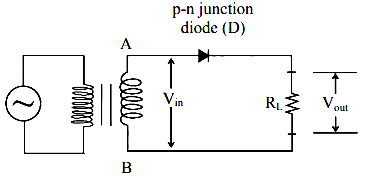
  1. The given figure shows the circuit of a half-wave rectifier.

    Half wave rectifier
  2. The secondary coil AB of a transformer is connected in series with a diode D and the load resistance $R_L$. The AC voltage across the secondary coil AB changes its polarities after every half cycle.
  3. When the positive half cycle begins, the voltage at point A is at higher potential with respect to that at point B, therefore, the diode (D) is forward biased. It conducts and current flows through the circuit.
  4. When the negative half cycle begins, the potential at point A is lower with respect to that at point B and the diode is reverse biased, therefore, it does not conduct and no current passes through the circuit.
  5. Hence, the diode conducts only in the positive half cycles of the AC input. It blocks the current during the negative half-cycles. In this way, current always flows through the load $R_L$​​​​​​​​​​​​​​ in the same direction for alternate positive half cycles and DC output voltage obtained across $R_L$​​​​​​​ in the form of alternate pulses.
  6. In a half-wave rectifier, the frequency of the ripple in the output is the same as that of the frequency of the input.

Need a full question paper?

Generate a complete, print-ready paper with questions like this in minutes — across 16+ boards, with answer keys.
Start Generating Free

Similar questions

Obtain an expression for the torque acting on a rotating body with constant angular acceleration. Hence state the dimensions and SI unit of torque.
An open tube manometer is connected to (i) a vacuum-packed candy jar, with the atmospheric pressure in the open tube supporting a column of fluid of height h (ii) a gas tank, with the absolute pressure in the tank supporting a column of fluid of height h. Is the absolute pressure in the jar and the gas tank greater than or less than the atmospheric pressure ? By how much ?
Define angular S.H.M. and obtain its differential equation.
Explain the term viscosity.
A coaxial cable, whose outer radius is five times its inner radius, is carrying a current of $1.5 A$. What is the magnetic field energy stored in a $2 m$ length of the cable?
Determine the change in wavelength of electro$-$magnetic radiation as it passes from air to glass, if the refractive index of glass with respect to air for the radiation under consideration is $1.5$ and the frequency of the radiation is $3.5 \times 10^{14} Hz. [$Speed of the radiation in air $( c )=3 \left.\times 10^8\ m / s \right]$
A stretched wire emits fundamental note of frequency \(256 Hz\). Keeping the streching force constant and reducing the length of wire by \(10 cm\), the frequency becomes \(320 Hz\). Calculate the original length of wire.
Two charged spherical conductors, of radii $R_1$ and $R_2$ and surface charge densities $\sigma_1$ and $\sigma_2$, are connected by a thin conducting wire. Except for this connecting wire, the spheres are sufficiently separated to be considered as isolated. Show that $\sigma_1 R_1=\sigma_2 R_2$.
A hollow metal ball $10 cm$ in diameter is given a charge of $1 \times 10^{-2} C$. What is the magnitude of the electric fiald intensity at a point $20 cm$ from the centre of the ball ?
Define the SI and CGS units of coefficient of viscosity.