Question

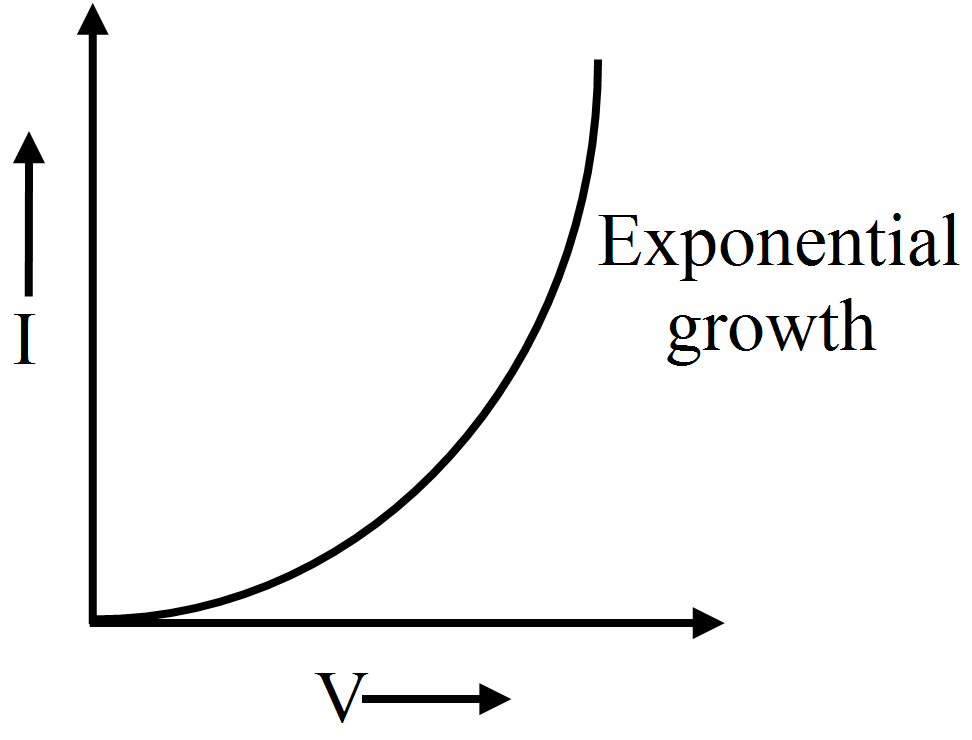
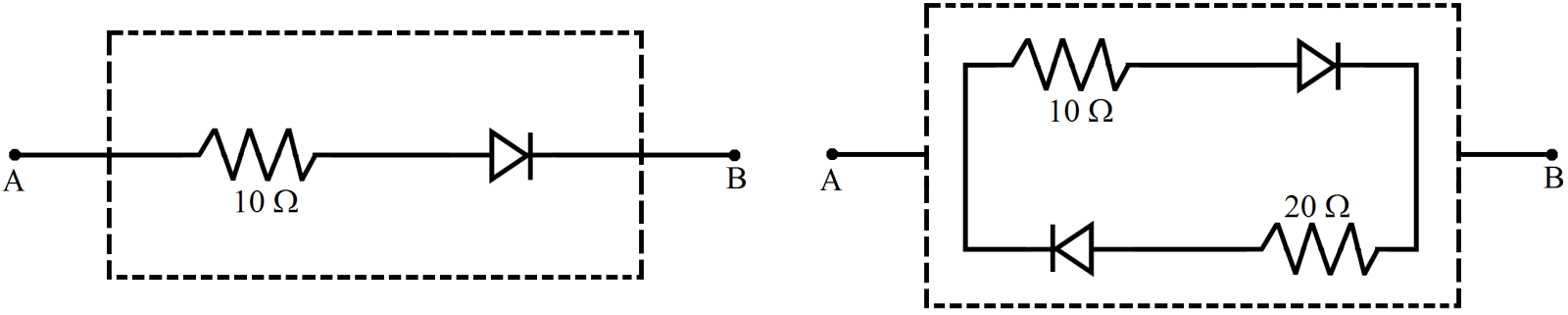
Draw the current-voltage characteristics for the device shown in figure. between the terminals A and B.

Answer

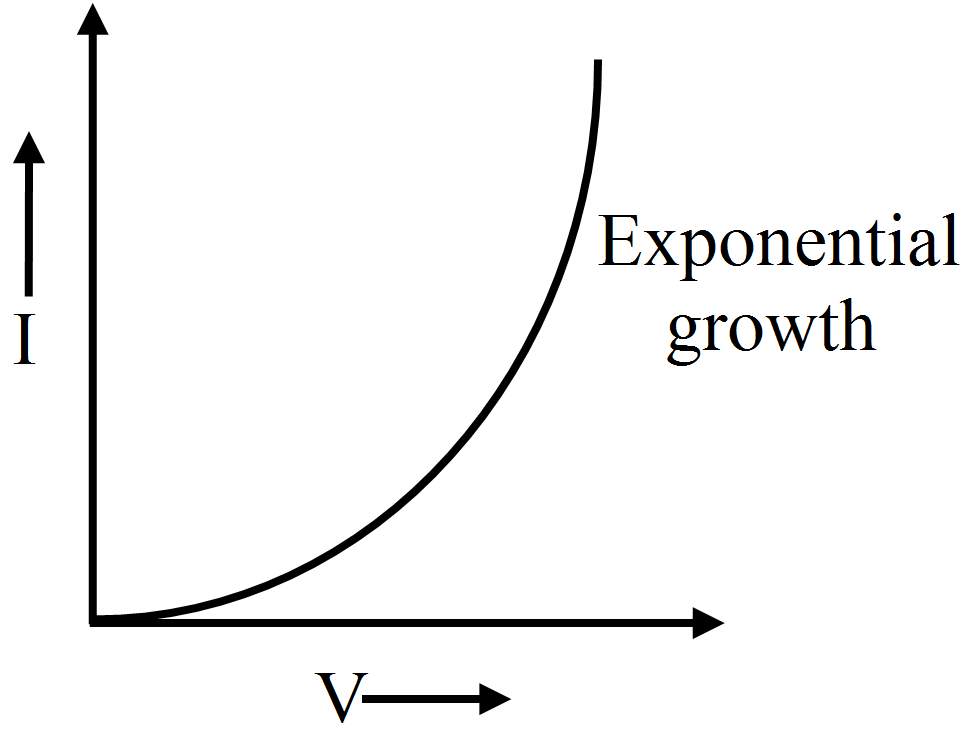
  1. If a battery is connected between terminals A and B, with positive terminal connected to point A and negative terminal connected to point B, then the diode will get forward biassed by the applied voltage. So, the current voltage graph for this circuit will be the same as that of the characteristic curves of a forward-biassed diode.
  1. If a battery is connected between terminals A and B, with positive terminal connected to point A and negative terminal connected to point B, then the upper diode will get forward biassed and the lower diode will get reverse biassed by the applied voltage. So, this lower branch can be replaced by an open circuit; hence, the current flow through this branch will be zero. The current flows only through the upper diode, so the circuit on simplification will become identical to the circuit in part (a). Hence, the current voltage graph for this circuit will be the same as that of the characteristic curves of a forward-biassed diode.

Need a full question paper?

Generate a complete, print-ready paper with questions like this in minutes — across 16+ boards, with answer keys.
Start Generating Free

Similar questions

Hari is a student of Class X in a school near his village. His uncle gifted him a bicycle with a dynamo fitted in it. He was thrilled to find that while cycling during night, he could light the bulb and see the objects on the road clearly. He, however, did not know how this device works. He asked this question to his teacher. The teacher considered it an opportunity and explained the working of a dynamo to the whole class.
Answer the following questions:
  1. State the principle and working of a dynamo.
  2. Write two values each displayed by Hari and his Science teacher.
An electrical technician requires a capacitance of 2μF in a circuitacross a potential difference of 1kV. A large number of 1μF capacitors are available to him each of which can withstand a potential difference of not more than 400V. Suggest a possible arrangement that requires the minimum number of capacitors.
With the help of a diagram, explain the principle of a device which changes a low voltage into a high voltage but does not violate the law of conservation of energy. Give any one reason why the device may not be $100\%$ efficient.
Answer the following the questions.
  1. A small compass needle of magnetic moment ‘m’ is free to turn about an axis perpendicular to the direction of uniform magnetic field ‘B’. The moment of inertia of the needle about the axis is ‘I’. The needle is slightly disturbed from its stable position and then released. Prove that it executes simple harmonic motion. Hence deduce the expression for its time period.
  2. A compass needle, free to turn in a vertical plane orients itself with its axis vertical at a certain place on the earth. Find out the values of (i) horizontal component of earth’s magnetic field and (ii) angle of dip at the place.
Distinguish the magnetic properties of dia, para- and ferro-magnetic substances in terms of (i) susceptibility, (ii) magnetic permeability and (iii) coercivity. Give one example of each of these materials. Draw the field lines due to an external magnetic field near a (i)diamagnetic, (ii) paramagnetic substance.
A circuit containing a $80 mH$ inductor and a $60 \mu F$ capacitor in series is connected to a $230 V, 50 Hz$ supply. The resistance of the circuit is negligible.
$a$. Obtain the current amplitude and rms values.
$b.$ Obtain the rms values of potential drops across each element.
$c$. What is the average power transferred to the inductor?
$d. $ What is the average power transferred to the capacitor?
$e$. What is the total average power absorbed by the circuit? $[$‘Average’ implies ‘averaged over one cycle’.$]$
The magnetic field inside a long solenoid having 50 turns/cm is increased from $2.5 × 10.3T$ to $2.5T$ when an iron core of cross-sectional area $4cm^2$ is inserted into it. Find:
  1. The current in the solenoid.
  2. The magnetization I of the core.
  3. The pole strength developed in the core.
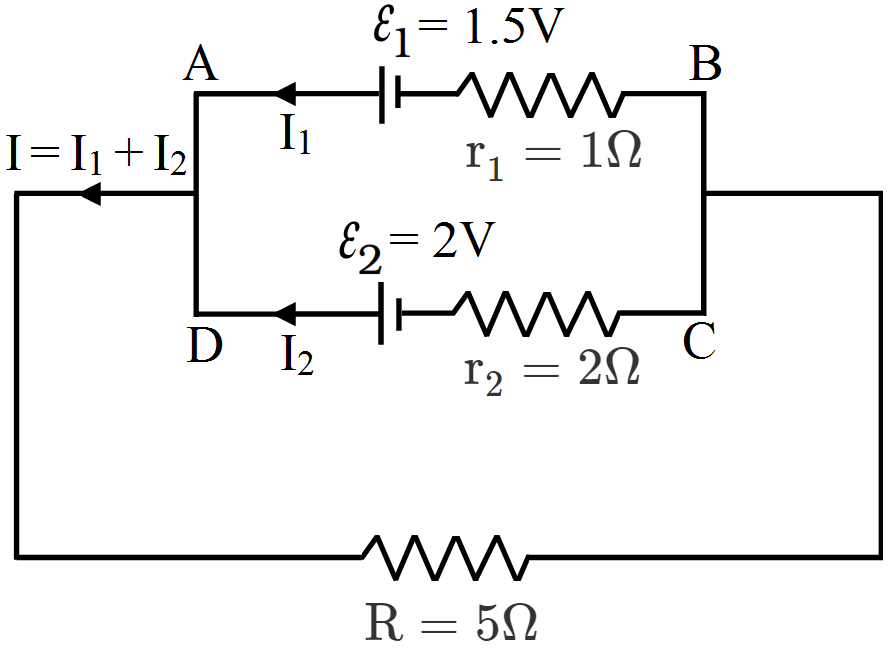
Two cells of emf 1.5V and 2V and internal resistance $1\Omega$ and $2\Omega$ respectively are connected in parallel to pass a current in the same direction through an external resistance of $5\Omega.$
  1. Draw the circuit diagram.
  2. Using Kirchhoff’s laws, calculate the current through each branch of the circuit and potential difference across $5\Omega$ resistor.
An unsymmetrical double convex thin lens forms the image of a point object on its axis. Will the position of the image change if the lens is reversed?
An LC circuit contains a 20mH inductor and a 50μF capacitor with an initial charge of 10mC. The resistance of the circuit is negligible.
Let the instant the circuit is closed be t = 0.
  1. What is the total energy stored initially? Is it conserved during LC oscillations?
  2. What is the natural frequency of the circuit?
  3. At what time is the energy stored
  1. completely electrical (i.e., stored in the capacitor)?
  2. completely magnetic (i.e., stored in the inductor)?
  1. At what times is the total energy shared equally between the inductor and the capacitor?
  2. If a resistor is inserted in the circuit, how much energy is eventually dissipated as heat?