Question
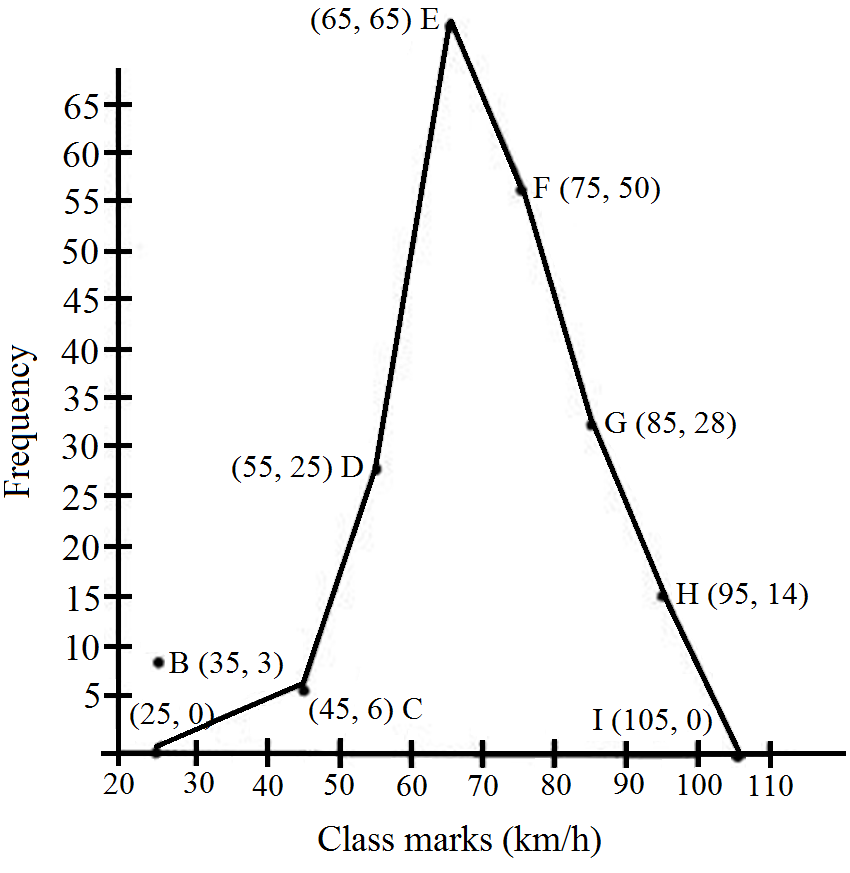
Draw the frequency polygon representing the above data without drawing the histogram.

Answer

We have to draw a frequency polygon without a histogram. Firstly,
 we find the class marks of the classes given that is $30-40, 40-50, 50-60, 60-70 .... $
The class mark $=\frac{(30+40)}{2}$
$\Rightarrow\frac{70}{2}=35$ Similarly, we can determine the class marks of the other classes.
So, table for class marks is shown below:
Class interval (km/ h)
Class marks
Frequency
$30-40$
$40-50$
$50-60$
$60-70$
$70-80$
$80-90$
$90-100$
$35$
$45$
$55$
$65$
$75$
$85$
$95$
$3$
$6$
$25$
$65$
$50$
$28$
$14$
We can draw a frequency polygon by plotting the class marks along the horizontal axis and the frequency along the vertical axis.
Now, plotting all the points $B(35, 3), C(45, 6), D(55, 25), E(65, 65), F(75, 50), G(85, 28), H(95,14)$, also plot the point corresponding to the considering classes $20-30$ and $100-110$ each with frequency 0. Join all these point line segments.

Need a full question paper?

Generate a complete, print-ready paper with questions like this in minutes — across 16+ boards, with answer keys.
Start Generating Free

Similar questions

If each of the two lines is perpendicular to the same line, what kind of lines are they to each other?
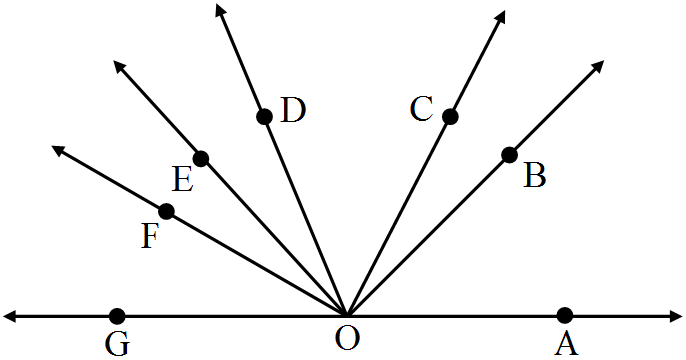
In figure, $\angle\text{AOF}$ and $\angle\text{FOG}$ from a linear pair. If $\angle\text{EOB}=\angle\text{FOC}=90^\circ$ and $\angle\text{DOC}=\angle\text{FOG}=\angle\text{AOB}=30^\circ.$

$i.$ Find the measure of $\angle\text{FOE},\angle\text{COB}$ and $\angle\text{DOE}.$
$ii.$ Name all the right angles.
$iii.$ Name three pairs of adjacent complementary angles.
$iv.$ Name three pairs of adjacent supplementary angles.
$v.$ Name three pairs of adjacent angles
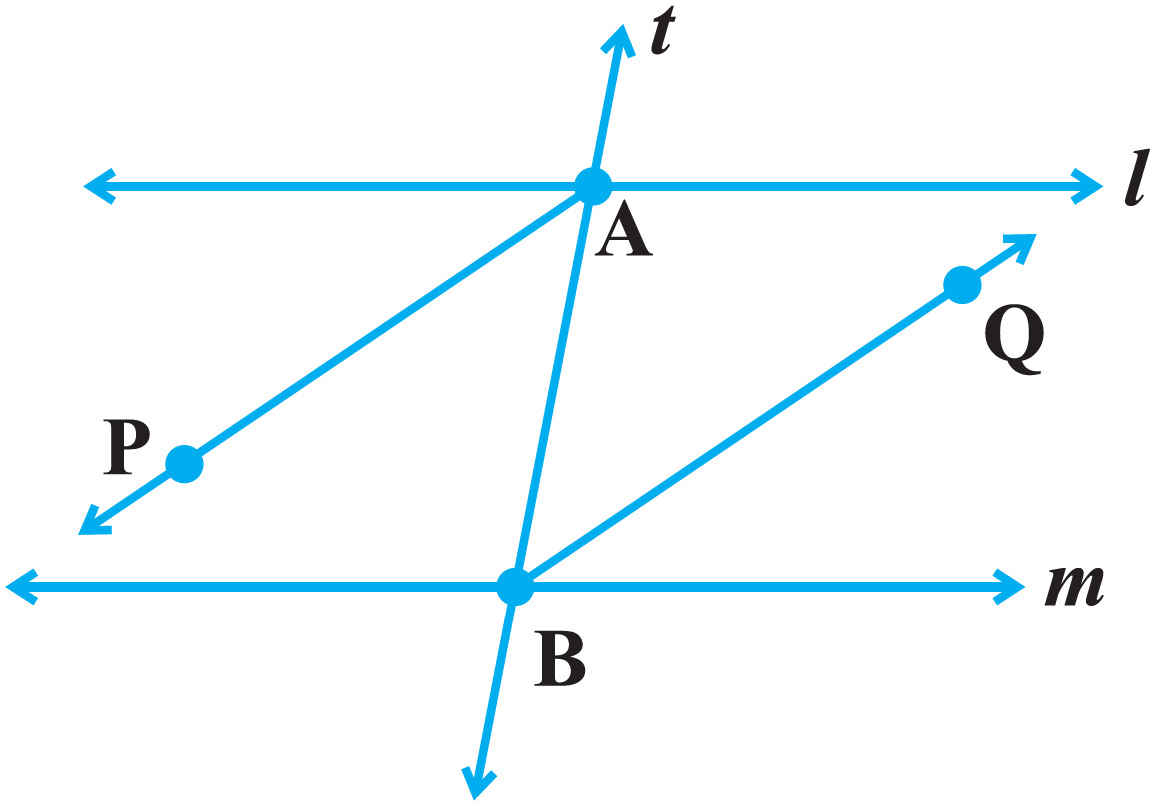
$AP$ and $BQ$ are the bisectors of the two alternate interior angles formed by the intersection of a transversal t with parallel lines l and m (Fig.). Show that $\text{AP}||\text{BQ}.$
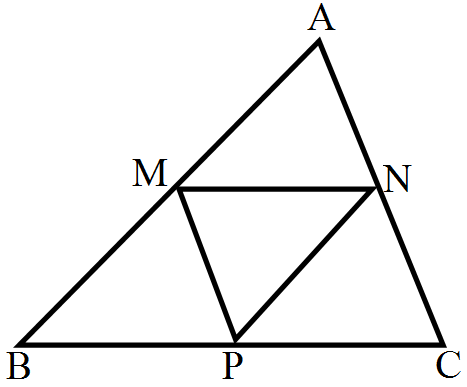
In figure, $M, N$ and $P$ are mid-points of $AB, AC$ and $BC$ respectively. If $MN = 3v\ cm, NP = 3.5\ cm$ and $MP = 2.5cm,$ calculate $BC, AB$ and $AC.$
In a cricket match, a batsman hits a boundary $6$ times out of $30$ balls he plays. Find the probability that a ball played:
$1.$ He hit boundary
$2.$ He does not hit a boundary.
Find the length of a chord which is at a distance of $5\ cm$ from the centre of a circle of radius $10\ cm.$
In a triangle, P, Q and R are the mid points of sides BC, CA and AB respectively. If AC = 21cm, BC = 29cm and AB = 30cm, find the perimeter of the quadrilateral ARPQ.
Circles are described on the sides of a triangle as diameters. Proved that the circle on any two sides intersect each other on the third side (or third side produced).
The following table gives the route length (in thousand kilometres) of the Indian Railways in some of the years:
Year $1960-61$ $1970-71$ $1980-81$ $1990-91$ $2000-2001$
Route lenght (in thousand Km) $56$ $60$ $61$ $74$ $98$
Represent the above data with the help of a bar graph.
In the adjoining figure, ABCD is a square and $\triangle\text{EDC}$ is an equilateral triangle. Prove that:
  1. AE = BE,
  2. $\angle\text{DAE}=15^{\circ}.$