Question
Draw the graph for the equation given below:$\frac{1}{2} x+\frac{2}{3} y=5$

Answer

To draw the graph of $\frac{x}{2}+\frac{2 y}{3}=5$ follows the steps:
First, prepare a table as below:
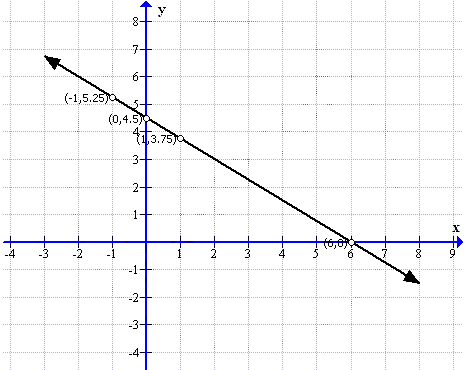
$X$ $-1$ $0$ $1$
$Y$ $5.25$ $4.5$ $3.75$
Now sketch the graph as shown:

From the graph it can verify that the line intersect the $x-$axis at $(10,0)$ and $y$ at $(0,7.5).$

Need a full question paper?

Generate a complete, print-ready paper with questions like this in minutes — across 16+ boards, with answer keys.
Start Generating Free

Similar questions

Draw the graph for the equation, given below : $x - 5y + 4 = 0$
Calculate the area of quadrilateral $\text{ABCD},$ in which $\angle \text{ABD} = 90^\circ,$ triangle $\text{BCD}$ is an equilateral triangle of side $24 \ cm$ and $AD = 26 \ cm.$
Prove that:
$\left(\frac{x^a}{x^b}\right)^{(a+b-c)} \cdot\left(\frac{x^b}{x^c}\right)^{(b+c-a)} \cdot\left(\frac{x^c}{x^a}\right)^{c+a-b}=1$.
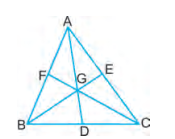
If the medians of a $\triangle A B C$ intersect at $G$, show that :
$
\operatorname{ar}(\triangle AGB)=\operatorname{ar}(\triangle AGC)=\operatorname{ar}(\Delta BGC)=\frac{1}{3} \operatorname{ar}(\Delta ABC)
$
Image
$\text{ABCD}$ is a parallelogram. $E$ is the mid$-$point of $C D$ and $P$ is a point on $A C$ such that $P C=\frac{1}{4} A C$. $E P$ produced meets $B C$ at $F$. Prove that: $F$ is the mid$-$point of $B C$.
The length of a rectangular field is thrice of its width. If the perimeter of this field is $1.6\ km$, find its area in $sq.m.$
The base of a rectangular container is a square of side $12 \ cm$. This container holds water up to $2 \ cm$ from the top. When a cube is placed in the water and is completely submerged, the water rises to the top and $224 \ cm^3$ of water overflows. Find the volume and surface area of the cube.
On a map drawn to a scale of $1: 2,50,000,$ a triangular plot of land has the following measurements:$AB = 3\ cm, BC = 4\ cm, \angle ABC = 90^\circ.$ Calculate$:(i)$ The actual length of $AB$ in $km.(ii)$ The area of Plot in $sq. \ km.$
Calculate the amount and the compound interest on ₹ 64000 for 3 years at $7 \frac{1}{2} \%$ per annum compounded annually.
If $\left(x+\frac{1}{x}\right)=3$, find the value of $\left(x^3+\frac{1}{x^3}\right)$.