Question
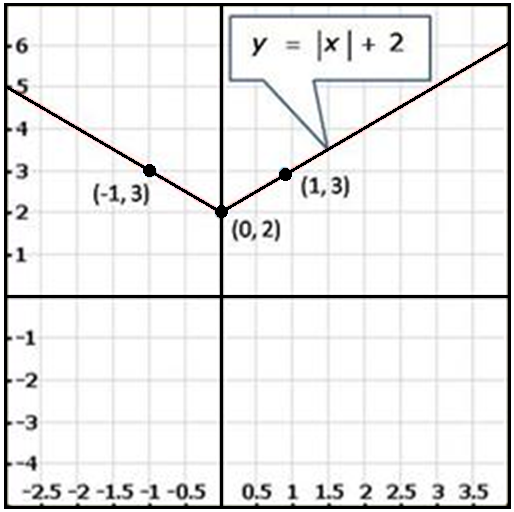
Draw the graph of $y = |x| + 2$.

Answer

We have, $y = |x| + 2 ...(i)$
Putting $x = 0$,
we get $y = 2$ Putting $x = 1$,
we get $y = 3$ Putting $x = -1$,
we get $y = 3$
Thus, we have the following table for the points on graph of $|x| + 2$:
$x$
$0$
$1$
$-1$
$y$
$2$
$3$
$3$
The graph of the equation $y = |x| + 2$:

Need a full question paper?

Generate a complete, print-ready paper with questions like this in minutes — across 16+ boards, with answer keys.
Start Generating Free

Similar questions

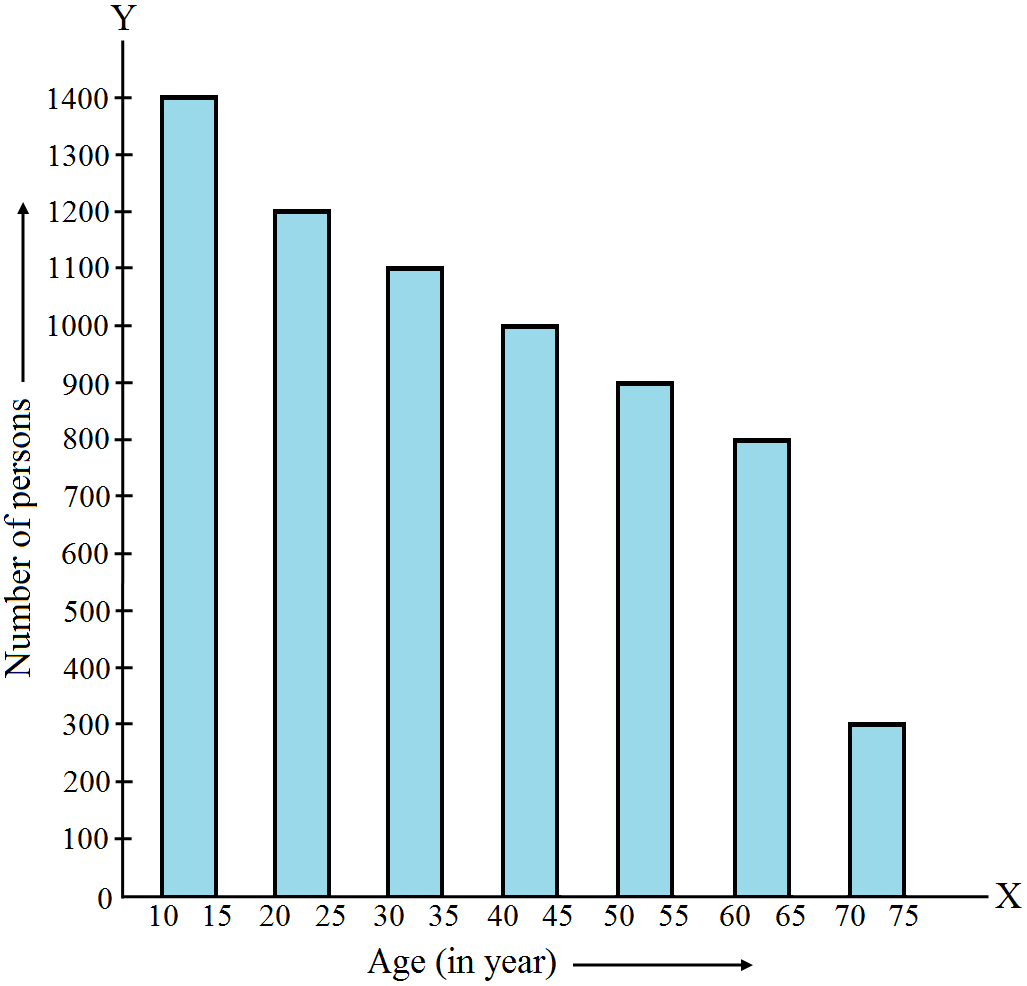
Study the bar graph representing the number of persons in various age groups in a town shown in figure Observe the bar graph and answer the following questions:
$i.$ What is the percentage of the youngest age$-$group persons over those in the oldest age group $?$
$ii.$ What is the total population of the town $?$
$iii.$ What is the number of persons in the age-group $60–65?$
$iv.$ How many persons are more in the age-group $10–15$ than in the age group $30–35?$
$v.$ What is the age$-$group of exactly $1200$ persons living in the town $?$
$vi.$ What is the total number of persons living in the town in the age$-$group $50–55?$
$vii.$ What is the total number of persons living in the town in the age$-$groups $10 – 15$ and $60 – 65?$

$viii.$ Whether the population in general increases, decreases or remains constant with the increase in the age$-$group.
The average weekly payment to $75$ workers in a factory is $Rs.\ 5680$. The mean weekly payment to $25$ of them is $Rs.\ 5400$ and that of $30$ others is $Rs.\ 5700$. Find the mean weekly payment of the remainning workers.
The lengths of the diagonals of a rhombus are 24cm and 18cm respectively. Find the length of each side of the rhombus.
In a parallelogram $ABCD, AB = 10cm$ and $AD = 6cm.$ The bisector of $\angle\text{A}$meets $DC$ in $E. AE$ and $BC$ produced meet at $F.$ Find the length of $CF.$
A cuboidal water tank is $6m$ long, $5m $wide and $4.5m$ deep. How many liters of water can it hold?
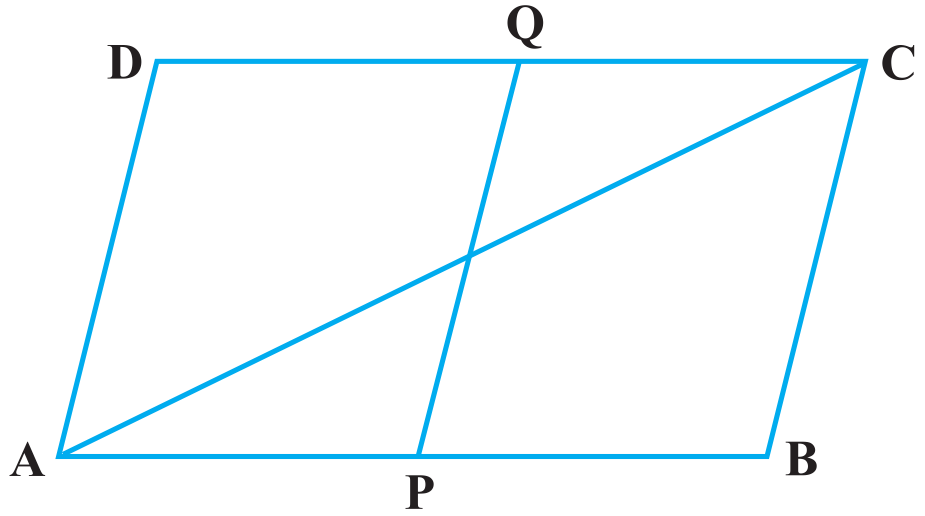
Points $P$ and $Q$ have been taken on opposite sides $AB$ and $CD,$ respectively of a parallelogram $ABCD$ such that$ AP = CQ$ Show that $AC$ and $PQ$ bisect each other.
Draw the graph of the equations given below. Also, find the coordinates of the points where the graph cuts the coordinate axes: $2x + y = 6$
If $\text{x}-\frac{1}{\text{x}}=5,$ find the value of $\text{x}^3-\frac{1}{\text{x}^3}.$
A diagonal of a parallelogram bisects one of its angles. Show that it is a rhombus.