Question
Draw the graph showing the variation of alternating current with frequency in a L-C-R series resonant circuit and derive the expression for band width.

Answer

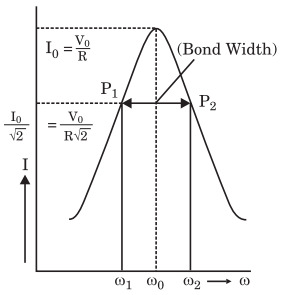
Variation of current with frequency (an-gular frequency) in a series L-C-R resonant cir-cuit is shown in adjoining figure.
It is clear that for frequencies greater than or less than $\omega_0$, the values of current are less than the maximum value (I), where $\omega_0$ is resonant angular frequency.
Expression for Band Width : In series LCR resonant circuit at resonant angular frequency $\omega_0=1 / \sqrt{ LC }$ the amplitude of current is maximum. The quickness with which the current falls from its resonant value $\left( V _{ o } /\right.$R) with change in applied frequency is known as sharpness of resonance.
"It is measured by the ratio of resonant frequency $\omega_0$ to the diffe-rence of two frequencies $\omega_1$ and $\omega_2$ at which the current falls to $1 / \sqrt{2}$ of the resonant value.
Image
∴ Sharpness of resonance $=\frac{\omega_0}{\omega_2-\omega_1}$ Here $\omega_1$ and $\omega_2$ known as half power frequencies, because at these frequencies the power in the circuit reduces to half of its maximum value. The difference of half power frequencies ($\omega_1$ - $\omega_2$) is known as 'band width'. The smaller is the band width, the sharper is the resonance.
Expression for Band Width : The value of impedance of series LCR circuit at resonant frequency is Z, therefore at $\omega_1$ and $\omega_2$ it will be $\sqrt{2} R$ because at these frequencies current falls to $1 / \sqrt{2}$ of the resonant value.
$\therefore Z=\sqrt{2} R \Rightarrow \sqrt{R^2+\left(\omega L-\frac{1}{\omega C}\right)^2}=\sqrt{2} \cdot R$
On squaring both sides,
$R ^2+\left(\omega L -\frac{1}{\omega C }\right)^2=2 R ^2$
or $\left(\omega L -\frac{1}{\omega C }\right)^2= R ^2$
or $\left(\omega L -\frac{1}{\omega C }\right)= \pm R$
Thus, if $\omega_2$ > $\omega_1$ then it may be concluded that
$\omega_1 L-\frac{1}{\omega_1 C}=-R$ ...(1)
and $\omega_2 L-\frac{1}{\omega_2 C}=+R$ ...(2)
On adding equations (1) and (2) get
$\left(\omega_1-\omega_2\right) L-\frac{1}{C}\left(\frac{\omega_1-\omega_2}{\omega_1 \omega_2}\right)=0$
$\Rightarrow \quad \omega_2 \omega_1=\frac{1}{ LC }$ ...(3)
On subtracting eq. (1) from (2), we get
$\left(\omega_2-\omega_1\right) L+\frac{1}{C}\left(\frac{\omega_2-\omega_1}{\omega_1 \omega_2}\right)=2 R$
or $\left(\omega_2-\omega_1\right)\left[L+\frac{1}{C \omega_1 \omega_2}\right]=2 R$ ...(4)
On substituting the value of $\omega_1 \omega_2$ from equation (3) in equation (4),
$\left(\omega_2-\omega_1\right)\left[ L +\frac{1}{ C \times \frac{1}{ LC }}\right]=2 R$
$\Rightarrow \quad\left(\omega_2-\omega_1\right)= R / L$
i.e., Band width $=( R / L )$

Need a full question paper?

Generate a complete, print-ready paper with questions like this in minutes — across 16+ boards, with answer keys.
Start Generating Free

Similar questions

A regular polygon of n sides is formed by bending a wire of total length $27\pi\text{r}$ which carries a current i.
  1. Find the magnetic field B at the centre of the polygon.
  2. By letting $\text{n}\rightarrow\infty,$ deduce the expression for the magnetic field at the centre of a circular current.
Consider the fission of $^{238}_{92}\text{U}$ by fast neutrons. In one fission event, no neutrons are emitted and the final end products, after the beta decay of the primary fragments, are  $^{140}_{58}\text{Ce}$ and   $^{99}_{44}\text{Ru}.$ Calculate $Q$ for this fission process.
The relevant atomic and particle masses are:
$\text{m}(^{238}_{92}\text{U})=238.05079\text{ u}$
$\text{m}(^{140}_{58}\text{Ce})=139.90543\text{ u}$
$\text{m}(^{99}_{44}\text{Ru})=98.90594\text{ u}$
A regular polygon of n sides is formed by bending a wire of total length $27\pi\text{r}$ which carries a current i.
  1. Find the magnetic field B at the centre of the polygon.
  2. By letting $\text{n}\rightarrow\infty,$ deduce the expression for the magnetic field at the centre of a circular current.
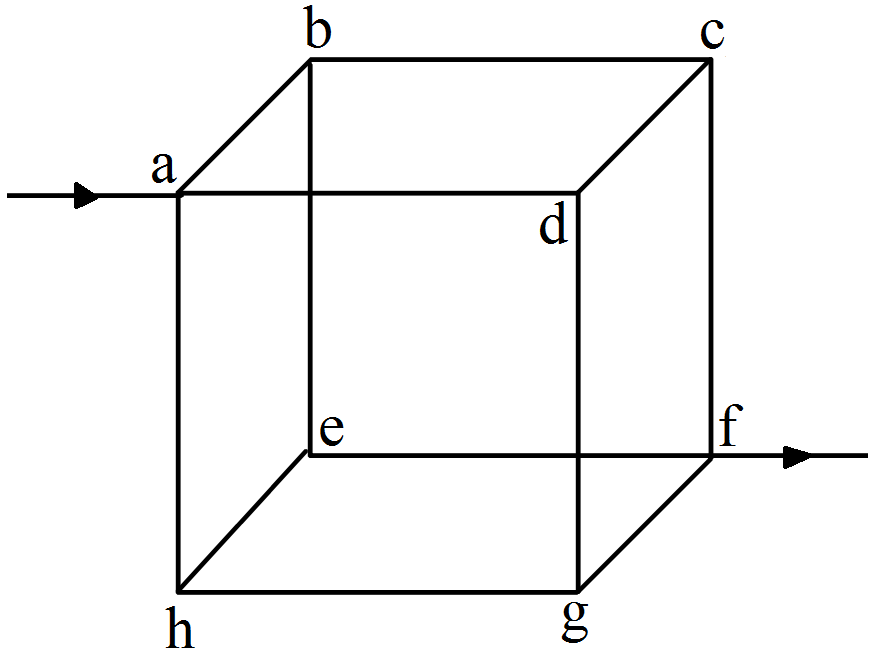
Twelve wires, each of equal resistance r, are joined to form a cube, as shown in the figure. Find the equivalent resistance between the diagonally opposite points a and f.
Suppose the second charge in the previous problem is $-1.0 \times 10^{-6}C.$ Locate the position where a third charge will not experience a net force.
In fig., the circuit symbol of a logic gate and two input waveforms A and B are shown:
  1. Name the logic gate.
  2. Write its truth table.
  3. Give the output waveform.
$\text{ }^{212}_{33}\text{Bi}$ can disintegrate either by emitting an $\alpha$-particle of by emitting a $\beta^-$-particle.
  1. Write the two equations showing the products of the decays.
  2. The probabilities of disintegration $\alpha$ and $\beta$ -decays are in the ratio $\frac{7}{13}.$ The overall half-life of $^{212}Bi$ is one hour. If $1g$ of pure $^{212}Bi$ is taken at $12.00$ noon, what will be the composition of this sample at $1\ P.m.$ the same day$?$
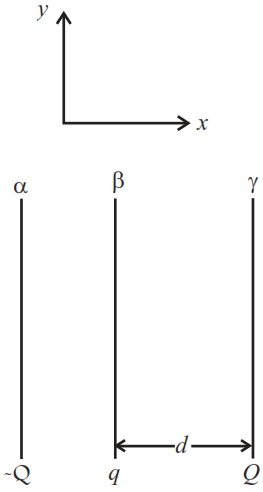
Two fixed, identical conducting plates $(\alpha\ \&\ \beta)$, each of surface area S are charged to -Q and q, respectively, where Q > q > 0. A third identical plate $(\gamma)$, free to move is located on the other side of the plate with charge q at a distance d (Fig.). The third plate is released and collides with the plate $\beta$. Assume the collision is elastic and the time of collision is sufficient to redistribute charge amongst $\beta\ \&\ \gamma$.

Find the electric field acting on the plate $\gamma$ before collision.
A student is studying a book placed near the edge of a circular table of radius $R$. A point source of light is suspended directly above the centre of the table. What should be the height of the source above the table so as to produce maximum illuminance at the position of the book?
The count rate of nuclear radiation coming from a radiation coming from a radioactive sample containing $^{128}I$ varies with time as follows.
Time $t($minute$)$ : $0$ $25$ $50$ $75$ $100$
Ctount rate $R(10^9s^{-1})$ : $30$ $16$ $8.0$ $3.8$ $2.0$
  1. Plot In $\Big(\frac{\text{R}_0}{\text{R}}\Big)$ against $t$.
  2. From the slope of the best straight line through the points, find the decay constant $\lambda.$
  3. Calculate the half$-$life $\text{t}_{\frac{1}{2}}.$