Question
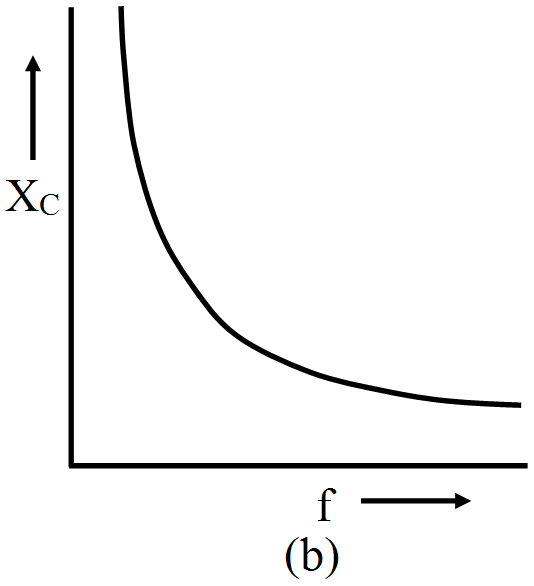
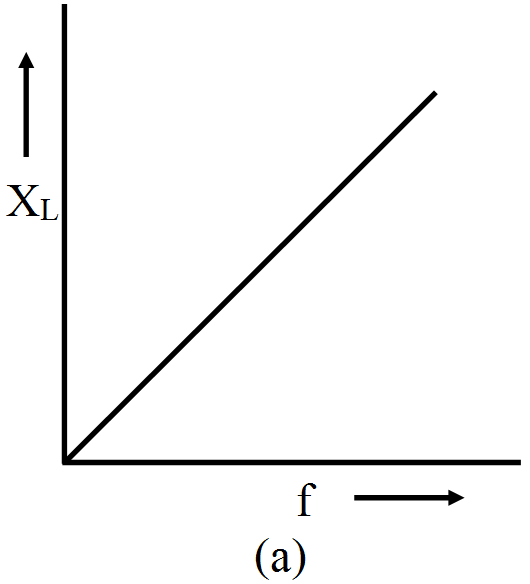
Draw the graphs showing variation of inductive reactance and capacitive reactance with frequency of applied a.c. source.

Answer

  1. $\text{X}_{\text{L}}=\text{w}_{\text{L}}=2\pi\text{vL};$ graph XL of f and f is a straight line.

  2. $\text{X}_{\text{C}}=\frac{1}{\omega\text{C}}=\frac{1}{2\pi\text{vC}},$ graph of XC and f is a rectangular hyperbola as shown in figs.
​​​​​​​

​​​​​​​

Need a full question paper?

Generate a complete, print-ready paper with questions like this in minutes — across 16+ boards, with answer keys.

Start Generating Free

Similar questions

If the bar magnet in Q. 58 is turned around by 180°, where will the new null points be located?
A spherical surface of radius 30cm separates two transparent media A and B with refractive indices 1.33 and 1.48 respectively. The medium A is on the convex side of the surface. Where should a point object be placed in medium A so that the paraxial rays become parallel after refraction at the surface?
A spherical shell is heated. The volume change according to the equation $\text{V}_\theta=\text{V}_\theta(1+\gamma\theta)$. Does the volume refer to the volume enclosed by the shell or the volume of the material making up the shell?
An ac input signal of frequency 60Hz is rectified by a (i) half wave (ii) full wave rectifier. Draw the output waveform and write the output frequency in each case.
A non-ideal battery is connected to a resistor. Is work done by the battery equal to the thermal energy developed in the resistor? Will your answer change if the battery is ideal?
What is the focal length of a convex lens of focal length 30 cm in contact with a concave lens of focal length 20 cm? Is the system a converging or a diverging lens? Ignore thickness of the lenses.
In a Young's double slit experiment $\lambda=500\text{nm},$ d = 1.0mm and D = 1.0m. Find the minimum distance from the central maximum for which the intensity is half of the maximum intensity.
Answer the following question:
Quarks inside protons and neutrons are thought to carry fractional charges [(+2/3)e ; (–1/3)e]. Why do they not show up in Millikan’s oil-drop experiment?
  1. The mass of a nucleus in its ground state is always less than the total mass of its constituents - neutrons and protons. Explain.
  2. Plot a graph showing the variation of potential energy of a pair of nucleons as a function of their separation.
The torque of the weight of any body about any vertical axis is zero. Is it always correct?