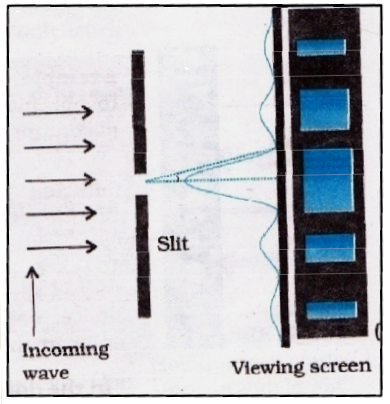
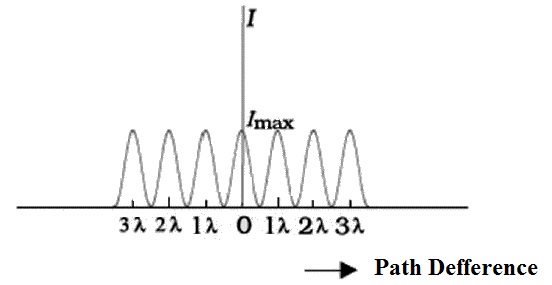
Draw the intensity pattern for single slit diffraction and double slit interference. Hence, state two differences between interference and diffraction patterns.
CBSE OUTSIDE DELHI - SET 3 2017
Download our app for free and get startedPlay store
Interference Diffraction
All maxima have equal intensity. Maxima have different (/rapidly decreasing) intensity.
All fringes have equal width. Different (/changing) width.
Superposition of two wavefronts. Superposition of wavelets from the same wavefront.
art

Download our app
and get started for free

Experience the future of education. Simply download our apps or reach out to us for more information. Let's shape the future of learning together!No signup needed.*

Similar Questions

  • 1
    Light of wavelength 560nm goes through a pinhole of diameter 0.20mm and falls on a wall at a distance of 2.00m. What will be the radius of the central bright spot formed on the wall?
    View Solution
  • 2
    The speed of the yellow light in a certain liquid is $2.4 \times 10^8 \mathrm{~m} / \mathrm{s}$. Find the refractive index of the liquid.
    View Solution
  • 3
    An equilateral glass prism has a refractive index 1.6 in air. Calculate the angle of minimum deviation of the prism, when kept in a medium of refractive index $\frac{4\sqrt2}{5}.$
    View Solution
  • 4
    (a) When monochromatic light is incident on a surface separating two media, the reflected and refracted light both have the same frequency as the incident frequency. Explain why?
    (b) When light travels from a rarer to a denser medium, the speed decreases. Does the reduction in speed imply a reduction in the energy carried by the light wave?
    (c) In the wave picture of light, intensity of light is determined by the square of the amplitude of the wave. What determines the intensity of light in the photon picture of light.
    View Solution
  • 5
    No interference pattern is detected when two coherent sources are infinitely close to each other. Why?
    View Solution
  • 6
    If we put a cardboard (say 20cm × 20cm) between a light source and our eyes, we can't see the light. But when we put the same cardboard between a sound source and our ear, we hear the sound almost clearly. Explain.
    View Solution
  • 7
    A parallel beam of light of 500 nm falls on a narrow slit and the resulting diffraction pattern is observed on a screen 1 m away. It is observed that the first minimum is at a distance of 2.5 mm from the centre of the screen. Calculate the width of the slit.
    View Solution
  • 8
    In a Young's double slit experiment $\lambda=500\text{nm},$ d = 1.0mm and D = 1.0m. Find the minimum distance from the central maximum for which the intensity is half of the maximum intensity.
    View Solution
  • 9
    State one feature by which the phenomenon of interference can be distinguished from that of diffraction.
    A parallel beam of light of wavelength 600 nm is incident normally on a slit of width ‘a’. If the distance between the slit and the screen is 0.8 m and the distance of 2nd order maximum from the centre of the screen is 15 mm, calculate the width of the slit.
    View Solution
  • 10
    A parallel beam of monochromatic light falls normally on a single narrow slit. How does the angular width of the principal maximum in the resulting diffraction pattern depend on the width of the slit?
    View Solution