Question
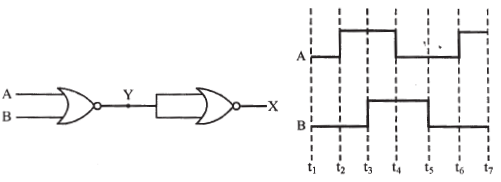
Draw the output waveform at X, using the given inputs A and B for the logic circuit shown below. Also, identify the logic operation performed by this circuit.
Answer

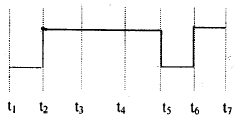
Drawing correct output waveform.

OR gate.

Need a full question paper?

Generate a complete, print-ready paper with questions like this in minutes — across 16+ boards, with answer keys.
Start Generating Free

Similar questions

A proton and a deuteron have the same velocity; what is the ratio of their de Broglie wavelengths?
Why are cells combined ? Also, how can the combination of cells be done?
Light of frequency $7.21 \times 10^{14} Hz$ is incident on a metal surface. Electrons with a maximum speed of $6.0 \times 10^5 m / s$ are ejected from the surface. What is the threshold frequency for photoemission of electrons?
\[\begin{array}{l}\left(h=6.625 \times 10^{-34} Js,\right. \\e=1.6 \times 10^{-19} C \\\left.m=9.1 \times 10^{-31} kg\right)\end{array}\]
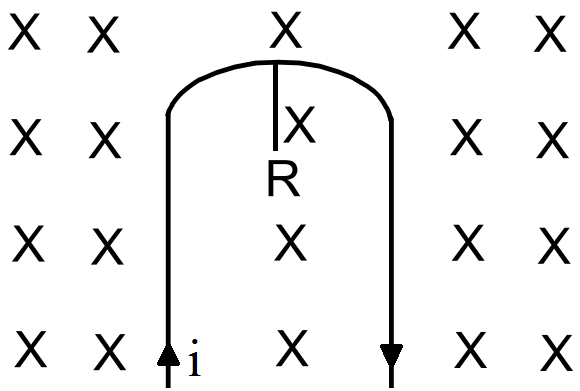
A rigid wire consists of a semi-circular portion of radius R and two straight sections The wire is partially immersed in a perpendicular magnetic field B, as shown in the figure. Find the magnetic force on the wire if it carries a current i.

A charge Q is placed at the centre of a cube. Find the flux of the electric field through the six surfaces of the cube.
Write the history of magnet in brief.
Show that the slope of p-V diagram is greater for an adiabatic process as compared to an isothermal process.
The radius of a spherical conductor shell is $R$ and the charge on it is $Q$. Compare the potential at a distance 2 R from the centre of the sphere with the potential at a distance $R / 2$.
A metallic rod of 'L' length is rotated with angular frequency of '$\omega$' with one end hinged at the centre and the other end at the circumference of a circular metallic ring of radius L, about an axis passing through the centre and perpendicular to the plane of the ring. A constant and uniform magnetic field B parallel to the axis is present everywhere. Deduce the expression for the emf between the centre and the metallic ring.
In a head-on collision between two particles, is it necessary that the particles will acquire a common velocity at least for one instant?