Question
Draw
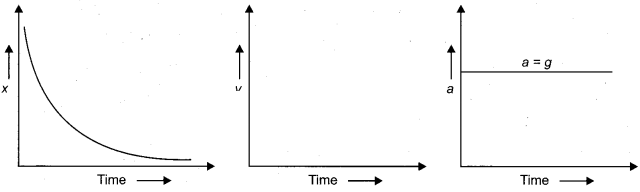
(a) acceleration – time
(b) velocity – time
(c) Position – time graphs representing motion of an object under free fall. Neglect air resistance.

Answer

The object falls with uniform acceleration equal to ‘g’Image

Need a full question paper?

Generate a complete, print-ready paper with questions like this in minutes — across 16+ boards, with answer keys.

Start Generating Free

Similar questions

A mass of ideal gas at pressure P is expanded isothermally to four times the original volume and then slowly compressed adiabatically to its original volume. Assuming γ(= CP/CV) to be 1.5, find the new pressure of the gas.
A body of mass 0.3 kg is taken up an inclined plane to length 10 m and height 5 m and then allowed to slide down to the bottom again. The coefficient of friction between the body and the plane is 0.15. What is the
(i) work done by the gravitational force over the round trip?
(ii) work done by the applied force over the upward journey?
(iii) work done by frictional force over the round trip?
(iv) kinetic energy of the body at the end of the trip?
How is the answer to (iv) related to the first three answers?
A perfect gas goes from state A to state B by absorbing $8 \times 10^5 J$ of heat and doing $6.5 \times 10^5 J$ of external work. It is now transferred between the same two states in another process in which it absorbs 10s J of heat. In second process. Find the work done in the second process.
A meter stick is balanced on a knife edge at its center. When two coins, each of mass 5 g are put one on top of the other at the 12.0 cm mark, the stick is found to be balanced at 45.0 cm, what is the mass of the meter stick?
Calculate the force required to move a train of 2000 quintal up on an incline plane of 1 in 50 with an acceleration of $2 ms ^{-2}$. The force of friction per quintal is $0.5 N$.
The angular speed of a motor wheel is increased from $1200$ rpm to $3120v rpm in $16$ seconds,
  1. What is its angular acceleration (assume the acceleration to be uniform)
  2. How many revolutions does the wheel make during this time ?
A truck of mass 1000 kg accelerates uniformly from rest to a velocity of 15 ms-1 in 5 seconds. Calculate
(i) its acceleration,
(ii) its gain in K.E.,
(iii) average power of the engine during this period, neglect friction.
Two particles mass $100 g$ and $300 g$ at a given time have velocities $10 \hat{j}-7 \hat{j}-3 \hat{j}$ and $7 \hat{i}-9 \hat{j}+$ $6 \hat{k} ms ^{-1}$ respectively. Determine velocity of center of mass.
A child stands at the center of turn table with his two arms out stretched. The turn table is set rotating with an angular speed of 40 rpm. How much is the angular speed of the child if he folds his hands back and thereby reduces his moment of inertia to 2/3 times the initial value?
  1. Assume that the turn table rotates without friction
  2. Show that the child’s new kinetic energy of rotation is more than the initial kinetic energy of rotation.

How do you account for this increase in kinetic energy ?
Three blocks of masses $ml =10 kg, m ^2=20 kg$ are connected by strings on smooth horizontal surface and pulled by a force of 60 N . Find the acceleration of the system and frictions in the string.
Image