MCQ
Dry ice is
  • A
    Ice cube
  • B
    Sodium chloride
  • C
    Liquid nitrogen
  • Solid carbon dioxide

Answer

Correct option: D.
Solid carbon dioxide
d
(d) We know that when solid carbondioxide is heated, it becomes vapour directly without passing through its liquid phase.

Therefore it is called dry ice.
 

Need a full question paper?

Generate a complete, print-ready paper with questions like this in minutes — across 16+ boards, with answer keys.
Start Generating Free

Similar questions

Intensity of $X-$ rays depends upon the number of
The material suitable for making a solar cell is
A body weighs $250\,N$ on the surface of the earth. ....... $N$ will it weigh half way down to the centre of the earth .
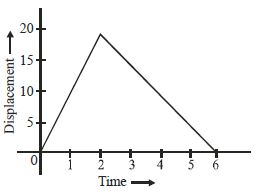
For the displacement-time graph shown in figure, the ratio of the magnitudes of the (constant) speeds during the first two seconds and the next four seconds is
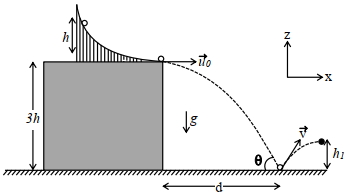
A slide with a frictionless curved surface, which becomes horizontal at its lower end,, is fixed on the terrace of a building of height $3 h$ from the ground, as shown in the figure. A spherical ball of mass $\mathrm{m}$ is released on the slide from rest at a height $h$ from the top of the terrace. The ball leaves the slide with a velocity $\vec{u}_0=u_0 \hat{x}$ and falls on the ground at a distance $d$ from the building making an angle $\theta$ with the horizontal. It bounces off with a velocity $\overrightarrow{\mathrm{v}}$ and reaches a maximum height $h_l$. The acceleration due to gravity is $g$ and the coefficient of restitution of the ground is $1 / \sqrt{3}$. Which of the following statement($s$) is(are) correct?

($AV$) $\vec{u}_0=\sqrt{2 g h} \hat{x}$ ($B$) $\vec{v}=\sqrt{2 g h}(\hat{x}-\hat{z})$  ($C$) $\theta=60^{\circ}$  ($D$) $d / h_1=2 \sqrt{3}$

A charged particle $q$ is shot towards another charged particle $Q$ which is fixed, with a speed $v$. It approaches $Q$ upto a closest distance $r$ and then returns. If $q$ were given a speed $2v$, the closest distances of approach would be
A uniform solid cylinder with radius $R$ and length L has moment of inertia $I_1$, about the axis of cylinder. A concentric solid cylinder of radius $R^{\prime}=\frac{R}{2}$ and length $L^{\prime}=\frac{L}{2}$ is caned out of the original cylinder. If $I_2$ is the moment of inertia of the carved out portion ot the cylinder then $\frac{I_1}{I_2}=..........$ (Both $I_1$ and $I_2$ are about the axis of the cylinder)
A drilling machine of $10\,KW$ power is used to drill a bore in a small aluminium block of mass $8\,kg.$ If $50\%$ of power is used up in heating the machine itself or lost to the surroundings then  ........ $^oC$  is the rise in temperature of the block in $2.5\,minutes$

[specific heat of aluminium $= 0.91\,J/g\,\,^oc$ ]
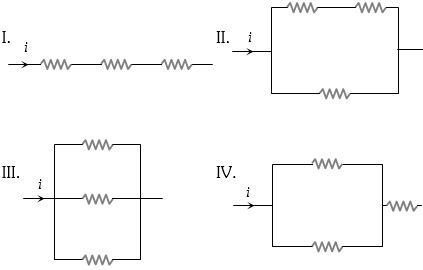
The three resistance of equal value are arranged in the different combinations shown below. Arrange them in increasing order of power dissipation.
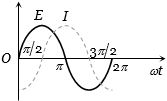
The variation of the instantaneous current $(I)$ and the instantaneous emf $(E)$ in a circuit is as shown in fig. Which of the following statements is correct