MCQ
Due to covalent bonding, the transitional metals are
  • A
    Lustrous
  • B
    Conductor
  • Hard and brittle
  • D
    Ductile

Answer

Correct option: C.
Hard and brittle
c
It’s Obvious.
 

Need a full question paper?

Generate a complete, print-ready paper with questions like this in minutes — across 16+ boards, with answer keys.
Start Generating Free

Similar questions

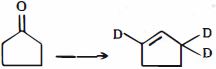
Arrange the following reagent in the correct order in which above transformation is  carried out
The maximum number of lone pairs of electrons on the central atom from the following species is $........$. $ClO _3^{-}, XeF _4, SF _4$ and $I _3^{-}$
Amylopectin is a polymer of
Choose the incorrect trend in the atomic radii (r) of the elements :
For the following reaction

$2 X + Y \xrightarrow{i} P$

the rate of reaction is $\frac{ d [ P ]}{ dt }=k[ X ]$. Two moles of $X$ are mixed with one mole of $Y$ to make $1.0 L$ of solution. At $50 s , 0.5$ mole of $Y$ is left in the reaction mixture. The correct statement(s) about the reaction is(are)

(Use: $\ln 2=0.693$ )

$(A)$ The rate constant, $k$, of the reaction is $13.86 \times 10^{-4} s ^{-1}$.

$(B)$ Half-life of $X$ is $50 s$.

$(C)$ At $50 s ,-\frac{ d [ X ]}{ dt }=13.86 \times 10^{-3} mol L ^{-1} s ^{-1}$.

$(D)$ At $100 s ,-\frac{ d [ Y ]}{ dt }=3.46 \times 10^{-3} mol L ^{-1} s ^{-1}$.

When Phenol is heated with phthalic anhydride in concentrated sulphuric acid and the hot reaction mixture is poured into a dilute solution of sodium hydroxide, the product formed is
Examine the following resonating structures of formic acid for their individual  stability and then answer the question given below.

Which of the following arrangements gives the correct order of decreasing stability of the above-mentioned resonance contributors?

Compound $\mathrm{A}, \mathrm{C}_{8} \mathrm{H}_{10} \mathrm{O},$ is found to react with $\mathrm{NaOI}$ (produced by reacting $Y$ with $NaOH$) and yields a yellow precipitate with characteristic smell.

$\mathrm{A}$ and $\mathrm{Y}$ are respectively

Homologue of $CH_3-Cl$ is
The maximum probability of finding an electron in the ${d_{xy}}$ orbital is