MCQ
Due to the earth's magnetic field, charged cosmic ray particles
  • A
    Can never reach the equator
  • B
    Require less kinetic energy to reach the equator than the poles
  • Require greater kinetic energy to reach the equator than the poles
  • D
    Can never reach the poles

Answer

Correct option: C.
Require greater kinetic energy to reach the equator than the poles
c
The earth's magnetic field is strongest at the poles hence cosmic rays of charges particles are deflected away from the equator. In order to reach the equator, they need to posses greater Kinetic Energy

Need a full question paper?

Generate a complete, print-ready paper with questions like this in minutes — across 16+ boards, with answer keys.

Start Generating Free

Similar questions

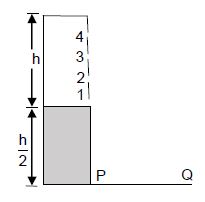
A cylinder of height $h$ is filled with water and is kept on a block of height $h / 2$ . The level of water in the cylinder is kept constant. Four holes numbered $1, 2, 3$ and $4$ are at the side of the cylinder and at heights $0,\ h / 4,\ h / 2$ and $3h / 4$ respectively. When all four holes are opened together, the hole from which water will reach farthest distance on the plane $PQ$ is the hole number
In a $YDSE$ experiment if $a$ slab whose refractive index can be varied is placed in front of one of the slits then the variation of resultant intensity at mid-point of screen with $‘\mu ’$ will be best represented by $(\mu \geq 1)$.[Assume slits of equal width and there is no absorption by slab]
A particle is moving in a circle with uniform speed $v$. In moving from a point to another diametrically opposite point
A proton (mass $m$ and charge $+e$) and an $\alpha  -$ particle (mass $4m$ and charge $+2e$) are projected with the same kinetic energy at right angles to the uniform magnetic field. Which one of the following statements will be true
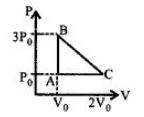
One mole of an ideal monoatomic gas is taken along the path $ABCA$  as shown in the $PV$ diagram. The maximum temperature attained by the gas along the path $BC$  is given by
In photoelectric effect if the intensity of light is doubled then maximum kinetic energy of photoelectrons will become
Flint glass prism is joined by a crown glass prism to produce dispersion without deviation. The refractive indices of these for mean rays are $1.602$ and $1.500$ respectively. Angle of prism of flint prism is $10^o $, then the angle of prism for crown prism will be
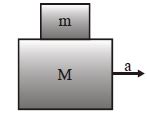
A block of mass $m$ is placed on the top of another block of mass $M$ as shown in the figure. The coefficient of friction between them is $\mu $. What is the maximum acceleration with which the block $M$ may move so that m also moves along with it ?
A short bar magnet with its north pole facing north forms a neutral point at $P$ in the horizontal plane. If the magnet is rotated by $90^o$ in the horizontal plane, the net magnetic induction at $P$ is (Horizontal component of earth’s magnetic field = ${B_H}$)
In damped oscillations, damping force is directly proportional to speed of oscillator. If amplitude becomes half of its maximum value in $1 \,s$, then after $2 \,s$ amplitude will be $\left(A_0-\right.$ initial amplitude)