MCQ
During a negative beta decay
  • A
    An atomic electron is ejected
  • B
    An electron which is already present within the nucleus is ejected
  • A neutron in the nucleus decays emitting an electron
  • D
    A part of the binding energy is converted into electron

Answer

Correct option: C.
A neutron in the nucleus decays emitting an electron
 A neutron in the nucleus decays emitting an electron

Need a full question paper?

Generate a complete, print-ready paper with questions like this in minutes — across 16+ boards, with answer keys.
Start Generating Free

Similar questions

Electrons moving with different speeds enter a uniform magnetic field in a direction perpendicular to the field. They will move along circular paths.
The electron mobility in $N-$type germanium is $3900 cm^{2}/v-s$ and its conductivity is $6.24 mho/cm$, then impurity concentration will be if the effect of cotters is negligible
A capacitor is charged to $200\, volt$ it has $0.1$ coulomb charge. When it is discharged, energy will be.....$J$
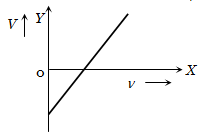
The stopping potential V for photoelectric emission from a metal surface is plotted along Y-axis and frequency n of incident light along X-axis. A straight line is obtained as shown. Planck's constant is given by
Threshold frequency for a metal is ${10^{15}}Hz$. Light of $\lambda = 4000{Å}$ falls on its surface. Which of the following statements is correct
The effective capacitances of two capacitors are $3\,\mu F$ and $16\,\mu F$, when they are connected in series and parallel respectively. The capacitance of two capacitors are
A moving coil galvanometer is based on the:
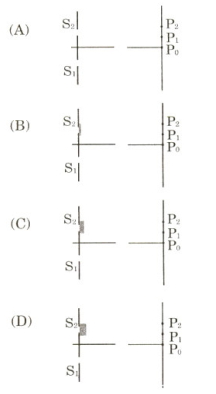
Column $I$ shows four situations of standard Young's double slit arrangement with the screen placed far away from the slits $S_1$ and $S_2$. In each of these cases $\mathrm{S}_1 \mathrm{P}_0=\mathrm{S}_2 \mathrm{P}_0, \mathrm{~S}_1 \mathrm{P}_1-\mathrm{S}_2 \mathrm{P}_1=\lambda / 4$ and $\mathrm{S}_1 \mathrm{P}_2-\mathrm{S}_2 \mathrm{P}_2=\lambda / 3$, where $\lambda$ is the wavelength of the light used. In the cases $\mathrm{B}, \mathrm{C}$ and $\mathrm{D}$, a transparent sheet of refractive index $\mu$ and thickness $t$ is pasted on slit $\mathrm{S}_2$. The thicknesses of the sheets are different in different cases. The phase difference between the light waves reaching a point $\mathrm{P}$ on the screen from the two slits is denoted by $\delta(\mathrm{P})$ and the intensity by $I(\mathrm{P})$. Match each situation given in Column $I$ with the statement$(s)$ in Column $II$ valid for that situation.

Column $I$ Column $II$
$(A)$ $Image$ $(p)$ $\delta\left(\mathrm{P}_0\right)=0$
$(B)$ $(\mu-1) t=\lambda / 4$ $Image$ $(q)$ $\delta\left(\mathrm{P}_1\right)=0$

$(C)$ $(\mu-1) t=\lambda / 2$ $Image$

$(r)$ $I\left(\mathrm{P}_1\right)=0$
$(D)$ $(\mu-1) t=3 \lambda / 4$ $Image$ $(s)$ $\left(\mathrm{P}_0\right)>I\left(\mathrm{P}_1\right)$
  $(t)$ $I\left(\mathrm{P}_2\right)>I\left(\mathrm{P}_1\right)$

What is shape of magnet in moving coil galvanometer to make the radial magnetic field
A coil of area $80 cm^2$ and number of turns $50$ is rotating about an axis perpendicular to a magnetic field of $0.05$ Tesla at $2000$ rotations per minute. The maximum value of emf induced in it will be.