Question
During a negative beta decay:
  1. An atomic electron is ejected.
  2. An electron which is already present within the nucleus is ejected.
  3. A neutron in the nucleus decays emitting an electron.
  4. A proton in the nucleus decays emitting an electron.

Answer

  1. A neutron in the nucleus decays emitting an electron.

Explanation:

Negative beta decay is given as

$\text{n}\rightarrow\text{p + e}^-+\bar{\text{v}}$

Neutron decays to produce proton, electron and anti-neutrino.

Need a full question paper?

Generate a complete, print-ready paper with questions like this in minutes — across 16+ boards, with answer keys.

Start Generating Free

Similar questions

A planet of mass m moves in an ellipse around the sun of mass   so that its maximum and minimum distances are  and   respectively. The angular momentum of the planet relative to the centre of the sun is

(a)  

(b)

(c)

(d)

Two similar spheres having +q  and -q charge are kept at a certain distance. F force acts between the two. If in the middle of two spheres, another similar sphere having +q charge is kept, then it experience a force in magnitude and direction as

(a) Zero having no direction

(b) 8F towards +q  charge

(c) 8F towards -q  charge

(d) 4F towards +q  charge

The energy required to excite an electron from the ground state of hydrogen atom to the first excited state, is

(a) 1.602  

(b) 1.619  

(c) 1.632  

(d) 1.656  

Due to the earth's magnetic field, charged cosmic ray particles

(a) Require greater kinetic energy to reach the equator than the poles

(b) Require less kinetic energy to reach the equator than the poles

(c) Can never reach the equator

(d) Can never reach the poles

Two waves of same amplitude and same wavelength are superimposed in different phases. The amplitude of the resultant wave will be maximum when the phase difference between them is:
Photons absorbed in matter are converted to heat. A source emitting n photon/sec of frequency ν is used to convert 1kg of ice at 0°C to water at 0°C. Then, the time T taken for the conversion:

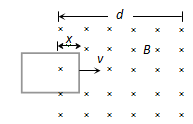
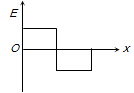
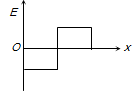
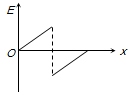
A rectangular loop is being pulled at a constant speed v, through a region of certain thickness d, in which a uniform magnetic field B is set up. The graph between position x of the right hand edge of the loop and the induced emf E will be

(a)

(b)

(c)

(d)

In a wave, the path difference corresponding to a phase difference of f is

(a)  

(b)

(c)

(d)

A person sees his virtual image by holding a mirror very close to the face. When he moves the mirror away from his face, the image becomes inverted. What type of mirror he is using

(a) Plane mirror

(b) Convex mirror

(c) Concave mirror

(d) None of these

The electric field in a region is directed outward and is proportional to the distance r from the origin. Taking the electric potential at the origin to be zero,
  1. It is uniform in the region.
  2. It is proportional to r.
  3. It is proportional to r2.
  4. It increases as one goes away from the origin.