MCQ
During a nuclear fission reaction:
  • A
    A heavy nucleus breaks into two fragments by itself a light nucleus bombarded by thermal neutrons breaks up.
  • B
    A light nucleus bombarded by thermal neutrons breaks up.
  • A heavy nucleus bombarded by thermal neutrons breaks up.
  • D
    Two light nuclei combine to give a heavier nucleus and possible other products.
Answer

Correct option: C.
A heavy nucleus bombarded by thermal neutrons breaks up.
In a nuclear reactor, a large fissile atomic nucleus like uranium-235 absorbs a thermal neutron and undergoes a nuclear fission reaction. The heavy nucleus splits into two or more lighter nuclei releasing gamma radiation and free neutrons.

Need a full question paper?

Generate a complete, print-ready paper with questions like this in minutes — across 16+ boards, with answer keys.

Start Generating Free

Similar questions

The amplitude of a damped oscillator decreases to $0.9$ times its original magnitude in $5\ s$. In another $10\ s$ it will decrease to $\alpha $ times its original magnitude, where  $\alpha $ equals
An alpha particle enters a hollow tube of $4 \,m$ length with an initial speed of $1 \,km/s$. It is accelerated in the tube and comes out of it with a speed of $9 km/s$. The time for which it remains inside the tube is
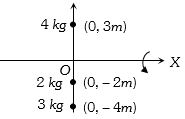
Three particles are situated on a light and rigid rod along $Y$axis as shown in the figure. If the system is rotating with an angular velocity of $2\,rad/\sec $about $X$axis, then the total kinetic energy of the system is ...... $J$
Given below are two statements :

Statement$-I:$ Acceleration due to gravity is different at different places on the surface of earth.

Statement$-II:$ Acceleration due to gravity increases as we go down below the earth's surface.

In the light of the above statements, choose the correct answer from the options given below

Let r be the distance of a point on the axis of a bar magnet from its centre. The magnetic field at such a point is proportional to:
In an elastic collision between disks $A$ and $B$ of equal mass but unequal radii, $A$ moves along the $x$ -axis and $B$ is stationary before impact. Which of the following is possible after impact?
If $r$ represents the radius of the orbit of a satellite of mass $m$ moving around a planet of mass $ M$, the velocity of the satellite is given by
On a temperature scale $X$. The boiling point of water is $65^{\circ} X$ and the freezing point is $-15^{\circ} X$. Assume that the $X$ scale is linear. The equivalent temperature corresponding to $-95^{\circ} X$ on the Farenheit scale would be $..........^{\circ} F$
A free ${}^{238}U$ nucleus kept in a train emits an alpha particle. When the train is stationary, a nucleus decays and a passenger measures that the separation between the alpha particle and the recoiling nucleus becomes $x$ at time $t$ after the decay. If the decay takes place while the train is moving at a uniform velocity $v,$ the distance between the alpha particle and the recoiling nucleus at a time $t$ after the decay as measured by the passenger is:
A hemisphere of radius $R$ and of mass $4m$ is free to slide with its base on a smooth horizontal table. A particle of mass $m$ is placed on the top of the hemisphere. The angular velocity of the particle relative to hemisphere at an angular displacement $\theta $ when velocity of hemisphere $v$ is