MCQ
During depression of freezing point in a solution the following are in equilibrium
  • Liquid solvent, solid solvent
  • B
    Liquid solvent, solid solute
  • C
    Liquid solute, solid solute
  • D
    Liquid solute solid solvent

Answer

Correct option: A.
Liquid solvent, solid solvent
a
During the depression of freezing point in a solution, liquid solvent and solid solvent are in equilibrium. During freezing of a solution, only the solvent freezes out and the equilibrium exists between solid and liquid forms of the solvent. Vapour pressure of the solid and liquid forms must be the same at freezing point, because otherwise, the system would not be at equilibrium, the lowering of the vapour pressure leads to the lowering of temperature at which the vapour pressures of the liquid and frozen forms of the solution will be equal.

Need a full question paper?

Generate a complete, print-ready paper with questions like this in minutes — across 16+ boards, with answer keys.

Start Generating Free

Similar questions

Kolbe-Schmidt reaction is used for
The total no. of chelate rings in $[Ni(dmg)_2]$ are
If the specific conductance of $1\,M\,\, H_2SO_4$ solution is $26 \times {10^{ - 2}}\,S\,c{m^{ - 1}}$, then the equivalent conductivity would be
Optical and geometrical isomerism exhibited by

$(a)$ $[Co(en)_2Cl_2]Br$ 

$(b)$ $[Pt(NH_3)_2Cl_2Br_2]$

$(c)$ $[Co(en)_3]Cl_3$

$(d)$ $[Pt(NH_3)_4Cl_2]$

$(e)$ $[Pt(NH_3)_2Cl_2]$

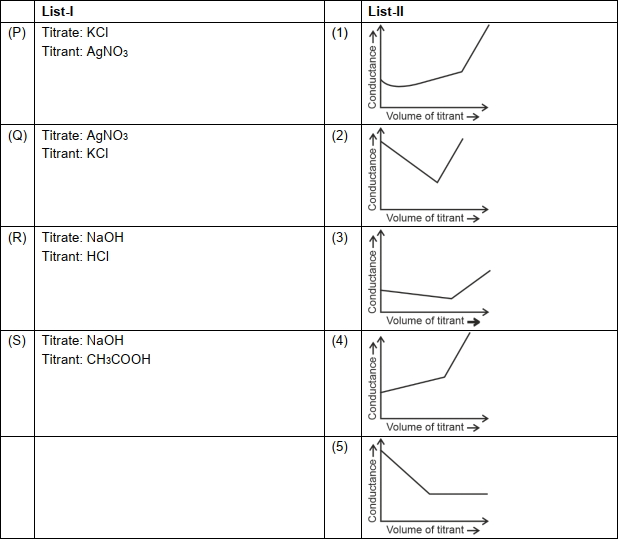
In a conductometric titration, small volume of titrant of higher concentration is added stepwise to a larger volume of titrate of much lower concentration, and the conductance is measured after each addition.

The limiting ionic conductivity ( $\Lambda 0$ ) values (in $mS m ^2 mol ^{-1}$ ) for different ions in aqueous solutions are given below:

Ions $Ag ^{+}$ $K ^{+}$ $Na ^{+}$ $H ^{+}$ $NO _3^{-}$ $CI ^{-}$ $SO _4^{2-}$ $OH ^{-}$ $CH_3COO ^{-}$
$\Lambda_0$ $6.2$ $7.4$ $5.0$ $35.0$ $7.2$ $7.6$ $16.0$ $19.9$ $4.1$

For different combinations of titrates and titrants given in $List-l$, the graphs of 'conductance' versus 'volume of titrant' are given in $List-II$.

Match each entry in $List-I$ with the appropriate entry in $List-II$ and choose the correct option.
Which metal has the highest melting point in the first transition series?
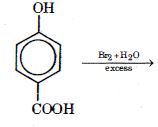
What is Product
$\begin{align}
  & C{{H}_{3}}-C\equiv CH\xrightarrow[dil.\,{{H}_{2}}S{{O}_{4}}]{HgS{{O}_{4}}}(A) \\ 
 & C{{H}_{3}}-C\equiv CH\xrightarrow[(2)\,{{H}_{2}}{{O}_{2}}/H{{O}^{-}}]{(1)\,B{{H}_{3}}.THF}(B) \\ 
\end{align}$

Product $(A)$ and $(B)$ is differentiated by

What is the molality of an aqueous solution,whose relative lowering of vapour pressure is 0.1
The compound obtained by heating salicylic acid with phenol in the presence of phosphorus oxychloride is