MCQ
During the conversion of peroxide ion to superoxide ion electron is removed from
- A${\pi _{2py}}$
- B$\sigma _{2pz}^*$
- ✓$\pi _{2py}^*$
- D${\sigma _{2pz}}$
$\mathrm{O}_{2}^{-2} : \sigma_{1 \mathrm{s}}^{2} \sigma_{1 \mathrm{s}}^{2} \sigma_{2 \mathrm{s}}^{2} \sigma_{2 \mathrm{s}}^{2} \pi_{2} \mathrm{p}_{\mathrm{x}}^{2} \pi_{2} \mathrm{p}_{\mathrm{y}}^{2} \sigma_{2} \mathrm{p}_{2}^{2} \pi_{2}^{*} \mathrm{p}_{\mathrm{x}}^{2} \pi_{2}^{*} \mathrm{p}_{\mathrm{y}}^{2}$
Generate a complete, print-ready paper with questions like this in minutes — across 16+ boards, with answer keys.
$A. \;n =3, l=2, m _{1}=1, m _{ s }=+1 / 2$
$B.\; n =4, l=1, m _{1}=0, m _{ s }=+1 / 2$
$C. \;n =4, l=2, m _{1}=-2, m _{ s }=-1 / 2$
$D. \;n =3, l=1, m _{1}=-1, m _{ s }=+1 / 2$
The correct order of increasing energy is
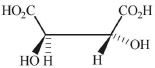
$I$ || $II$ || $III$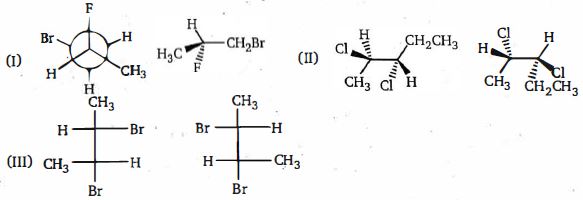
$(1)$ $\begin{array}{*{20}{c}}
{C{H_3}CH = C - C{H_3}} \\
{\,\,\,\,\,\,\,\,\,\,|} \\
{\,\,\,\,\,\,\,\,\,\,\,\,\,\,\,\,C{H_3}}
\end{array}$
$(2)$ $C{H_3}CH = CHC{H_3}$
$(3)$ $\mathop {C{H_3}C}\limits^{\begin{subarray}{l}
\,\,\,\,\,\,\,\,{\begin{array}{*{20}{c}}
{}&H
\end{array}} \\
\,\,\,\,\,\,\,\,\,\,\,\,\,\,|
\end{subarray} } = CHC{H_2}C{H_3}$
$(4)$ $\begin{array}{*{20}{c}}
{C{H_3}C = C - C{H_3}} \\
{\,\,\,\,\,\,\,|\,\,\,\,\,\,\,\,\,\,\,\,|\,\,\,\,\,\,\,\,\,\,\,\,\,} \\
{\,\,\,\,\,\,\,\,\,\,\,\,\,C{H_{3\,\,}}\,\,C{H_3}\,\,\,\,\,\,\,\,\,\,\,\,\,\,\,\,}
\end{array}$