MCQ
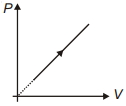
During the thermodynamic process shown in figure for an ideal gas
  • A
    $\Delta T=0$
  • B
    $\Delta Q=0$
  • C
    $W < 0$
  • $\Delta U > 0$

Answer

Correct option: D.
$\Delta U > 0$
d
(d)

For a straight $P-V$ graph line $P \propto V$

If pressure increases, volume increases then $T$ also increases $[P V \propto T]$

So $\Delta T \neq 0$

Volume increasing so work is positive, $W > 0$

and temperature also increasing so $\Delta Q > 0$

$\because \Delta Q=\Delta U+\Delta W$

So $\Delta U > 0$
Need a full question paper?

Generate a complete, print-ready paper with questions like this in minutes — across 16+ boards, with answer keys.
Start Generating Free

Similar questions

A bomb explodes at time $t=0$ in a uniform, isotropic medium of density $\rho$ and releases energy $E$, generating a spherical blast wave. The radius $R$ of this blast wave varies with time $t$ as
A string vibrates according to the equation $y = 5\sin \,\left( {\frac{{2\pi x}}{3}} \right)\,\,\cos \,20\,\pi t$, where $x$ and $y$ are in $cm$ and $t$ in sec. The distance between two adjacent nodes is .... $cm$
Two wires of equal lengths are made of the same material. Wire $A$ has a diameter that is twice as that of wire $B$. If identical weights are suspended from the ends of these wires, the increase in length is
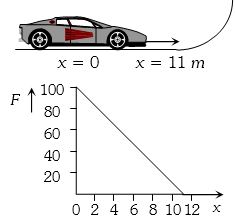
A toy car of mass $5 \,kg$ moves up a ramp under the influence of force  $ F$  plotted against displacement $x$. The maximum height attained is given by
In absence of torque the rotational frequency of a body changes from $1$ cy/sec to $16$ cy/sec, then ratio of radius of gyration in two cases will be :
The potential energy of a certain spring when stretched through a distance $S$ is $10 \,joule$. The amount of work (in $joule$) that must be done on this spring to stretch it through an additional distance $S$ will be
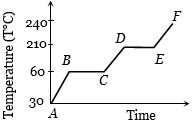
A solid substance is at $30°C$. To this substance heat energy is supplied at a constant rate. Then temperature versus time graph is as shown in the figure. The substance is in liquid state for the portion (of the graph)
Starting from rest a body slides down a $45^o$ inclined plane in twice the time it takes to slide down the same distance in the absence of friction. The co-efficient of friction between the body and the inclined plane is 
A body of mass $40 \,gm$ is moving with a constant velocity of $2\, cm/sec$ on a horizontal frictionless table. The force on the table is  ....... $dyne$
The ratio of the accelerations for a solid sphere (mass $m$ and radius $R$) rolling down an incline of angle $\theta$ without slipping and slipping down the incline without rolling is