MCQ
E = mc2
- A$\text{E} = \frac{\text{m}}{\text{c}^2}$
- BM = Ec2
- CAll of the expressions are accurate.
- Dc = Em2
Explanation:
Before Sir Einstien, mass and energy were two completely different physical quantities, which were not related to each other anyway.
Sir Einstein told that energy and mass are related to each other i.e. energy and mass can be converted into each other by the following relation:
E=mc2, called Sir Einstein's mass-energy equivalence.
Generate a complete, print-ready paper with questions like this in minutes — across 16+ boards, with answer keys.
Our eye is most sensitive for which of the following wavelength
|
(a) 4500 Å |
|
(b) 5500 Å |
|
(c) 6500 Å |
|
(d) Equally sensitive for all wave lengths of visible spectrum |
The shortest wavelength of X-rays emitted from an X-ray tube depends on the
|
(a) Current in the tube |
(b) Voltage applied to the tube |
|
(c) Nature of gas in the tube |
(d) Atomic number of target material |
The angle of polarisation for any medium is 60o, what will be critical angle for this
(a)  
|
(b) 
|
(c) |
(d) |
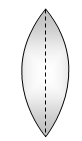
A convex lens has a focal length f. It is cut into two parts along the dotted line as shown in the figure. The focal length of each part will be
|
(a) |
(b) f |
(c) |
(d) 2f |
The rate of disintegration of fixed quantity of a radioactive element can be increased by
|
(a) Increasing the temperature |
(b) Increasing the pressure |
|
(c) Chemical reaction |
(d) It is not possible |
Two charged spheres of radii 10 cm and 15 cm are connected by a thin wire. No current will flow, if they have
|
(a) The same charge on each |
(b) The same potential |
|
(c) The same energy |
(d) The same field on their surfaces |


