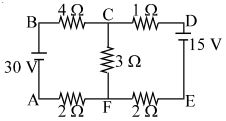
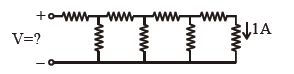
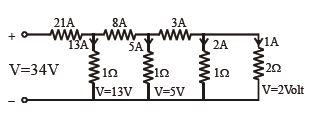
Each element in the finite chain of resistors shown in the figure is $\,1\,\Omega $ . A current of $1\, A$ flows through the final element. Then what is the potential difference $V$ across input terminals of the chain .................. $\mathrm{volt}$
Medium


Download our appand get started for free
Experience the future of education. Simply download our apps or reach out to us for more information. Let's shape the future of learning together!No signup needed.*
Similar Questions
- 1A battery of $e.m.f.$ $10\, V$ and internal resistance $0.5\, ohm$ is connected across a variable resistance $R$. The value of $R$ for which the power delivered in it is maximum is given by ......... $ohm$View Solution
- 2An electric iron draws $5\, amp$, a $TV$ set draws $3\, amp$ and refrigerator draws $2\, amp$ from a $220\, volt$ main line. The three appliances are connected in parallel. If all the three are operating at the same time, the fuse used may be of ............. $amp$View Solution
- 3Two cells, having the same $e.m.f.$ are connected in series through an external resistance $R.$ Cells have internal resistances $r_1$ and $r_2\,\, (r_1 > r_2)$ respectively. When the circuit is closed, the potential difference across the first cell is zero. The value of $R$ isView Solution
- 4The electric current through a wire varies with time as $I=I_0+\beta t$. where $I_0=20 \mathrm{~A}$ and $\beta=3 \mathrm{~A} / \mathrm{s}$. The amount of electric charge crossed through a section of the wire in $20 \mathrm{~s}$ is :View Solution
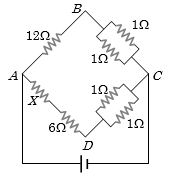
- 5For what value of unknown resistance $X$, the potential difference between $B$ and $D$ will be zero in the circuit shown in the figure ............... $\Omega$View Solution
- 6Resistance of $100\, cm$ long potentiometer wire is $10 \,\Omega$, it is connected to a battery ($2\, volt$) and a resistance $R$ in series. A source of $10\, mV$ gives null point at $40\, cm$ length, then external resistance $R$ is ........... $\Omega $View Solution
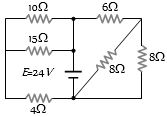
- 7Find the equivalent resistance across the terminals of source of $e.m.f$. $24\, V$ for the circuit shown in figure .............. $\Omega$View Solution
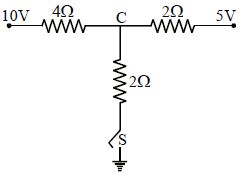
- 8As the switch $S$ is closed in the circuit shown in figure, current passed through it is .............View Solution
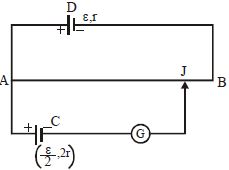
- 9In the figure, the potentiometer wire $AB$ of length $L$ and resistance $9r$ is joined to the cell $D$ of $emf$ $\varepsilon $ and internal resistance $r$. The cell $C's$ $emf$ is $\frac{\varepsilon }{2}$and its internal resistance is $2r$. The galvanometer $G$ will show no deflection when the length $AJ$ isView Solution
- 10The figure shows a network of five resistances and two batteries The current through the $15\,V$ battery is .............. $A$View Solution