MCQ
$EAN$ of complex $[Fe(C_2O_4)_3]^{3-}$ is
  • $27$
  • B
    $24$
  • C
    $35$
  • D
    $29$

Answer

Correct option: A.
$27$
a
$(a)$ $\begin{align}
   MN{{(CO)}_{5}}+\overline{e}\to {{[Mn{{(CO)}_{5}}]}^{-}} \\ 
 less\,stable\,\,\,\,\,\,\,\,\,\,\,\,\,\,\,\,more\,stable,as\,EAN\,of\,Mn=36(Kr) \\ 
  \,\,\,\,(O.A.) \\ 
\end{align}$

Need a full question paper?

Generate a complete, print-ready paper with questions like this in minutes — across 16+ boards, with answer keys.

Start Generating Free

Similar questions

A sample of phosphorus trichloride $(PC{l_3})$ contains $1.4$ moles of the substance. How many atoms are there in the sample
Which of the following reaction gives diastereomers
$0.01$ mole of iodoform $(CHI_3)$ reacts with $Ag$ to produce a gas whose volume at  $NTP$ is  ............. $\mathrm{mL}$

$2CHI_3 + 6Ag \to 6AgI(s) + C_2H_2(g)$
Identify the which can exhibit tautomerism ?
The solution of a chemical compound reacts with $AgNO_3$ solution to form a white preciptate of $Y$ which dissolves in $NH_4OH$ to give a complex $Z$. When $Z$ is treated with dilute $HNO_3$, $Y$ reappears. The chemical compound $X$ can be:
Which of the following is the buffer solution of strong acidic nature
The standard reduction potential data at $25^{\circ} C$ is given below.

$E ^0\left( Fe ^{3+} . Fe ^{2+}\right)=+0.77 V $

$E ^0\left( Fe ^{2+} . Fe \right)=-0.44 V $

$E ^{\circ}\left( Cu ^{2+} . Cu \right)=+0.34 V $

$E ^0\left( Cu ^{+} . Cu \right)=+0.52 V $

$E ^{\circ}\left( O _2( g )+4 H ^{+}+4 e ^{-} \rightarrow 2 H _2 O \right)=+1.23 V $

$E ^{\circ}\left( O _2( g )+2 H _2 O +4 e ^{-} \rightarrow 4 OH \right)=+0.40 V $

$E ^0\left( Cr ^{3+} . Cr \right)=-0.74 V $

$E ^{\circ}\left( Cr ^{2+} . Cr \right)=-0.91 V$

Match $E ^{\circ}$ of the rebox pair in List $I$ with the values given in List $II$ and select the correct answer using the code given below the lists:

List $I$ List $II$
$P.$ $\quad E ^{\circ}\left( Fe ^{3+}, Fe \right)$ $1.$ $\quad-0.18 V$
$Q.$ $\quad E ^{\circ}\left(4 H _2 O \rightleftharpoons 4 H ^{+}+4 OH ^{-}\right)$ $2.$ $\quad-0.4 V$
$R.$ $\quad E ^{\circ}\left( Cu ^{2+}+ Cu \rightarrow 2 Cu ^{+}\right)$ $3.$ $\quad-0.04 V$
$S.$ $\quad E ^{\circ}\left( Cr ^{3+}, Cr ^{+2}\right)$ $4.$ $\quad-0.83 V$

Codes: $ \quad P \quad Q \quad R \quad S $ 

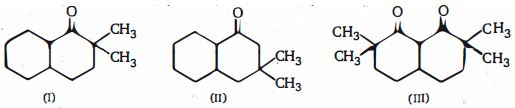
A carbonyl compound ${P}$, which gives positive iodoform test, undergoes reaction with $\mathrm{MeMgBr}$ followed by dehydration to give an olefin ${Q}$. Ozonolysis of ${Q}$ leads to a dicarbonyl compound ${R}$, which undergoes intramolecular aldol reaction to give predominantly ${S}$.

${P} \xrightarrow[\substack{\text { 2. } \mathrm{H}^{+}, \mathrm{H}_2 \mathrm{O} \\ \text { 3. } \mathrm{H}_2 \mathrm{SO}_4, \Delta}]{\text { 1. MeMgBr }}Q \xrightarrow[\text { 2. } \mathrm{Zn}, \mathrm{H}_2 \mathrm{O}]{1 . \mathrm{O}_3} {R} \xrightarrow[\text { 2. } \Delta]{1 . \mathrm{OH}^{-}} {S}$

$1.$ The structure of the carbonyl compound ${P}$ is

$Image$

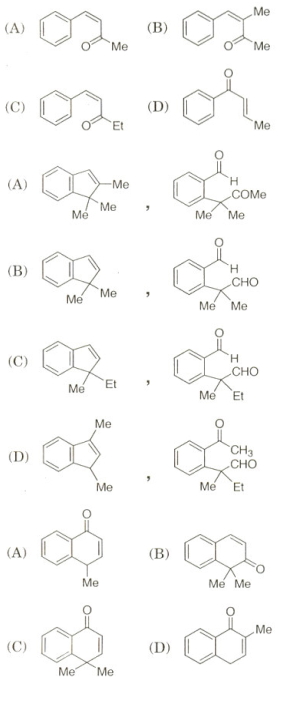
$2.$ The structures of the products ${Q}$ and ${R}$, respectively, are

$Image$

$3.$ The structure of the product ${S}$ is

$Image$

Give hte answer question $1,2$ and $3.$
Heat of reaction at constant volume is measured in the apparatus
$\begin{array}{*{20}{c}}
  {{\mkern 1mu} {\mkern 1mu} {\mkern 1mu} {\mkern 1mu} {\mkern 1mu} {\mkern 1mu} {\mkern 1mu} {\mkern 1mu} {\mkern 1mu} {\mkern 1mu} {\mkern 1mu} \,\,\,\,\,\,\,\,\,\,\,\,{\mkern 1mu} {\mkern 1mu} {\mkern 1mu} O{\mkern 1mu} {\mkern 1mu} {\mkern 1mu} {\mkern 1mu} {\mkern 1mu} {\mkern 1mu} {\mkern 1mu} {\mkern 1mu} {\mkern 1mu} {\mkern 1mu} {\mkern 1mu} {\mkern 1mu} {\mkern 1mu} {\mkern 1mu} {\mkern 1mu} {\mkern 1mu} {\mkern 1mu} {\mkern 1mu} {\mkern 1mu} {\mkern 1mu} \,\,\,\,\,\,\,\,\,\,\,\,\,\,\,\,\,\,\,\,\,\,\,\,\,\,\,\,\,\,\,\,\,\,\,\,\,\,\,\,\,\,\,\,\,\,\,\,\,\,\,\,\,\,\,\,\,\,\,\,\,\,\,\,\,{\mkern 1mu} {\mkern 1mu} {\mkern 1mu} \,\,{\mkern 1mu} {\mkern 1mu} {\mkern 1mu} {\mkern 1mu} {\mkern 1mu} {\mkern 1mu} {\mkern 1mu} {\mkern 1mu} {\mkern 1mu} {\mkern 1mu} {\mkern 1mu} {\mkern 1mu} {\mkern 1mu} {\mkern 1mu} {\mkern 1mu} {\mkern 1mu} {\mkern 1mu} {\mkern 1mu} {\mkern 1mu} {\mkern 1mu} {\mkern 1mu} {\mkern 1mu} {\mkern 1mu} {\mkern 1mu} {\mkern 1mu} {\mkern 1mu} {\mkern 1mu} {\mkern 1mu} {\mkern 1mu} {\mkern 1mu} {\mkern 1mu} {\mkern 1mu} {\mkern 1mu} O{\mkern 1mu} {\mkern 1mu} {\mkern 1mu} {\mkern 1mu} {\mkern 1mu} {\mkern 1mu} {\mkern 1mu} {\mkern 1mu} {\mkern 1mu} {\mkern 1mu} {\mkern 1mu} {\mkern 1mu} {\mkern 1mu} {\mkern 1mu} {\mkern 1mu} {\mkern 1mu} {\mkern 1mu} {\mkern 1mu} {\mkern 1mu} {\mkern 1mu} {\mkern 1mu} {\mkern 1mu} {\mkern 1mu} {\mkern 1mu} {\mkern 1mu} } \\ 
  {{\mkern 1mu} {\mkern 1mu} {\mkern 1mu} \,\,\,\,\,{\mkern 1mu} {\mkern 1mu} {\mkern 1mu} {\mkern 1mu} {\mkern 1mu} ||{\mkern 1mu} {\mkern 1mu} {\mkern 1mu} {\mkern 1mu} {\mkern 1mu} {\mkern 1mu} \,\,\,\,\,\,\,\,\,\,\,\,\,\,\,\,\,\,{\mkern 1mu} {\mkern 1mu} {\mkern 1mu} {\mkern 1mu} {\mkern 1mu} \,\,\,\,\,\,\,\,\,\,\,\,\,\,\,\,\,\,\,\,\,\,\,\,\,\,\,\,\,{\mkern 1mu} {\mkern 1mu} {\mkern 1mu} {\mkern 1mu} {\mkern 1mu} {\mkern 1mu} {\mkern 1mu} {\mkern 1mu} \,\,\,\,\,\,\,\,\,\,\,\,\,\,{\mkern 1mu} {\mkern 1mu} {\mkern 1mu} {\mkern 1mu} {\mkern 1mu} {\mkern 1mu} {\mkern 1mu} {\mkern 1mu} {\mkern 1mu} {\mkern 1mu} {\mkern 1mu} {\mkern 1mu} {\mkern 1mu} {\mkern 1mu} {\mkern 1mu} {\mkern 1mu} {\mkern 1mu} {\mkern 1mu} {\mkern 1mu} {\mkern 1mu} {\mkern 1mu} {\mkern 1mu} \,\,{\mkern 1mu} {\mkern 1mu} {\mkern 1mu} {\mkern 1mu} {\mkern 1mu} {\mkern 1mu} {\mkern 1mu} {\mkern 1mu} {\mkern 1mu} {\mkern 1mu} {\mkern 1mu} {\mkern 1mu} {\mkern 1mu} {\mkern 1mu} {\mkern 1mu} {\mkern 1mu} {\mkern 1mu} {\mkern 1mu} {\mkern 1mu} {\mkern 1mu} {\mkern 1mu} {\mkern 1mu} {\mkern 1mu} {\mkern 1mu} {\mkern 1mu} {\mkern 1mu} {\mkern 1mu} ||} \\ 
  {C{H_3} - C - C{H_2} - C{H_2} - C{H_2} - C{H_2} - C - H} 
\end{array}$ $\xrightarrow{{H{O^ - }/\Delta }}$ $\mathop {(A)}\limits_{(73\% )} $ Product $(A)$ is