MCQ
$EAN$ of complex $[Fe(C_2O_4)_3]^{3-}$ is
- A$27$
- B$24$
- C$35$
- ✓$29$
Generate a complete, print-ready paper with questions like this in minutes — across 16+ boards, with answer keys.
${A_2}(g) + 4{B_2}(g) \rightleftharpoons 2A{B_4}(g)\,;\,\Delta H < 0$
the formation of $AB_4(g)$ will be favoured by
(Image)
Total number of $\pi$ bonds present in product ' $P$ ' is/are
$\mathop {C{H_3} - N{H_2}}\limits_{(P)} \,\,\,\,\,\,\,\,\,\,\,\mathop {Ph - N{H_2}}\limits_{(Q)} $
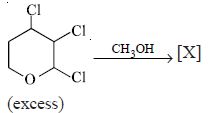
Statement I : $\left[\mathrm{Co}\left(\mathrm{NH}_3\right)_6\right]^{3+}$ is a homoleptic complex whereas $\left[\mathrm{Co}\left(\mathrm{NH}_3\right)_4 \mathrm{Cl}_2\right]^{+}$is a heteroleptic complex.
Statement II : Complex $\left[\mathrm{Co}\left(\mathrm{NH}_3\right)_6\right]^{3+}$ has only one kind of ligands but $\left[\mathrm{Co}\left(\mathrm{NH}_3\right)_4 \mathrm{Cl}_2\right]^{+}$has more than one kind of ligands.
In the light of the above statements, choose the correct answer from the options given below.