Question
Ectomycorrhizae and Endomycorrhizae.

Answer

EctomycorrhizaeEndomycorrhizae
1. Mycelium of ectomycorrhizal fungi form a sheath called mantle on the surface of roots.1. Most of the endomycorrhizal hyphae penetrate in the root cortex.
2. Few hyphae form hartig-net in the intercellular spaces of root cortex.2. Fungal hyphae do not produce hartig-net.
3. Arbuscles and vesicles are not formed. 3. Arbuscles and vesicles are formed.

Need a full question paper?

Generate a complete, print-ready paper with questions like this in minutes — across 16+ boards, with answer keys.

Start Generating Free

Similar questions

Column I (Biofortified crop)Column II (Nutrient Enrichment)
(1) Maize (a) Five times more iron
(2) Rice(b) Twice the amount of lysine and tryptophan
(3) Wheat Atlas-66(c) Enriched in vitamin A and minerals
(4) Carrots, spinach(d) High protein content
Polymerase chain reaction:
  1. Is a method of synthesising human protein from human DNA
  2. Uses restriction enzymes
  3. Can produce billions of copies of a DNA fragment
  4. Takes place naturally in bacteria
Read the following and answer any four questions from (i) to (v) given below:
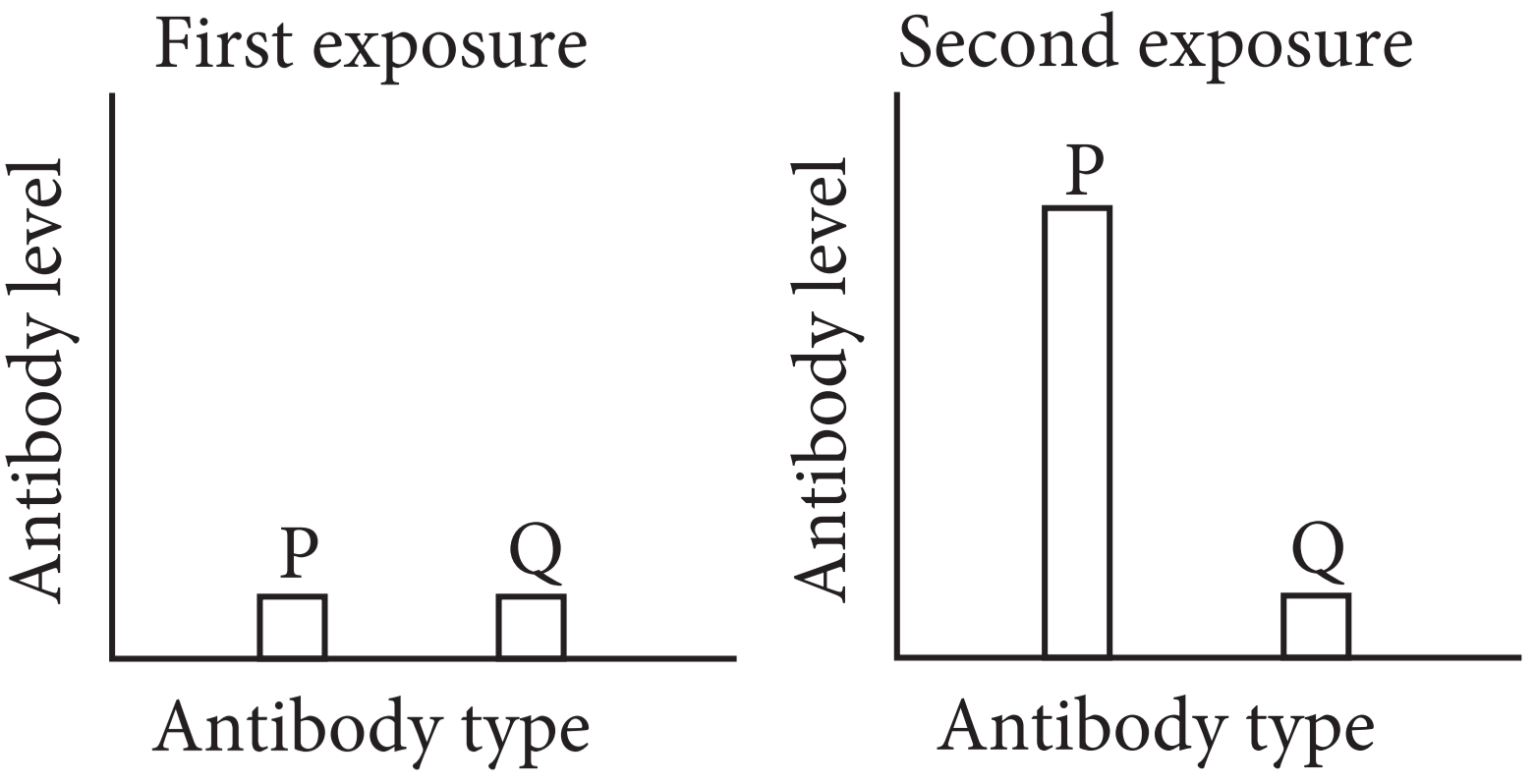
In a study to test a new vaccine against a viral disease, mouse model testing is done. In this process, mice are vaccinated and their blood samples were tested. Mice developed mild disease symptom. After few days those mice were again infected with the virus. This time they do not show any disease symptoms. Their blood samples were tested. Two graphs show antibody concentration for the first and second infection in mice blood.

Based on the above information, answer the following questions.
  1. P and Qin the given graphs indicate.
  1. IgM and IgG respectively.
  2. IgG and IgM respectively
  3. IgG and IgM respectively
  4. IgM and IgA respectively.
  1. Which form of pathogen is used in vaccination?
  1. Activated and strong pathogenic antigen.
  2. Inactivated and weakened pathogenic antigen.
  3. Hyperactive and strong pathogen.
  4. Preformed antibodies.
  1. Which of the following is incorrect for P?
  1. It is the most abundant class of lg.
  2. It is found in blood, lymph, and intestine.
  3. It is unable to cross the placental barrier.
  4. It is a monomer.
  1. How does vaccination work?
  1. The immune system produces antibodies which stay in the blood.
  2. Memory lymphocytes remain in the body to fight off any future infection with the same pathogen.
  3. The dead pathogen stays in the body and constantly stimulates the immune system.
  4. All of these.
  1. Assertion: Mice do not show any disease symptoms during second exposure to the pathogenic virus.
Reason: The antibody production is accelerated and more intense during secondary immune response.
  1. Both assertion and reason are true, and reason is the correct explanation of assertion.
  2. Both assertion and reason are true, but reason is not the correct explanation of assertion.
  3. Assertion is true, but reason is false.
  4. Both assertion and reason are false.
Distinguish between: Spermatogenesis and Oogenesis.
Read the following and answer any four questions from (i) to (v) given below:
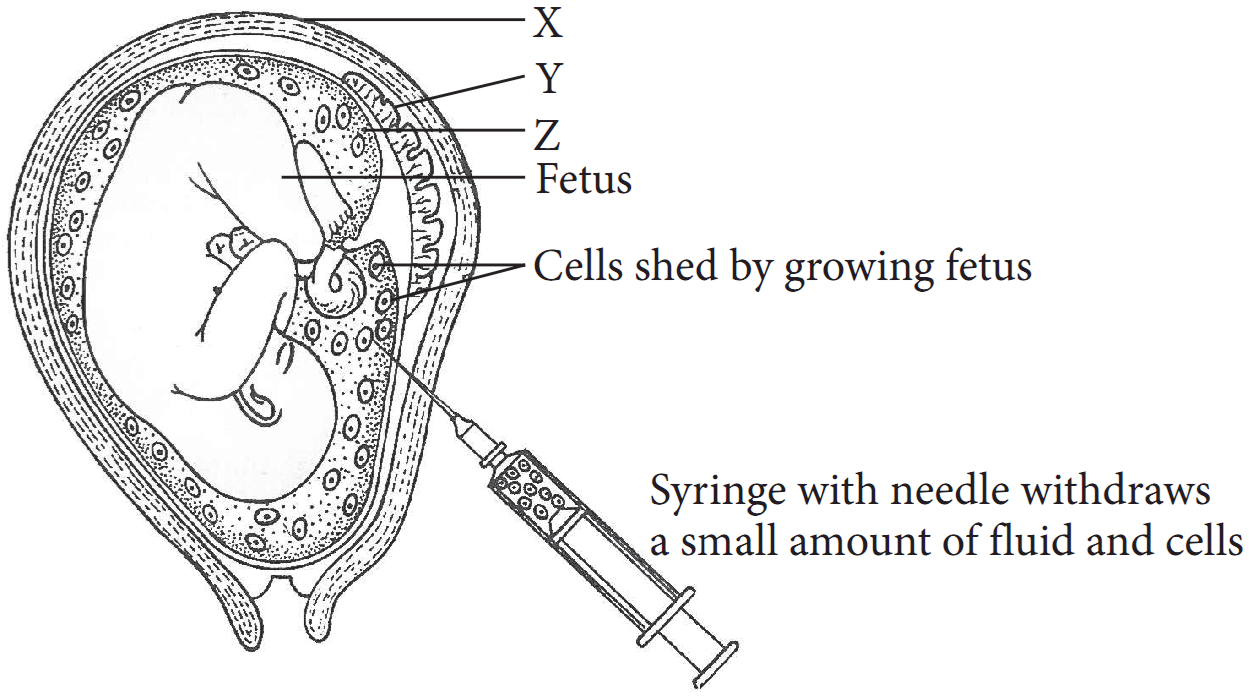
A technique known as amniocentesis is used to determine fetal abnormalities. This test chromosomal pattern in amniotic fluid. However, this technique is legally banned now.
  1. Identify X and Y in the above given figure.
S. No
X
Y
(a)
Amnion
Chorion
(b)
Uterine wall
Placenta
(c)
Placenta
Uterine wall
(d)
Uterine wall
Amnion
  1. What is the function of Z?
  1. Z is an amniotic fluid which prevents dessication of an embryo.
  2. Z is yolk sac which functions as site of early blood cell formation.
  3. Z is amnion, which takes part in placenta formation.
  4. None of these
  1. Which of the following diseases can not be diagnosed by amniocentesis?
  1. Down's syndrome.
  2. Sickle cell disease.
  3. Jaundice.
  4. Cystic fibrosis.
  1. Assertion: Amniocentesis is legally banned for sex determination.
Reason: Amniocentesis was being misused for aborting normal female fetus.
  1. Both assertion and reason are true, and reason is the correct explanation of assertion.
  2. Both assertion and reason are true, but reason is not the correct explanation of assertion.
  3. Assertion is true, but reason is false.
  4. Both assertion and reason are false.
  1. Which of these is a non-invasive technique of detecting fetal disorder?
  1. Fetoscopy.
  2. Chorionic villi sampling.
  3. Amniocentesis.
  4. Ultrasound imaging.
Distinguish between : Extero and entero receptors.
Distinguish between: Hypohydrophily – Epihydrophily
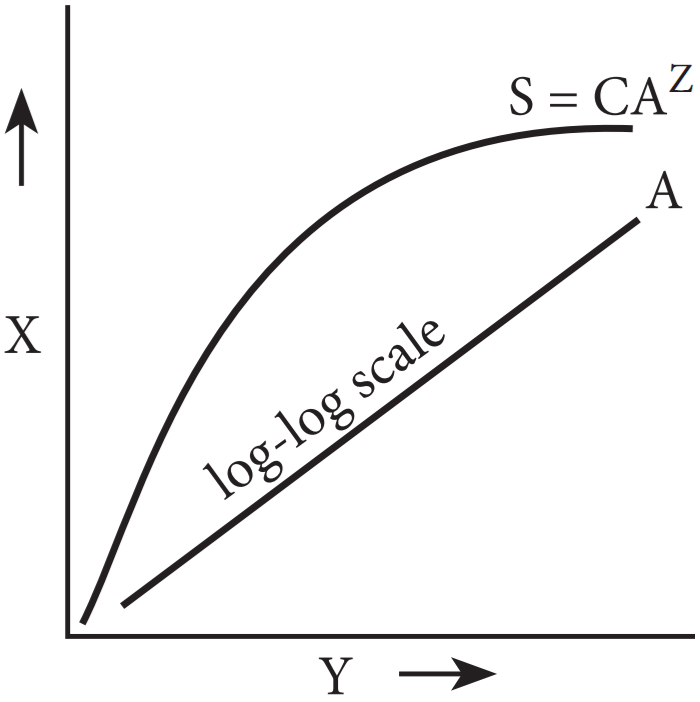
Read the following and answer any four questions from (i) to (v) given below: Within a region, species richness increases with increasing explored area, but only upto a limit. TI1e given graph explains this relationship.
  1. What does the given figure show?
  1. Rivet-popper hypothesis.
  2. Species-area relationship.
  3. Proportionate number of species of major taxa.
  4. $\alpha-\text{ecological diversity }$
  1. Equation for relationship (A) between species richness and area is:
  1. $\log\text{ S}=\log\text{ C}+\text{Z }\log\text{ A}$
  2. $\log\text{ C}=\log\text{ S}+\text{Z }\log\text{ A}$
  3. $\text{Z }\log\text{ A}=\log\text{ S}+\log\text{ C}$
  4. $\log\text{ S}=\log\text{ C}+\log\text{ A}$
  1. What is the value of slope of line or regression coefficient Z for frugivorous birds?
  1. 0.1 - 0.2
  2. 1.15
  3. 0.01 - 0.1
  4. 0.6 - 1.2
  1. The shape of curve for relationship between species richness and areas for wide variety of taxa is:
  1. Straight line.
  2. Parabola.
  3. Rectangular hyperbola.
  4. Bell shaped.
  1. Who gave this concept of increase in species richness with increasing offered area?
  1. Humboldt.
  2. Odum.
  3. Edward Wilson.
  4. Paul Ehrlich.
Image
Explain how does trisomy of 21st chromosome occur in humans. List any four characteristic features in an individual suffering from it.