MCQ
Eels are able to generate current with biological cells called electroplaques. The electroplaques in an eel are arranged in $100$ rows, each row stretching horizontally along the body of the fish containing $5000$ electroplaques. The arrangement is suggestively shown below. Each electroplaques has an emf of $0.15 V$ and internal resistance of $0.25 W$
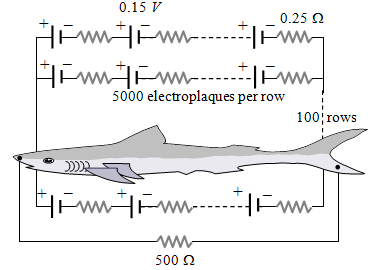
The water surrounding the eel completes a circuit between the head and its tail. If the water surrounding it has a resistance of $500 W,$ the current an eel can produce in water is about
  • $1.5 A$
  • B
    $3.0 A$
  • C
    $15 A$
  • D
    $30 A$

Answer

Correct option: A.
$1.5 A$
$1.5 A$

Need a full question paper?

Generate a complete, print-ready paper with questions like this in minutes — across 16+ boards, with answer keys.

Start Generating Free

Similar questions

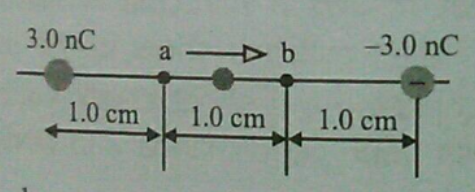
As shown in figure a dust particle with mass $m = 5.0 \times 10^{-9}\  kg$ and charge $q_{0 }= 2.0\ n\ C$ starts from rest at point a and moves in $a$ straight line to point $b.$ What is its speed $v $at point $b$?
Mass number is:
A compass needle which is allowed to move in a horizontal plane is taken to a geomagnetic pole. It:
  1. Will stay in north-south direction only.
  2. Will stay in east-west direction only.
  3. Will become rigid showing no movement.
  4. Will stay in any position.
The refractive index of a piece of transparent quartz is the greatest for(a) Red light(b) Violet light(c) Green light(d) Yellow light
       
In a CRT the acceleration of electrons is controlled by changing ________ between the cathode and anode:
Television signals broadcast from the moon can be received on the earth while the TV broadcast from Delhi cannot be received at places about 100 km distant from Delhi. This is because(a) There is no atmosphere around the moon(b) Of strong gravity effect on TV signals(c) TV signals travel straight and cannot follow the curvature of the earth(d) There is atmosphere around the earth


Identify the quantity which changes when a charged particle moves through a magnetic field?
Two light waves of intensities I and 4I, makes fringes by interference. The phase difference between the waves at point A of the screen is $\pi / 2$ and at point B is $\pi$. Then at point A and B the difference between the resulting intensities is :
At room temperature, a P-type semiconductor has(a) Large number of holes and few electrons(b) Large number of free electrons and few holes(c) Equal number of free electrons and holes(d) No electrons or holes