MCQ
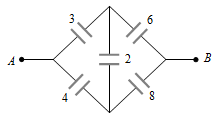
Effective capacitance between A and B in the figure shown is (all capacitance are in mF)
  • A
    21 mF
  • B
    23 mF
  • C
    $\frac{3}{14} \mu_F$
  • $\frac{14}{3} \mu \mathrm{F}$

Answer

Correct option: D.
$\frac{14}{3} \mu \mathrm{F}$
(d) $\frac{14}{3} \mu \mathrm{F}$

Need a full question paper?

Generate a complete, print-ready paper with questions like this in minutes — across 16+ boards, with answer keys.
Start Generating Free

Similar questions

An electric dipole of moment p is placed at the origin along the x-axis. The electric field at a point P, whose position vector makes an angle θ with the x -axis, will make an angle ..... with the x -axis, where tanα = $\frac{1}{2} \tan \theta$ 
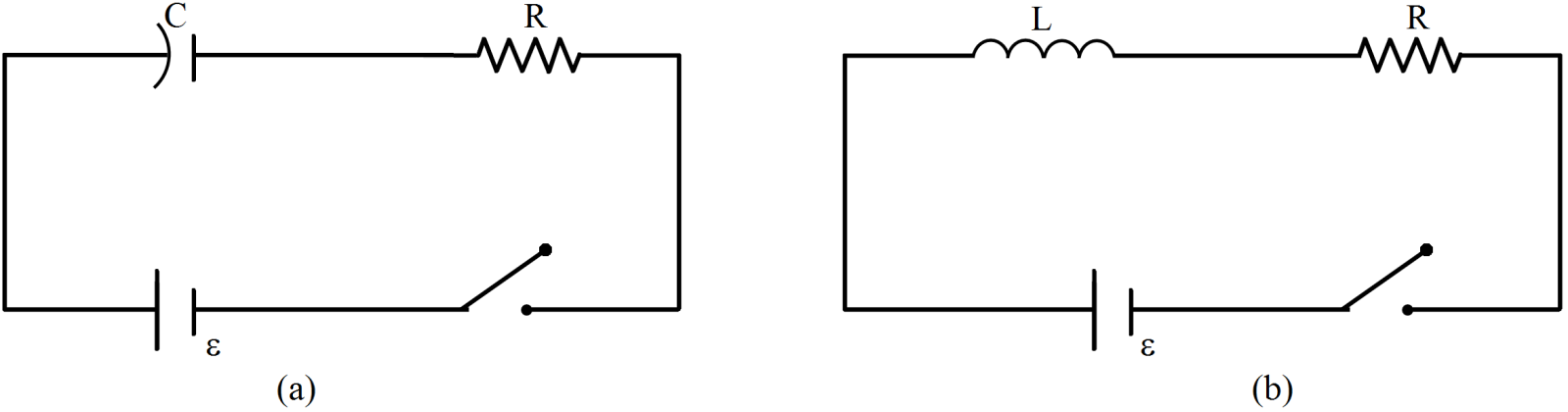
The switches in figure are closed at $t=0$ and reopened after a long time at $t=t_0$ :
Magnetic field in a current carrying solenoid is B. If length of the solenoid and current flowing through the solenoid is doubled, keeping the number of turns same, the magnitude of magnetic field in the solenoid will be:
Image formed by a convex mirror is
When a current passes through a wire whose different parts are maintained at different temperatures, evolution or absorption of heat all along the length of wire is known as
Two lenses of power 6D and – 2D are combined to form a single lens. The focal length of this lens will be
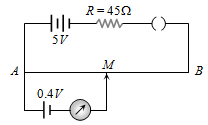
In given figure, the potentiometer wire AB has a resistance of 5 W and length 10 m. The balancing length AM for the emf of 0.4 V is
In a series $LCR$ circuit $R = 200 \Omega$ and the voltage and the frequency of the main supply is $220\ V$ and $50\ Hz$ respectively. On taking out the capacitance from the circuit the current lags behind the voltage by $30^o $. On taking out the inductor from the circuit the current leads the voltage by $30^o $. The power dissipated in the $LCR$ circuit is......$ W$
In a Young's double slit experiment, the central point on the screen is
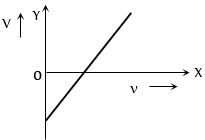
The stopping potential $V$ for photoelectric emission from a metal surface is plotted along $Y-$ axis and frequency $v$ of incident light along $X-$ axis. A straight line is obtained as shown. Planck's constant is given by