MCQ
Einstein was awarded a Noble Prize for:
  • Photo electric effect
  • B
    Compton effect
  • C
    Theory of relativity
  • D
    None of the above

Answer

Correct option: A.
Photo electric effect

The noble prize in Physics $1921$ was awarded to Albert Einstein for his services to theoretical Physics and especially for his discovery of the two of the photoelectric effect

Need a full question paper?

Generate a complete, print-ready paper with questions like this in minutes — across 16+ boards, with answer keys.
Start Generating Free

Similar questions

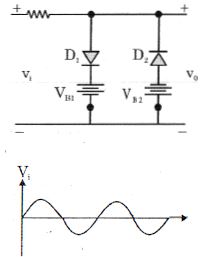
Consider the following circuit the waveform given in input is If ${V_{{B_1}}}$ , and ${V_{{B_2}}}$  , are less than peak value of input than output will look like
When the temperature of silicon sample is increased from 27℃ to 100℃, the conductivity of silicon will be
Pauli suggested the emission of nutrino during $\beta^{+}$decay to explain
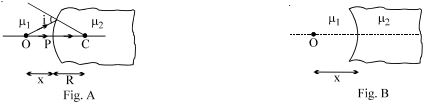
$A$ curved surface of radius $R$ separates two medium of refractive indices $\mu_1$ and $\mu_2$ as shown in figures $A$ and $B$ Choose the correct statement $(s)$ related to the virtual image formed by object $O$ placed at a distance $x$, as shown in figure $A$
Equal mass of three liquids are kept in three identical cylindrical vessels $A, B$ and $C$. The densities are $P_A, P_B, P_C$ with $\mathrm{P}_{\mathrm{A}}<\mathrm{P}_{\mathrm{B}}<\mathrm{P}_{\mathrm{C}}$ The force on the base will be:
A flood light is covered with a filter that transmits red light. The electric field of the emerging beam is represented by a sinusoidal plane wave

$E_x=36\,sin\,(1.20 \times 10^7z -3.6 \times 10^{15}\,t)\,V/m$

The average intensity of the beam will be.....$W/m^2$

Two spheres A and B of radius ‘a’ and ‘b’ respectively are at same electric potential. The ratio of the surface charge densities of A and B is
Which of the following are in the ascending order of wavelength?
A compound microscope is used to enlarge an object kept at a distance $0.03\,m$ from it’s objective which consists of several convex lenses in contact and has focal length $0.02\,m$. If a lens of focal length $0.1\,m$ is removed from the objective, then by what distance the eye-piece of the microscope must be moved to refocus the image......$cm$
A converging beam of rays is incident on a diverging lens. Having passed through the lens the rays intersect at a point $15\,\, cm$ from the lens on the opposite side. If the lens is removed the point where the rays meet will move $5\,\, cm$ closer to the lens. The focal length of the lens is......$cm$