MCQ
Elastic coefficient of material on increasing temperature :
  • A
    increases
  • decreases
  • C
    does not depend
  • D
    increase upto a limit and then starts decreasing

Answer

Correct option: B.
decreases
B

Need a full question paper?

Generate a complete, print-ready paper with questions like this in minutes — across 16+ boards, with answer keys.
Start Generating Free

Similar questions

When $n$ vectors of different magnitudes are added, we get a null vector. Then the value of $n$ cannot be
Areversible adiabatic path on a $P-V$ diagram for an ideal gas passes through stateAwhere $P=0$.$7\times 10^5 \,\,N/ m^{-2}$ and $v = 0.0049 \,\,m^3$. The ratio of specific heat of the gas is $1.4$. The slope of path at $A$ is :
A vessel is filled with an ideal gas at a pressure of $10$ atmospheres and temperature ${27}^\circ C$. Half of the mass of the gas is removed from the vessel and temperature of the remaining gas is increased to ${87}^\circ C$. Then the pressure of the gas in the vessel will be ...... $atm$
Newton's law of cooling is used in laboratory for the determination of the
Which is the quantity which remains conserved in both elastic and inelastic collisions?
A $210$ meter long train is moving due North at a of $25\,m/s$. A small bird is flying due South a little above the train with speed $5\,m/s$. The time taken by the bird to cross the train is........$s$
Main scale division of vernier calliper is $1\ mm$ and vernier scale division are in $A.P. ; 1^{st}$ division is $0.95\ mm$ ; $2^{nd}$ division is $0.9\ mm$ and so on. When an object is placed between jaws of vernier calliper, zero of vernier lies between $3.1\ cm$ and $3.2\ cm$ and $4^{th}$ division of vernier coincide with main scale division. Reading of vernier is  .......... $cm$
A particle executing $S.H.M.$ of amplitude 4 cm and $T = 4 \,sec.$ The time taken by it to move from positive extreme position to half the amplitude is ..... $\sec$
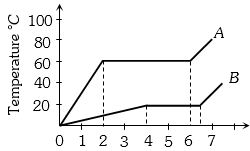
Two substances $A$ and $B$ of equal mass m are heated at uniform rate of $6\, cal s^{-1}$ under similar conditions. $A$ graph between temperature and time is shown in figure. Ratio of heat absorbed ${H_A}/{H_B}$ by them for complete fusion is
In the equation, $\text{PV = RT,}$ the $V$ refers to the volume of: