Question
Electric conduction in a semiconductor takes place due to:
  1. Electrons only.
  2. Holes only.
  3. Both electrons and holes.
  4. Neither electrons nor holes.

Answer

  1. Both electrons and holes.
Explanation:
A hole is created in a semiconductor when a valence electron moves to the conduction band. When potential difference is applied across the semiconductor, the electron drifts opposite to the electric field applied, while the hole moves along the electric field. Therefore, electric conduction takes place in a semiconductor because of both electrons and holes.

Need a full question paper?

Generate a complete, print-ready paper with questions like this in minutes — across 16+ boards, with answer keys.
Start Generating Free

Similar questions

The magnetic flux through a circuit of resistance $R$ changes by an amount $\triangle \varnothing$  in time $\triangle t, $ Then the total quantity of electric charge $Q,$ which passing during this time through any point of the circuit is given by
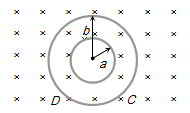
Plane figures made of thin wires of resistance $R = 50$ milli ohm/metre are located in a uniform magnetic field perpendicular into the plane of the figures and which decrease at the rate $dB/dt = 0.1\ m T/s$. Then currents in the inner and outer boundary are. $($The inner radius $a = 10 \ cm$ and outer radius $b = 20 \ cm)$
$86^{\mathrm{A}^{222}} \rightarrow 84^{\mathrm{B}^{210}}$ In this reaction how many $\alpha$ and $\beta$  particles are emitted
$ 1 \text { Tesla = } $ $\qquad$ Gauss
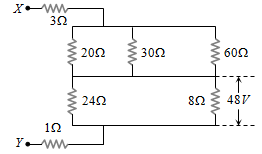
The potential difference across $8$ ohm resistance is $48$ volt as shown in the figure. The value of potential difference across $X$ and $Y$ points will be
If the shift of wavelength of light emitted by a star is towards violet, then this shows that star is(a) Stationary(b) Moving towards earth(c) Moving away from earth(d) Information is incomplete
   
   
When a hole is produced in P-type semiconductor, there is:
If the temperature of cold junction of a thermocouple is lowered, then the neutral temperature:
The electric potential decreases uniformly from $120V$ to $80V$ as one moves on the $x-$axis from $x = -1\ cm$ to $x = + 1\ cm$. The electric field at the origin.
  1. Must be equal to $20Vcm^{-1}$
  2. May be equal to $20Vcm^{-1}$
  3. May be greater than $20Vcm^{-1}$
  4. May be lees than $20Vcm^{-1}$
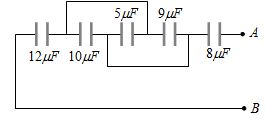
The capacities and connection of five capacitors are shown in the adjoining figure. The potential difference between the points $A$ and $4$ is $60$ volts . Then the equivalent capacity between $A$ and $B$ and the charge on $5\ \mu F$ capacitance will be respectively