MCQ
Electric conduction in a semiconductor takes place due to:
  • A
    Electrons only.
  • B
    Holes only.
  • Both electrons and holes.
  • D
    Neither electrons nor holes.

Answer

Correct option: C.
Both electrons and holes.
A hole is created in a semiconductor when a valence electron moves to the conduction band. When potential difference is applied across the semiconductor, the electron drifts opposite to the electric field applied, while the hole moves along the electric field. Therefore, electric conduction takes place in a semiconductor because of both electrons and holes.

Need a full question paper?

Generate a complete, print-ready paper with questions like this in minutes — across 16+ boards, with answer keys.

Start Generating Free

Similar questions

On increasing the reverse bias to a large value in a $PN-$junction diode, current
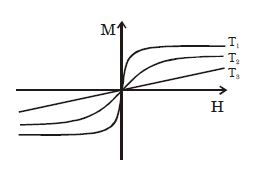
The following graph shows the response of magnetization $M$ of paramagnetic material  to the applied magnetic field strength $H$ for three different temperatures $T_1$ , $T_2$ , $T_3$ 

Which of the following is correct?

In hydrogen atom which quantity is integral multiple of $\frac{h}{{2\pi }}$
A potentiometer wire is $100\ cm$ long and a constant potential difference is maintained across it. Two cells are connected in series first to support one another and then in opposite direction. The balance points are obtained at $50\ cm$ and $10\ cm$ from the positive end of the wire in the two cases. The ratio of emf's is:
The direction of electric field is from:
Diffraction and interference of light suggest
The internal resistance of dry cell is $...A...,$ than the internal resistance of common electrolytic cell. Here, $A$ refers to:
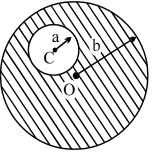
A long straight metal rod has a very long hole of radius $‘a’$ drilled parallel to the rod axis as shown in the figure. If the rod carries a current $‘i’$ find the value of magnetic induction on the axis of the hole, where $OC = c$
The speed of light depends:
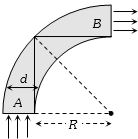
A rod of glass ($/mu = 1.5$) and of square cross section is bent into the shape shown in the figure. A parallel beam of light falls on the plane flat surface $A$ as shown in the figure. If $d$ is the width of a side and $R$ is the radius of circular arc then for what maximum value of $\frac{d}{R}$ light entering the glass slab through surface $A$ emerges from the glass through $B$