MCQ
Electric field of plane electromagnetic wave propagating through a non-magnetic medium is given by ${E}=20 \cos \left(2 \times 10^{10} {t}-200 {x}\right) \,{V} / {m} .$ The dielectric constant of the medium is equal to :

(Take $\mu_{{r}}=1$ )

  • $9$
  • B
    $2$
  • C
    $\frac{1}{3}$
  • D
    $3$

Answer

Correct option: A.
$9$
a
Speed of wave $=\frac{2 \times 10^{10}}{200}=10^{8}\, {m} / {s}$

Refractive index $=\frac{3 \times 10^{8}}{10^{8}}=3$

Now refractive index $=\sqrt{\varepsilon_{{r}} \mu_{{r}}}$

$3=\sqrt{\varepsilon_{{r}}(1)}$

$\Rightarrow \varepsilon_{{r}}=9$

Need a full question paper?

Generate a complete, print-ready paper with questions like this in minutes — across 16+ boards, with answer keys.

Start Generating Free

Similar questions

A magnetic needle free to rotate in a vertical plane parallel to the magnetic meridian has its north tip pointing down at $22^o$ with the horizontal. The horizontal component of the earth’s magnetic field at the place is known to be $0.35\; G$. Determine the magnitude of the earth’s magnetic field (in $G$) at the place
If a heavy nucleus has $N / Z$ ratio higher than that required for stability, then
A parallel plate capacitor has plates with area $A$ and separation $d$ . A battery charges the plates to a potential difference $V_0$ . The battery is then disconnected and a dielectric slab of thickness $d$ is introduced. The ratio of energy stored in the capacitor before and after the slab is introduced, is
A wire has a resistance of $6  \,\Omega$. It is cut into two parts and both half values are connected in parallel. The new resistance is ................ $\Omega$
The far point of a myopic person is $80\, cm$ in front of the eye. What is the eye power of the lens required to enable him to see very distant objects clearly? 
Two metallic spheres of radii 1 cm and 2 cm are given charges $10^{-2} \mathrm{C}$ and 5 × $10^{-2} \mathrm{C}$ respectively. If they are connected by a conducting wire, the final charge on the smaller sphere is
In Young's double slit experiment, the wavelength of red light is $7800\, Å$ and that of blue light is $5200\, Å$. The value of $n$ for which nth bright band due to red light coincides with $(n + 1)^{th}$ bright band due to blue light, is :
When light of a given wavelength is incident on a metallic surface, the minimum potential needed to stop the emitted photoelectrons is $6.0 V$. This potential drops to $0.6 V$ if another source with wavelength four times that of the first one and intensity half of the first one is used. What are the wavelength of the first source and the work function of the metal, respectively? $\left[\right.$ Take $\left.=\frac{h c}{c}=1.24 \times 10^{-6} Jm ^{-1}.\right]$
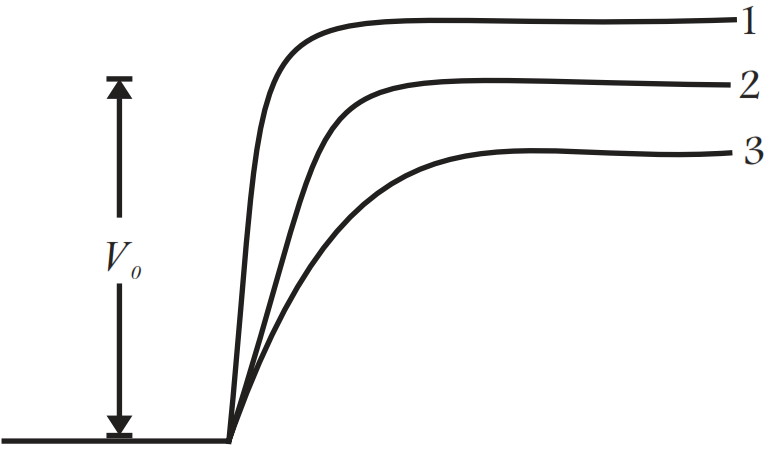
In Fig, Vo is the potential barrier across a $p-n$ junction, when no battery is connected across the junction:
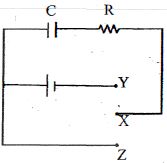
The capacitor $C$ is initially without charge.$X$ is now j oined to $Y$ for a long time, during which $H_1$ heat is produced in the resistance $R$. $X-Y$ connection is removed and $X$ is now joined to $Z$ for a long time, during which heat $H_2$ is produced in $R$.